
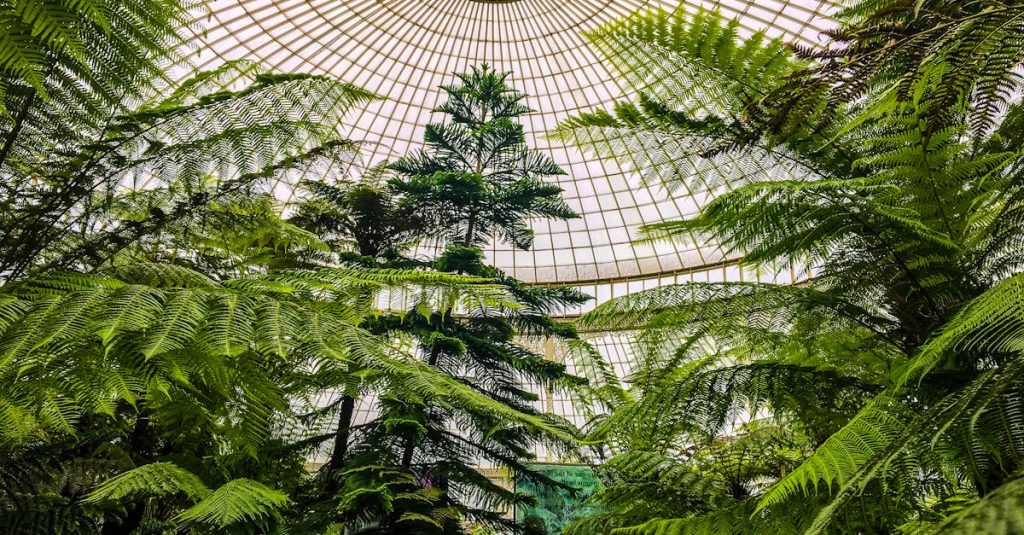
There is an often underrated side of Scotland that deserves all our attention: the incredible variety of its flora and fauna. Scotland’s botanic gardens offer a unique chance to come into direct contact with this wealth. Visiting one means immersing yourself in unique ecosystems where Atlantic vegetation, majestic conifers and alpine plants live in perfect harmony with the local wildlife. These true paradises are an outstanding natural heritage, combining history, scientific research and breathtaking scenery thanks to the particular influence of the Gulf Stream and the variety of local microclimates.
What you will find in this article is not a list. It is an invitation to walk slowly, from one garden to the next, listening to the stories of those who created them and watching those who still live there today: birds, squirrels, otters, eagles.
The secret of a land that shouldn’t bloom like this
You can’t help wondering how palms, giant ferns and magnolias survive so far north. The answer comes from the sea. The Gulf Stream slides along the western coasts, bringing unexpected warmth: winters stay mild, frost is rare and the air is always moist. Acid soils and generous rain do the rest, reminding many Asian mountain plants of home.
And then there are the people. For two centuries Scotland produced some of the greatest ‘plant hunters’: botanists who set off for Yunnan, Tibet and the Himalayas and came back with crates full of seeds, bulbs and cuttings. George Forrest, Robert Fortune, David Douglas are names we now read on the labels at the foot of the trees. So walking through the gardens of Scotland really means retracing their expeditions, one step at a time.
Edinburgh: the garden that breathes beside the city
Our journey begins in the capital, at the Royal Botanic Garden Edinburgh. Founded in 1670 near Holyrood by two doctors as a simple physic garden of medicinal herbs, it now covers some 70 acres at Inverleith and is one of the most important centres of botanical research in the world. Yet when you walk in, you don’t feel you are entering a laboratory, but rather a park where time slows down and the rest of the world disappears: the Rock Garden with its tiny alpine plants, the Chinese Hillside where the rhododendrons look like a piece of Asian mountain transplanted to Scotland, the immaculate lawns where Edinburgh people come to read or stroll even when the sky threatens rain… every corner is pure joy for the heart and senses!
Since 2 October 2026 the garden has one more reason to visit: after five years of work, the historic Victorian Palm Houses have reopened to the public. Stepping inside is like passing in an instant from the Scottish climate to that of a tropical forest, under a dome of glass and iron that seems to come straight out of a nineteenth-century novel.
At the Royal Botanic Garden Edinburgh it is not unusual to see grey herons, mallards and moorhens by the ponds, to cross paths with red squirrels along the avenues and, as evening falls, in the quieter corners, to be lucky enough to come across a fox wandering unhurriedly.
Benmore: walking among the giants of Argyll
Leaving Edinburgh, the road west leads to the Cowal peninsula, among long narrow lochs and forested hills. Here, near Dunoon, is Benmore Botanic Garden. Its welcome is unforgettable: an avenue of giant redwoods planted in 1863, so tall they seem to brush the sky. Walking among them in the silence of early morning or at dusk, savouring the scents and rustles of nature, has something mystical about it. You feel you are entering a sacred place you will hardly forget.
The garden then climbs the mountainside among brightly coloured rhododendrons. All of a sudden you come across a Bhutanese pavilion that seems to have materialised from another continent, and finally you reach a viewpoint from which your gaze slides over Loch Eck and the hills of Loch Lomond and The Trossachs National Park.
The real star of Benmore Botanic Garden is small, red and very fast: the red squirrel, the only squirrel native to the British Isles, which has almost disappeared from much of the UK, replaced by the grey squirrel from America. In the forests of Argyll, however, it seems to have found the perfect habitat. At Benmore it finds plenty of cones, seeds and fungi. In the thickest woods moves the pine marten, elegant and almost invisible. Higher up, on the mountain slopes, the roaring of red deer announces the rut in October.
Remember that Benmore is a seasonal garden and closes with the arrival of winter. Autumn, with its extraordinary copper and gold colours, is the perfect time to visit it and treasure the memory.
Logan: the south that dreams of the tropics
Heading south to the very tip of Scotland, you reach the Rhins of Galloway, a tongue of land surrounded by the sea. Here the Gulf Stream works its greatest magic. Logan Botanic Garden looks like a trick of nature: huge tree ferns from Australia, gunneras with leaves as wide as umbrellas, eucalyptus, palms and flowers of the southern hemisphere grow outdoors as if they were at home. You walk in feeling you’ve got the wrong continent!
If you want to combine your visit to the garden with an excursion in the area, a few kilometres away the Mull of Galloway marks Scotland’s southernmost point. In spring and summer its cliffs become a noisy gathering place for seabirds: guillemots, razorbills, fulmars gliding on the wind, and offshore gannets diving like white arrows.
Dawyck: the wood that speaks softly
In the Scottish Borders, among hills and rivers, Dawyck Botanic Garden is the garden of trees. For more than three hundred years trees from all over the world have been planted in this corner of Scotland, and it was here that the Dawyck beech was born, a slender, columnar variety now found in many European parks. But the most surprising thing is under your feet: Dawyck has the world’s first ‘sanctuary’ for cryptogams, that is mosses, lichens, ferns and fungi. They are the plants nobody notices, yet without them the woodland would not exist.
A burn, the Scrape Burn, flows through this ancient garden; along its banks live the dipper, a small bird with a white breast, and the great spotted woodpecker. At the edge of the wood, at dawn, roe deer appear. And of course, here too, the red squirrel is at home.
Inverewe: the garden born against the wind
The journey through Scotland’s botanic gardens ends in the north-west, where the Highlands meet the Atlantic. At Poolewe, on the shores of Loch Ewe, is Inverewe Garden; its story is like a fairy tale. In 1862 a young man, Osgood Mackenzie, and his mother bought a vast, desolate headland, battered by the wind, treeless and at the same latitude as Labrador; and he, ignoring the critics, decided to turn it into a garden. Everyone thought it impossible. Except Osgood! He worked out a strategy to make his idea work: first he planted a barrier of pines and windbreak trees, waited for them to grow, and only then, in their shelter, began planting species from New Zealand, Chile and Tasmania. And it is thanks to this achievement that subtropical plants, ferns and exotic Himalayan blue poppies now grow here.
Today Inverewe is cared for by the National Trust for Scotland and is a weave of paths, flowers and sea views. Looking up above the treetops, you may often see a huge shadow, broad wings and a short white tail. It is the white-tailed sea eagle, the largest bird of prey in the British Isles. It had vanished from Scotland in the early twentieth century, hunted to the last bird; then, from the 1970s, it was reintroduced and today it reigns again over the west coast and the islands.
At low tide, on the shores of the loch, it is also worth looking for otters, and on the furthest rocks for common seals, lazy and curious. If you want to know more about these coastal residents, continue the journey in our Wild-Alba section.
Glasgow and the glass palace by the river
There is one last garden worth a stop, even though it is right in the city. In Glasgow’s West End, the Glasgow Botanic Gardens are the Sunday refuge of students, families and older people. Its heart is the Kibble Palace, a monumental Victorian glasshouse of iron and glass, full of tree ferns and white marble statues that seem to sleep among the leaves. Behind the garden the path goes down to the River Kelvin, among stone bridges and trees reflected in the water.
And it is along the river that the loveliest surprise may come: a flash of blue and orange just above the water, too fast to photograph. It is the kingfisher. In recent years otters have also returned to the Kelvin, a sign that the river is in good health. For little ones, looking for footprints in the mud of the banks becomes a small treasure hunt: if you are looking for ideas for exploring with children, our Kids Corner may be just what you need.
When to go and how to enjoy Scotland’s botanic gardens
Every season has its garden. In spring, in April and May, rhododendrons and azaleas burst into colour at Benmore, Inverewe and in Argyll gardens such as Crarae and Arduaine. Summer brings very long days and cliffs full of seabirds. Autumn, perhaps the most poetic season, sets Dawyck and Benmore ablaze in copper and gold, but it is also when the seasonal gardens get ready to close: always check the dates before you go.
Edinburgh and Glasgow are easy to reach on foot or by public transport, and their outdoor gardens are free. For all the others you need a car and a little patience on the single-track roads of the Highlands, plus an admission ticket. Don’t forget a waterproof jacket, comfortable shoes and binoculars.
If you want to keep exploring Scotland, the AlbaUnicorn blog is waiting for you!
Silvia Miraglia