
“Here I am again, as promised, to share a secret with you. I told you about the amazing tree trunks carefully preserved at Fossil Grove, in Victoria Park in Glasgow, and now, feeling the same thrill as when I first saw them, I’ll reveal how these trees became such beautiful fossils.
First, though, close your eyes and try to imagine walking into a kind of big glasshouse with a glass roof and standing in the middle. All around you are stumps about 60 centimetres high… they are what’s left of a special kind of tree that geologists call Lepidodendron. They are so well preserved that scientists have worked out lots of things about them. For example, that they were “vascular” plants, with tiny channels that carried nutrients from the roots to the leaves, and that they had very tough bark that let them grow as tall as 45 metres! Lepidodendron are extinct plants that belonged to an ancient group related to today’s clubmosses. Their trunk, which could be up to 2 metres across at the base, was covered in little diamond-shaped scars (very like scales!) arranged in a spiral, left by fallen leaves, which were long and thin like blades of grass. They might have looked a bit like giant succulents, with leaves only at the very top.
When Scotland was a tropical forest
You should know that Scotland, 325 million years ago, was a very different place, much closer to the Equator, and looked like a hot, steamy tropical rainforest full of giant plants and strange animals: huge dragonflies with wings up to 70 centimetres across, millipedes 2 metres long… Use your imagination again and picture this ancient forest, full of trees almost as tall as a ten-storey building, where at one point something incredible happened: a river burst its banks, causing a huge flood that carried masses of mud, sand and debris and covered everything. This disaster knocked down the trees, leaving only the stumps. Then the inside of the trunks rotted away and the hollow trunks filled with sand which, over millions and millions of years, hardened into rock.
The outer bark, on the other hand, turned into a thin layer of coal – the same coal that was later used for a long time in Glasgow’s industries!
So that’s how the trunks turned into the sandstone casts we can still see today! The ground the trees grew in, made of mud and silt, also became a layer of rock with bits of fossilised plants inside. It’s as if nature decided to take a perfect photo of those trees, using stone instead of paper!
What you’ll see in the museum
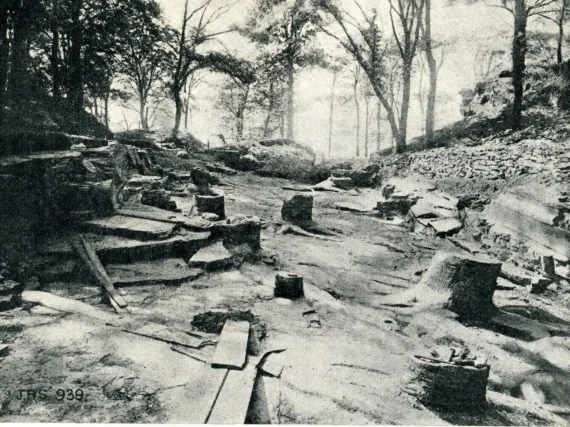
When you go into the museum, you’ll find 11 stumps, a big trunk lying on its side just as it fell during the flood, and several smaller pieces of branches and roots. If you look closely at the ground around them, you’ll notice little ripples that show how the river current flowed between the trunks. Isn’t that amazing?!
Another hidden treasure: dolerite
In this lovely park in the middle of Glasgow, just a few steps from the ancient trunks, there is another piece of Earth’s history! Above the layer of rock containing the fossil trees there’s another special rock called dolerite. Dolerite is an igneous rock, which means it was once molten magma, like the lava that comes out of volcanoes! In a later period, after the Carboniferous, called the Permian, this magma squeezed into the existing rocks, forming a kind of glue.
And do you know something incredible? The place where the fossils were found in 1887 was actually a quarry where, until a little earlier, people dug out this dolerite. Near the building put up to protect the fossils you can see up to eight metres of this rock layer! It’s a bit like a giant Earth sandwich, with different layers of rock one on top of the other.
A place protected by law
The Fossil Grove is a really special place, so special that it is protected by law as a “Site of Special Scientific Interest” and looked after by an organisation called Scottish Natural Heritage (now NatureScot), just as if it were a national park… but for fossil plants! The building that houses it is sometimes closed for important work, like a big restoration that began in May 2025, to make it even nicer and more welcoming for all visitors.
It’s truly incredible to think that we can still see these trees after so much time! Scotland is full of magical places and the Fossil Grove is one of the most fascinating! I hope you enjoyed my story! Let me know what you think! Bye everyone!”
Silvia Miraglia