
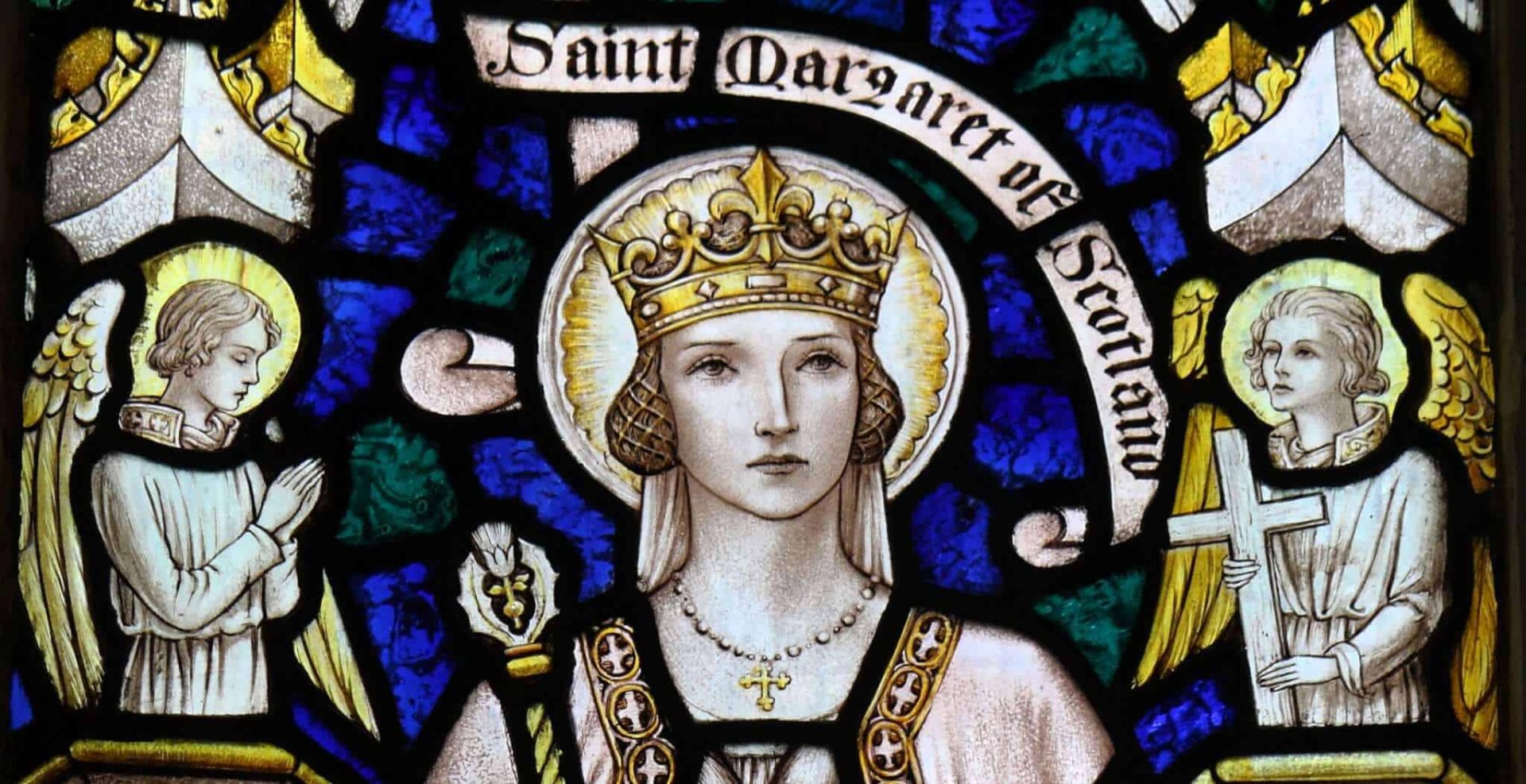
“The silence of my mother’s chapel, scented with fresh flowers, always gives me a feeling of peace and serenity. St Margaret’s Chapel is one of the few places that move me deeply; whenever I feel the need to gather myself in prayer, or simply for a little calm, I come here and allow myself a moment of my own. It is as if my mother’s gentle embrace held me tight, reassuring and comforting me.
Mons Meg, the giant cannon
Forgive me for letting myself get carried away… Let us not digress and move on. Leaving the chapel, we find ourselves on the terrace that is home to the gigantic Mons Meg, one of the largest medieval cannons in the world. Built in 1449 in Mons, in Belgium, it was given by the Duke of Burgundy to King James II in 1457. It was a truly cutting-edge piece of artillery: it had a calibre of 48 cm and could fire stone balls about 3.2 km, an impressive firepower! Unfortunately, though, its weight – over 6 tonnes – made it too cumbersome to move: it could travel only 5 km a day and needed no fewer than 100 men to shift it. What’s more, in battle it could fire only one cannonball every half hour, making it useless for prolonged use! As you can imagine, it soon became obsolete and was replaced by much more powerful and lighter bronze guns. Mons Meg, however, went on firing to mark important occasions such as the wedding of Mary Stuart in 1558. The last time it was used was in 1681, to celebrate the birthday of the Duke of Albany, the future King James VII. But the shot was so powerful that it burst the barrel, ending its career!
It was taken to the Tower of London in 1754 to be melted down, but as fate would have it, it was too big to fit into the furnace, and so it was saved! It returned to Edinburgh Castle in 1829 amid great celebrations, like a true hero coming home!
The mystery of the Half Moon Battery
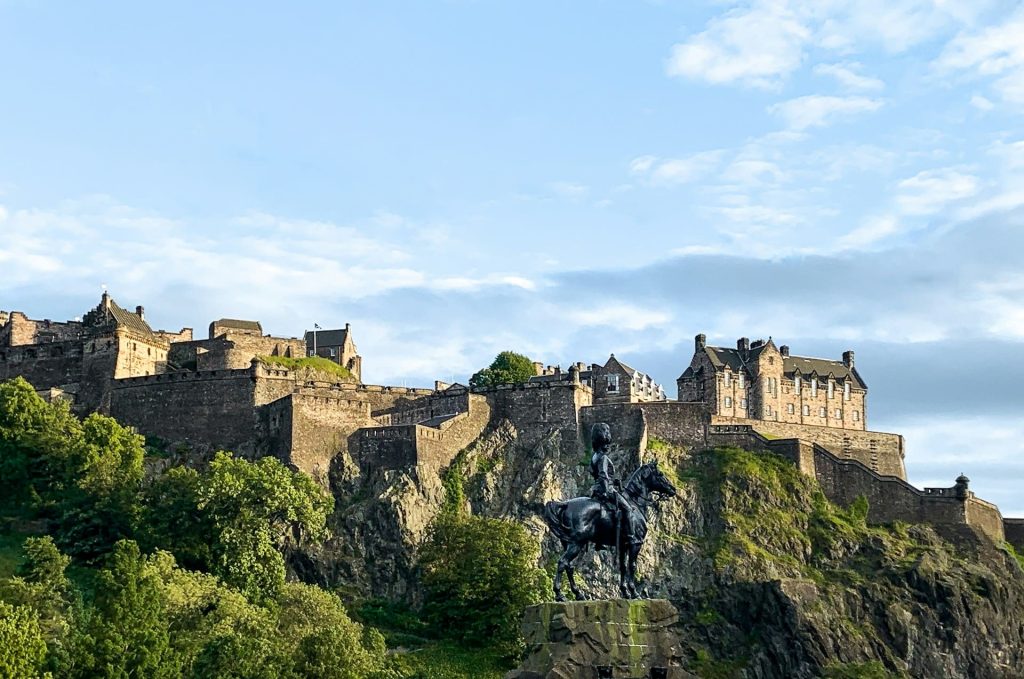
Now, ladies and gentlemen, let us head for the Half Moon Battery, at the other end of the rampart. You should know that a mystery lay hidden beneath it for centuries, revealed only at the end of the 1800s. This imposing half-moon battery was built after the Lang Siege, on the very spot where the legendary David’s Tower once stood, built by King David II, son of Robert the Bruce, as a symbol of power. Imagine a mighty keep about 30 metres high, with three floors of royal apartments. Anyone approaching the castle was greeted by this majestic structure rising out of the walls and towering over the whole fortress: a visual reminder of Scottish sovereignty. The tower had incredibly thick walls that narrowed as they rose, and a whole series of cleverly placed arrow slits that let archers defend the king’s residence from every side, making it almost unassailable.
King David’s tower
On the ground floor, protected by a barbican, was one of the main entrances to the castle, leading into a hall; above it was the king’s chamber and, higher still, the queen’s, reflecting the hierarchy of the royal spaces.
In 1433 James I added another tower behind the first, using it as a banqueting hall and so expanding the royal residence’s capacity for hospitality and ceremony. It was from this tower that the new royal palace was built, although David II’s keep remained vital for defence, so much so that the walls facing Edinburgh were thickened by no less than 2.5 metres, further strengthening its resistance.
22 May 1573 is the fateful date on which King David’s majestic tower almost entirely collapsed during the Lang Siege, blocking the Fore Well, the castle’s main well, and so forcing the defenders to surrender.
The Fore Well
Carrying on in this direction, we can see up close what we have been talking about – what for centuries was considered a fortress’s most precious asset: its inhabitants’ water supply! I assure you that, especially during a siege, having supplies of drinking water can change the fate of both armies. Having one or more wells is vital! The Fore Well was the main source of water for Edinburgh Castle from the 14th century. It was 34 metres deep and could hold up to around 130,000 litres; apparently a large amount, but in fact not enough to withstand long sieges. After the tower collapsed, the well was cleared, enlarged and brought back into use. Just imagine how many people, famous or not, have drunk water from the Fore Well over the centuries!
The rediscovery of the lost tower
But now let us turn back to the Half Moon Battery. It was built right after the 1573 siege around the ruins of the tower, hiding them until 1891, when the architect Blanc, who was in charge of some of the castle’s restoration work, made an incredible discovery: he spotted an arrow slit inside a cellar right beneath the battery. The architect argued that the cellar itself might be the surviving part of David’s Tower, since it was clearly built of older stones.
Blanc was right! In 1912 excavations were commissioned that proved his theory: David’s Tower had lain buried and forgotten for about 400 years!
They started by digging 1.5 metres beneath the Half Moon Battery and found an arrow slit, then went another 4.5 metres down and found the top of a stone vault. Next they broke through the vault and kept going down another 9 metres until they reached a door and a flight of worn steps. Imagine their excitement when they realised they had found the entrance to King David II’s Tower! The digging went on, revealing more vaults and passages, cannonballs and shell fragments.
It is truly fascinating how the careful work of scholars and archaeologists can uncover buildings forgotten for centuries and bring them back to light and back to life! Every time, I am moved to think how centuries of oblivion can be undone thanks to the dedication and passion of people who believe in the richness of the past as a source of knowledge for the present and the future.”
Silvia Miraglia