
“Let us take a short break to catch our breath and meanwhile look closely at the Argyle Tower, which forms the upper part of the portcullis gate through which we entered the castle. It was in fact added in 1887 by the architect Blanc and paid for by one William Nelson, an Edinburgh publisher, in the hope that it might house the precious Scottish Crown Jewels. This work was part of a series of restorations carried out during the reign of Queen Victoria, who showed great interest in promoting Scotland’s heritage. The tower’s name comes from an event involving the ninth Earl of Argyll in 1685: accused of plotting against James VII, he was sentenced to death and imprisoned right above the Portcullis Gate the night before his execution.
Edinburgh at your feet
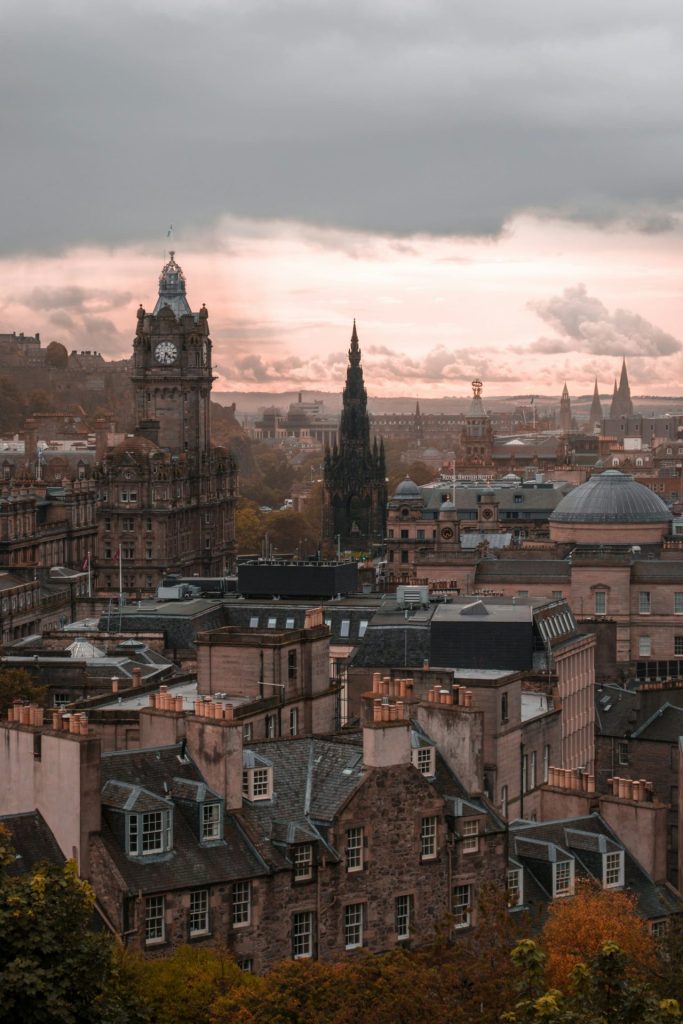
Having climbed all the way up here, we are rewarded with an exceptional view: look straight ahead. Don’t you feel as if the whole of Edinburgh lies at your feet?! From this vantage point we can admire the New Town with the gardens of Princes Street, where the Nor’ Loch, a loch long since drained, used to be. In the distance you can make out the Royal Botanic Garden and, on the horizon, the Firth of Forth with its spectacular bridge across the estuary. The building with the tall spire is the monument to Sir Walter Scott, the great Scottish writer whose works shaped the romantic image of Scotland. Beyond the Argyle Tower, to our right, you can see Calton Hill and Arthur’s Seat, two more hills that help shape Edinburgh’s unmistakable skyline.
The oldest building in Scotland
Let us continue exploring the fortress by approaching the oldest building not only in the castle but in Edinburgh and the whole of Scotland… a building dear to my heart, which I myself wished for and commissioned in 1130 in honour of my mother, Queen Margaret of Scotland. It was part of the castle’s first stone buildings, built in stone precisely to avoid the fires that were quite common at the time. It was originally a private chapel for the exclusive use of the royal family, able to hold at most 20 people; the building also housed a hall and private rooms. As several scholars have suggested, the little chapel was enclosed within a great tower. If you look carefully, you will notice that the original masonry is missing along the whole north wall and, even more tellingly, the voussoirs – the stones around the door – are laid differently from the squarer ones around the windows on the other sides. Moreover, the absence of a window on the north side alone shows that the chapel was originally inside an adjoining building.
Saint Margaret, queen and saint
Let us stop beside the low wall at the foot of the church to spend a few minutes on Saint Margaret, a figure still much loved in Scotland. Her story is intense and moving, and I say this not only because she was my mother; if you wish, another time, I would like to tell you about this extraordinary woman whose actions left an indelible mark on Scotland. For now, I will limit myself to the events linked to the castle we are visiting. Forgive my emotion, but it is not easy to recall what happened!
My mother fell gravely ill when she learned that my father, King Malcolm, and my elder brother Edward had been ambushed and treacherously killed by the Normans at the Battle of Alnwick, in Northumbria. She let herself die right here, in Edinburgh Castle. Almost two centuries later, in 1250, Pope Innocent IV declared her a saint for her conduct in life and the miracles attributed to her; and that is why the building is known as St Margaret’s Chapel. In my view it is no coincidence that this little chapel has survived to this day… especially when you consider that the castle has been one of the most besieged places in all of Great Britain, having suffered no fewer than 26 attacks! There was one moment in particular when the little church really risked being destroyed: in 1314, during the Wars of Independence, the castle, which was in English hands, was recaptured by the Earl of Moray, Thomas Randolph, on behalf of the Scots. King Robert the Bruce, who usually razed fortresses to the ground rather than leave them to the English invader, ordered the castle to be demolished but the chapel to be spared, as a sign of devotion to Queen Margaret. A few years later, in 1329, on his deathbed, the Bruce left 40 pounds Scots for the restoration of the church, a testament to his deep respect.
The chapel through the centuries
The centuries passed, and many events involved Scotland and Edinburgh Castle. Around 1530, the palace of Holyrood became the royal residence, and from then on St Margaret’s Chapel was no longer used for religious purposes; sadly, for almost 300 years it was even turned into a gunpowder store, a use that completely betrayed its purpose. It regained its original function only in 1845, thanks to the antiquarian Sir Daniel Wilson, who championed its restoration, funded by Queen Victoria. The windows were decorated with stained glass depicting Saint Margaret, Malcolm III, yours truly and a cross. These windows were replaced in 1922 by the present ones, made by Douglas Strachan and dedicated to Saint Andrew, Saint Ninian, Saint Columba, Saint Margaret and William Wallace. In 1993, 900 years after my mother’s death, the chapel was refurbished and various works were commissioned, including the embroidered altar cloth, the kneelers and the benches. The St Margaret’s Chapel Guild, founded in 1942, makes sure there are fresh flowers every day, keeping alive a tradition of devotion.
Follow me, I will take you inside. A short rest in the quiet half-light of the chapel will refresh our minds as well as our bodies.”
Silvia Miraglia