
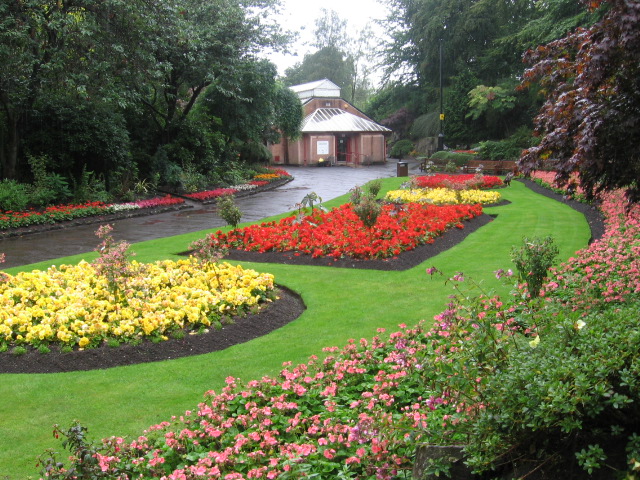
Glasgow has many green spaces and the historic Botanic Gardens, created in 1817 on the initiative of Thomas Hopkirk, a distinguished local botanist, with the support of many local figures and of the University itself. Today, however, I want to take you to a special place that holds the most extraordinary collection of trees in the world. Glasgow, famous for its Victorian architecture and industrial history, hides in the heart of Victoria Park a true monument that takes visitors back hundreds of millions of years. I think of it as a ‘botanic garden like no other’, because it holds a single species for which ‘rare’ is a huge understatement! This place, which struck me deeply when I visited it, preserves and continues to study a group of plants you won’t find anywhere else.
I want to take you into a glasshouse dating from 1889, in the heart of the Victorian era. Are you ready to immerse yourselves in a world that, I hope, will move you so much that you feel you are standing in the very place these plants belong to? Well then, once you reach Victoria Park, head to the south-west corner, walk up to the building, climb the short ramp and… close your eyes!
Fossil Grove: the ancient forest that fuelled Scottish industry
Welcome to Fossil Grove! Glasgow’s fossil forest! Here, to be precise, they call it ‘the fossil grove’ because it consists of eleven fossil tree stumps dating back to the Carboniferous period, a full 325 million years ago! But let’s take things step by step, because there is so much to tell you!
First of all, you should know that in the period I mentioned Scotland lay near the Equator, in a decidedly tropical position, on a coastal floodplain with a hot, humid climate. In this environment so different from today’s grew Lepidodendron, tree-like vascular plants with woody stems, branches and roots, which therefore looked very much like modern trees. These now-extinct plants, related to today’s clubmosses and quillworts, reached 30–45 metres thanks to the structure of their trunks. The trunk, thick and sturdy, had an incredibly tough outer bark that could support very tall stems. Lepidodendron were among the first plants to develop lignin, a substance that strengthens tissues and so allows plants to grow tall and stand upright. Lepidodendron are often nicknamed ‘scale trees’ because of the typical diamond-shaped ‘scars’ left on the trunk where leaves had fallen.
Another important point is that the micro-organisms able to break down this kind of material did not yet exist. As a result, the remains of these vast forests built up into peat deposits, which later turned into the coal reserves that helped Glasgow grow.
The fossilisation process
Returning to the eleven stumps of the Fossil Grove, the trees are thought to have been killed by an exceptional flood of a large river that deposited sand and mud around their bases. Later, when the plants died, the trunks sticking up above the sediment broke off and the soft inner tissue decayed, leaving only the outer bark which, as I said, was incredibly strong.
Later still, the area was flooded again by fast-flowing water, and the now-hollow trunks were filled with a thick layer of sand and buried. Over time the sand turned into sandstone (a sedimentary rock), preserving the stumps as internal casts, while the outer bark was reduced to a thin layer of coal.
A Victorian discovery and the birth of a monument
Jumping forward hundreds of millions of years, we reach 1885, when the officials running the burgh of Partick, an old district of Glasgow, decided to lease part of the Scotstoun estate to create a public park, Victoria Park. At the end of 1887, while a path was being dug through an old quarry, the first fossil stump was found. The quarry had originally been used to extract dolerite, a dark igneous rock used for road building.
The news spread quickly, and in March of the following year national newspapers, including The Scotsman, reported it, calling it ‘the most remarkable discovery’ made in the kingdom.
Scientists from the Geological Society of Glasgow, including John Young, David Corse Glen and Robert Kidston, immediately recognised the importance of the finds. The trunks were identified as Lepidodendron veltheimianum and the root system as Stigmaria ficoides. It was on their advice that it was decided to preserve the fossils in situ, that is, where they had grown. The present building, of brick with a slate and glass roof, was built in 1889.
Unique features of the site:
Inside the Fossil House you can see the eleven extraordinary stumps relatively close up.
• The roots: The so-called root system, called Stigmaria, is still clearly visible. It follows a distinctive pattern in which each main root divides into two equal branches. The roots are shallow, typical of swamp trees.
• The trunk: Although round in life, the trunks are now more oval; this distortion was most likely caused by the force of the water as the stumps were filled.
• The current: The ripple marks visible on the sandstone surfaces clearly show that the ancient current flowed strongly towards the south-west between the trunks.
The challenge of conservation today
The original glass and slate roof was damaged during the Second World War and replaced. Later alterations, in particular the addition of insulating panels in the 1990s, have unfortunately reduced ventilation and increased humidity, causing condensation and leaks that drip onto the fossils and damage the rock surfaces.
The Fossil Grove Trust, together with Glasgow City Council, is seeking funding for a restoration plan to repair the roof structure and improve drainage, electrics and internal humidity, so that the fossils can continue to be admired.
The hope is that, having been designated a Site of Special Scientific Interest (SSSI) by Scottish Natural Heritage, it can be protected more seriously and lastingly.
Silvia Miraglia