
“Scotland is a land full of charm and mystery, with a vast heritage of traditions and legends. To understand this country in depth, we shall take a long journey back in time, to an age when man had not yet appeared on Earth, by studying its ancient geological deposits.
All my life I have devoted myself passionately to the study of the past; even as a child I loved listening to the old legends handed down by word of mouth among my people, as well as the tales of those who had lived through the Battle of Culloden themselves, whose consequences were still all too visible in my youth. In this way, without realising it, I drew close to what I consider one of the most fascinating and absorbing of professions. Even today, in your time, I am called a ‘historian’, yet I see myself more simply as a passionate explorer of history.”
Our ‘Découverte’ Project
“I love my country for the beauty and magic it offers even to the most distracted eye. I have decided to involve fellow scholars from my homeland in a ‘découverte’ project – a project of discovering and celebrating the most unusual aspects of our wonderful land. As the first step in this journey of exploration of ancient Alba, I gladly hand over to Professor James Hutton, who will tell you about the geological formation of Scotland.”
A Special Honour
“It is a great honour for me to have the opportunity to launch this project with a true journey through time that will lead us to discover how ancient Alba was formed, just as Sir Walter Scott has announced. We all hope that the AlbaUnicorn project will offer you a broader and more unusual view of our country.
I am James Hutton. For years I roamed the length and breadth of Scotland, driven by the desire to understand its origins more deeply: from the most inhospitable peaks to the jagged coastlines plunging into the sea, it proved a precious source of ideas for my work. As a geologist, and as a lover of many other disciplines (medicine, physics, meteorology, natural history…), I published various writings resulting from my research and was one of the founders of the Royal Society of Edinburgh back in 1783. I am still regarded as one of the fathers of modern geology because, thanks to my studies, I was among the first to understand the great age of the Earth.”
A Surprising Geological Variety
“You should know that Scotland, although not particularly large, has a truly varied geology, with a great number of different geological features.
There are three main geographical areas:
the Highlands, together with the Orkney and Shetland Islands and the Western Isles, which lie north-west of the boundary fault running from Arran (west) to Stonehaven (east);
the Central Lowlands, a true rift valley that preserves mainly Palaeozoic formations;
the Southern Uplands, which extend south of the southern fault and are made up largely of Palaeozoic deposits.”
The Clash of Continents and the Caledonian Orogeny
“It all began when present-day Scotland was part of one of two great landmasses (continents) called Gondwana (South America, Africa, Australia, Antarctica and India) and Laurentia. Scotland belonged to the latter, which formed the ancient North American continent. During the Palaeozoic era two orogenic cycles (processes that led to the formation of mountain chains) took place; one of them in particular, called the Caledonian orogeny (from Caledonia, the ancient name of Scotland), involved, besides Scotland, Ireland, northern England and Wales, Norway, Greenland and the eastern part of North America. In this era of mountain building, starting about 490 million years ago, the mountainous region of the Highlands was created, and the collision of plates formed volcanic arcs, now extinct, whose remains can be seen among the rocks of the Highlands and the Lowlands.”
The Mark of the Ice Ages
“Later, the ice ages helped to shape the Scottish landscape, eroding huge quantities of sedimentary, volcanic and metamorphic rock and creating the long glens (steep-sided valleys), the lochs (picturesque lakes) and the firths (fjord-like inlets reaching many kilometres inland). All these features are the last evidence of great tongues of ice that wore away the land, carving out gorges.
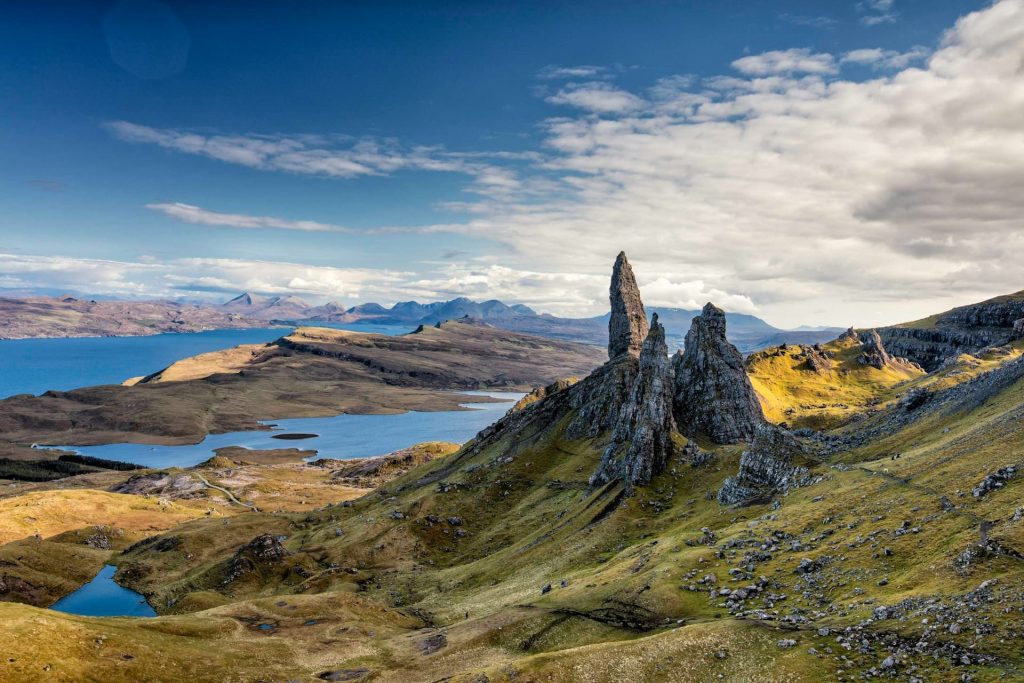
In Scotland there is an island that is a real treasure for researchers like me, an island that seems to have passed through the centuries unchanged: Skye, the misty isle, Eilean a’ Cheò in Gaelic. With its breathtaking landscapes, medieval castles and picturesque villages, it is one of Scotland’s gems, the largest and northernmost of the Inner Hebrides. But behind its almost fairy-tale beauty lies an even older and more fascinating secret: Skye is a true ‘dinosaur paradise’, an invaluable heritage for palaeontologists all over the world, telling almost 3 billion years of Earth’s history. This Scottish island, known today for its cold, windy climate, was a warm, humid subtropical area about 170 million years ago, much closer to the equator.
We know that the first dinosaurs appeared on Earth during the Late Triassic: a very diverse group of animals that dominated the entire Mesozoic Era. There were herbivores and carnivores, bipeds and quadrupeds, small ones (under a metre long) and giants (over thirty metres long). The fossils available to us, however, show that they all had one thing in common: they laid eggs, just like today’s birds, and many of them built nests.
To understand the importance of Skye, we must go back in time to the Middle Jurassic, a geological period between about 174 and 164 million years ago. Although little studied because of a relative scarcity of fossils, this period was of crucial importance, as the palaeontologist Brusatte, whom I shall introduce to you later, maintains. Roughly 200 million years ago, a mass extinction event that wiped out more than half of all living species marked the beginning of the Jurassic period and allowed the dinosaurs to dominate the land for about 136 million years.
The Middle Jurassic, in particular, was a period of accelerated change. The supercontinent Pangaea began to break up into today’s landmasses, and environments diversified: inland deserts gave way to large flooded areas, temperate regions and tropical forests. Animals, plants and other living organisms either died out or adapted. Many important groups of dinosaurs, such as the tyrannosaurs and stegosaurs, made their appearance, the first birds probably took to the air, and new large reptiles began to dominate and spread through the oceans.
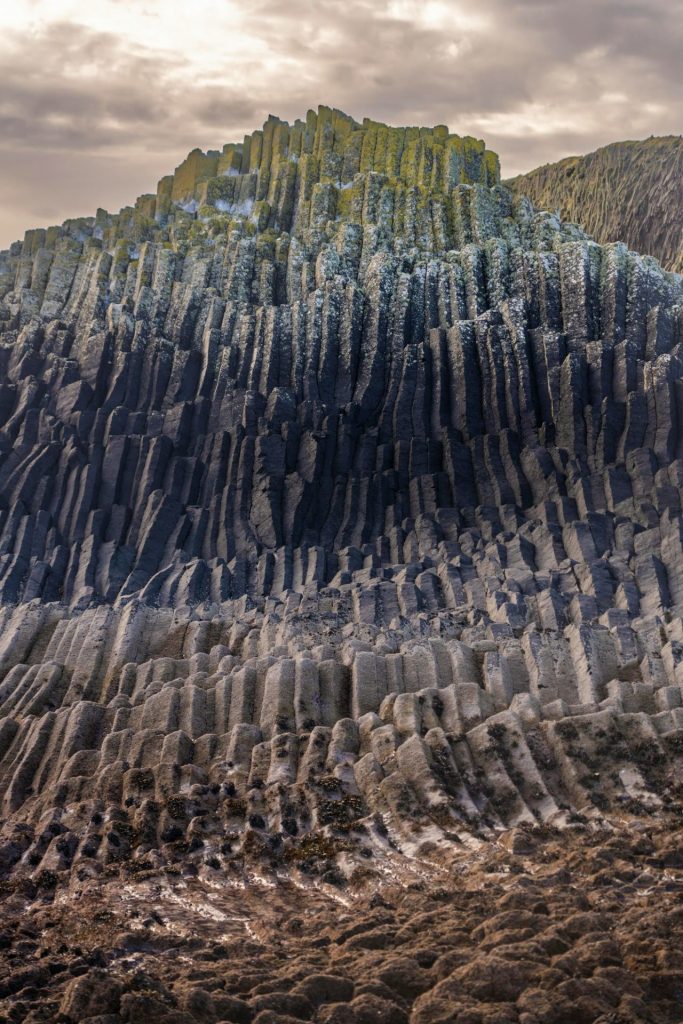
This is where the Isle of Skye takes centre stage. The island’s ever-changing landscape reflects the nature of its rocks, which range from the Archaean to the Quaternary. Its peninsulas radiate from a mountainous centre dominated by the majestic Cuillin Hills (in Scottish Gaelic, An Cuiltheann), sculpted by the glaciers of the last ice age, which ended about 11,700 years ago. It is a mostly rocky range with sharp peaks, made of igneous rocks that are relatively resistant to erosion. The main range is the Black Cuillin, whose name comes from the dark colour of gabbro, a magmatic rock that, together with basalt, forms the heart of these remarkable peaks. Rough and granular, gabbro offers excellent holds for climbers. Their jagged profiles are easy to recognise, with steep cliffs, deep corries (glacial cirques, amphitheatre-shaped hollows) and gullies.
East of Glen Sligachan rise the Red Cuillin (na Beanntan Dearga), lower and less rocky. They are made mainly of granite, a rock paler than gabbro that takes on a reddish tint when the light strikes it from certain angles. The weather has shaped the granite into more rounded forms, and vegetation covers the summits and the long screes along the slopes. The highest point of the Red Cuillin is Glamaig.
From this brief, rapid introduction to the origin and formation of Scotland, it is clear that the Isle of Skye can be considered the guardian of our planet’s most ancient history: a unique window on the geological and biological past of the Earth.”
Silvia Miraglia