
Our AlbaUnicorn project officially gets under way today. Its aim is to create a space where we can share knowledge, impressions, inspiration and dreams about a country that – as you will discover by “leafing through” the various sections just like the pages of a diary – will reveal itself to us in every aspect.
This very day, Scotland celebrates the life of one of its most beloved queens… Saint Margaret, the “Pearl of Scotland”, a queen whose piety and influence left an indelible mark on the nation. Her story begins in a turbulent age of wars, invasions and intrigue. It is an adventurous tale, worthy of a gripping novel, centred on a courageous heroine whose actions shaped the destiny of a country.
Childhood in Hungary, exile and adolescence at the English court
Margaret was born around 1045 in Hungary – according to tradition at Réka Castle, in Mecseknádasd, in the region of Southern Transdanubia – even though she was descended from an ancient Anglo-Saxon royal family (the House of Wessex). Her father Edward, son of Edmund Ironside, King of England, had been forced into exile by the Danish conquest, and so little Margaret spent her childhood at the Hungarian court, an environment that actively promoted Christianity and gave her a strict religious education with the Benedictine nuns.
The family returned to England in 1057, as her father was among the candidates to succeed his uncle, King Edward the Confessor. Sadly, he died soon after arriving; it is unknown whether his death was due to natural causes or, more likely, to a plot against him. Margaret was still a child; she remained at the English court with her mother and her brother Edgar Ætheling, who was in turn the rightful heir to the throne. However, when King Edward the Confessor died in January 1066, Harold Godwinson was crowned king because Margaret’s brother was still too young. The situation took another dramatic turn with Harold’s death at the Battle of Hastings. As the Normans advanced on London, Margaret’s mother realised how precarious her position was and, fearing for her own life and above all for her children’s, decided to flee, first northwards and then to the Continent, setting sail from Northumbria.
When destiny decides
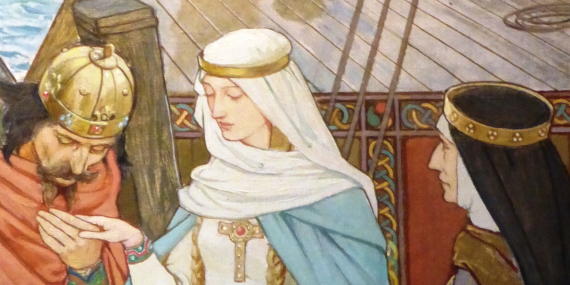
A violent storm caught their ship and drove it towards the Kingdom of Alba, where they were shipwrecked in 1068. The place where they landed is still known today as St Margaret’s Hope, in Fife. King Malcolm III Canmore, who probably already knew them well from his years of exile in England, when Macbeth was on the Scottish throne, offered them his protection.
Despite her wish to devote herself to religious life, Margaret agreed to marry King Malcolm in 1070 at Dunfermline and became Queen of Alba, a title she held until her death. This union, at first purely political and strategic, soon turned into a passionate bond that produced eight children (six sons and two daughters).
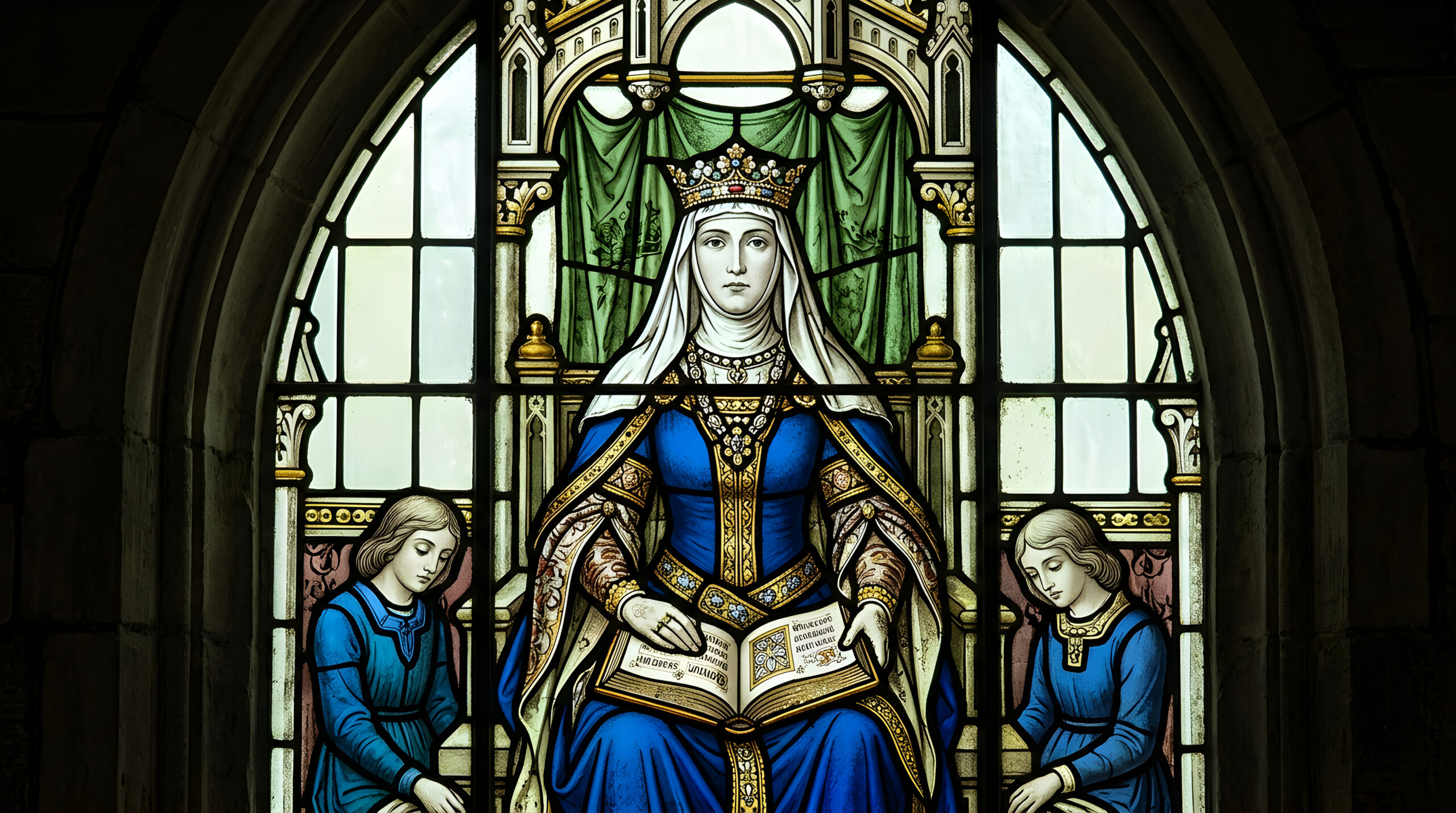
Over the years, Margaret exerted considerable influence over the king and the court. Malcolm, who went down in the chronicles as a “rough and uncultured” man, became under her guidance more refined, more just and, above all – as his wife wished – a Christian. Margaret also transformed life at court, introducing gold and silver plates, furniture and tapestries, spiced food and French wine.
Yet what she cared about above all else was her faith, and she promoted a true reform of the Scottish Church, believing it right to bring worship into line with Rome. She helped to re-found the monastery of Iona and invited the Benedictine order to establish a priory at Dunfermline, later raised to an Abbey by her son David I, which became the new burial place of Scottish kings.
A strong woman who could change a country with love
Throughout her life, Margaret showed deep compassion for the poor and the oppressed, even caring personally for orphans and the destitute. She established a ferry service across the Firth of Forth – which still gives its name to the towns of North and South Queensferry (“The Queen’s Ferry”) – to help pilgrims travelling to St Andrews. She also built hospices and shelters for travellers and the poor.
Margaret was so devout that she often withdrew alone to meditate in a cave on the banks of the Tower Burn stream, near Dunfermline, in a steep glen now known as St Margaret’s Cave. Tradition has it that King Malcolm, growing suspicious, followed her and, finding her at prayer, was so moved that he had the place made a little more comfortable. Sadly, much of the glen has since been destroyed to build a car park, and the cave can now only be reached through a tunnel of 87 steps beneath it.
Another place Margaret visited regularly was St Margaret’s Well, now known as Headwell, a spring north-east of Dunfermline that was once the focus of annual celebrations on 10 June.
Although King Malcolm could not read and was not particularly religious, he admired her devotion so much that he had his wife’s books adorned with gold and gems. One of them, a pocket Gospel book with portraits of the Evangelists, is now in the Bodleian Library in Oxford, England.
King Malcolm and their eldest son, Edward, were killed at the Battle of Alnwick on 13 November 1093. Three days later, aged only 48 and overwhelmed by grief at this tragic loss, Margaret died on 16 November at Edinburgh Castle. She was buried before the high altar of Dunfermline Abbey.
Saint Margaret of Scotland
In 1250 Pope Innocent IV, recognising her personal holiness, her loyalty to the Roman Catholic Church, her work for church reform and her charity, canonised her; her body and her husband’s were exhumed and placed in a new shrine, still inside the abbey. After the Protestant Reformation, to protect the remains of Margaret and Malcolm, George Durie, Abbot of Dunfermline, moved them to his country estate at Craigluscar.
In 1566 Mary, Queen of Scots, awaiting the birth of her son, had Margaret’s head brought to Edinburgh Castle; later, in 1597, it passed to the Jesuits of the Scots College at Douai, in France, but was lost during the French Revolution.
After a further transfer of the couple’s remains to Spain in 1580, to the royal monastery of El Escorial near Madrid, all trace of them was lost.
Margaret, a strong and determined woman, also had a fundamental dynastic impact: three of her sons, Edgar, Alexander I and David I, became kings of Scotland one after the other. Under their rule, Scotland enjoyed a “golden age” that lasted two hundred years after the queen’s death. Her daughter Edith, known as Matilda, married Henry I of England, uniting the Anglo-Saxon and Norman royal lines and becoming “Good Queen Maud”.
Margaret is still celebrated on 16 November, the anniversary of her death, as one of Scotland’s patron saints, and she is also venerated in the Anglican Church.
The life of Saint Margaret of Scotland is a vivid example of the power of faith, charity and the positive influence of a queen who, despite adversity and exile, devoted her life to the good of her family and her adopted nation, leaving a legacy that continues to inspire.
Silvia Miraglia