From a distance, the peaks of Beinn Eighe can look snow-capped even in high summer. Then you get closer and discover that the white is not snow but quartzite: a pale stone that glitters in the sun and turns pearl-grey in the rain. At its feet, between the mountain and the dark waters of Loch Maree, survives a woodland that is the largest remnant of the original Caledonian forest of north-west Scotland.
Beinn Eighe National Nature Reserve is the oldest in Britain; established in 1951, it marks the true birth of environmental protection and ecological management in the United Kingdom. Since then, this corner of Wester Ross has become a symbol: proof that a forest that had almost disappeared can still breathe again.
Britain’s first nature reserve
Before Beinn Eighe, there was no national nature reserve in the United Kingdom. This remote corner of the Highlands was chosen for a specific reason: its pinewoods were among the last surviving fragments of the Caledonian Forest, the great wildwood of Scots pine that covered much of Scotland after the last Ice Age.
Centuries of felling, grazing and fires had reduced it to a few green islands scattered among the glens. At Beinn Eighe the wood held on, clinging to the slopes above the loch. Protecting it meant saving a piece of living memory, a genetic line of trees descending directly from those that arrived here thousands of years ago. More than 800,000 native trees, including pines, birches, oaks and hollies, were therefore planted to restore the woodland. Today, however, the choice has been made to rely only on entirely natural regeneration, letting nature itself manage its own ecosystem.
Today the reserve includes forests, moorland, peat bogs and the mountain’s rocky ridges. It is managed by NatureScot and remains, as it was then, one of the most authentic places to understand what Scotland looked like before humans. In the Coille na Glas Leitir pinewood grow the so-called “granny pines”, spectacular monumental Scots pines, the oldest of which are almost 400 years old!
If you’re curious to discover the country’s other nature reserves, this is the ideal starting point.
Three billion years beneath your feet
Beinn Eighe is not just a forest. As you enter the reserve, you are welcomed by a genuine open-air geology book. Within a few kilometres you come across some of the oldest rocks in Europe, layered one on top of another.
Lewisian gneiss. At the base of the landscape lies gneiss, a rock about three billion years old; you can recognise it by its light and dark bands, folded by the pressures of the Earth’s crust.
Torridonian sandstone. Above the gneiss lie huge layers of reddish sandstone, laid down by ancient rivers about a billion years ago. These are the same rocks that give the Torridon mountains their terraced shapes, almost as if they had been sculpted.
The white quartzite of the summits. Finally, at the top, the quartzite: younger, about half a billion years old, born from the sand of ancient beaches. It is this that gives Beinn Eighe the pale colour that fools travellers into thinking of snow.
What to see in Beinn Eighe National Nature Reserve
Loch Maree and its islands
Many consider Loch Maree the most beautiful loch in the Highlands: long and narrow, dotted with islets covered in pines. On one of them, Isle Maree, tradition places the hermitage of Saint Maol Rubha, a 7th-century Irish monk, and an ancient oak known as the “wishing tree”, into whose trunk coins were hammered over the centuries in the belief that illnesses would pass into the tree. Queen Victoria herself, on 16 September 1877, during a visit to the island, pushed her shilling into the tree, helping to keep the legend of the Wishing Tree alive. The oak is now dead, partly because of the large amount of copper it absorbed over time; its remains, however, are still visible as a reminder of this tradition.
The loch’s islands are home to some of the best-preserved pinewoods in Scotland, which have survived intact precisely because livestock could not reach them.
The peaks of Beinn Eighe
The Beinn Eighe massif is a long ridge with several summits. The two highest, Ruadh-stac Mòr and Spidean Coire nan Clach, rise above 900 metres and are Munros, the Scottish mountains over 3,000 feet so beloved by hillwalkers. These are demanding climbs on rocky and often exposed ground, for experienced mountaineers only.
Coire Mhic Fhearchair
On the Glen Torridon side lies one of the most spectacular natural amphitheatres in Scotland: Coire Mhic Fhearchair. A glacial lochan surrounded by three huge rock walls called the Triple Buttress, where red sandstone and white quartzite are layered like the tiers of a cake. The approach path starts from the Glen Torridon road and is a long walk, but with no technical difficulties as far as the lochan.
Trails in Beinn Eighe National Nature Reserve
The reserve offers two waymarked trails starting from the Glas Leitir car park, on the shores of Loch Maree, a few kilometres from Kinlochewe.
Woodland Trail. A short loop of just over a mile that winds among pines, birches and little burns. It is suitable for everyone, children included, and lets you soak up the atmosphere of the forest without effort. It offers wonderful viewpoints over Loch Maree.
Mountain Trail. About four miles and over 500 metres of ascent: it is one of the finest waymarked trails in the United Kingdom, but it should be tackled with suitable equipment and a reasonable level of fitness. The route climbs from the woodland up to a plateau of rocks and lochans, offering a truly complete immersion in Highland scenery.
Wildlife
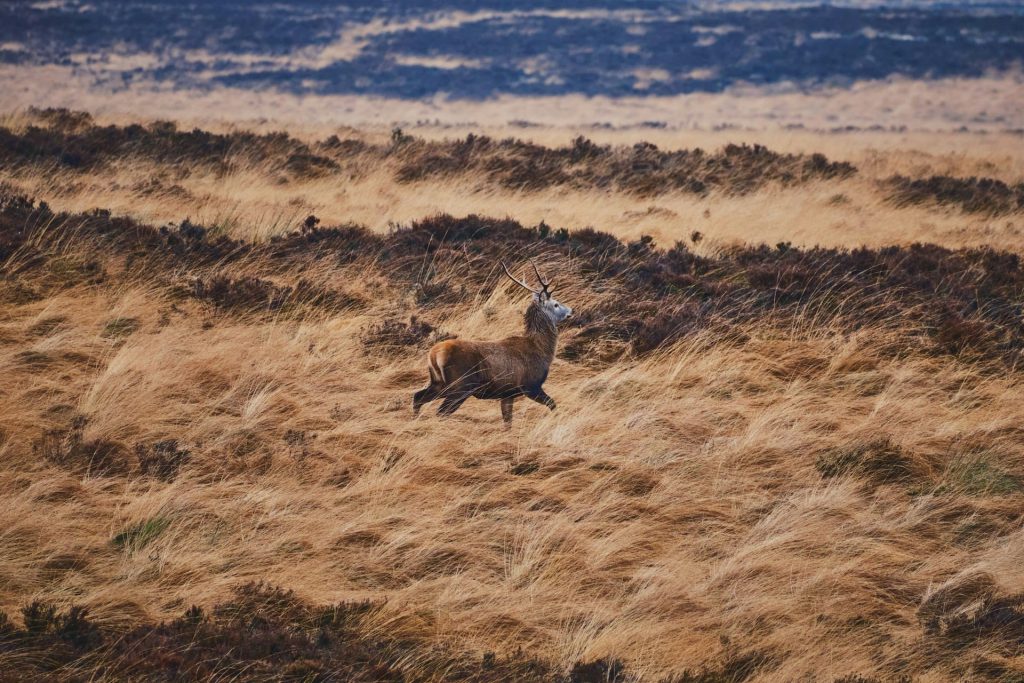
Beinn Eighe has a remarkable variety of habitats (from lochs to arctic tundra) that make it the ideal place to see a wide range of animals, both in the skies (golden eagle, Scottish crossbill, black-throated diver) and in the undergrowth (pine marten, dragonflies, red squirrel, wildcat, red deer).
How and when to visit Beinn Eighe National Nature Reserve
The reserve is in Wester Ross, in the north-west Highlands, near the village of Kinlochewe.
- By car from Inverness: about an hour and a half. Follow the A835 west and then the A832 through Achnasheen. The last stretches are scenic roads, sometimes single-track with passing places.
- By train: the Inverness to Kyle of Lochalsh line stops at Achnasheen, from where you’ll need your own transport or a lift for the last few miles.
Every season has its own face.
- Spring: lengthening days, birdsong, fewer midges.
- Summer: light until late evening and dry paths, but beware of the midges, Scotland’s tiny biting flies.
- Autumn: golden birches, the roar of rutting stags, misty atmospheres. Perhaps the most evocative time of year.
- Winter: spectacular scenery but very short days. The Mountain Trail can be icy and should only be attempted with experience and proper equipment.
Practical tips for your visit
- Dress in layers and always carry a waterproof jacket.
- Walking boots, especially for the Mountain Trail.
- Insect repellent in summer.
- Dogs on leads, especially during the nesting season.
- Stock up beforehand: services are few and distances long in this area.
- Respect the Scottish Outdoor Access Code: stay on the paths and leave no trace.
A forest that remembers
There is something moving in the thought that the pines of Beinn Eighe descend from those that arrived as the ice was retreating. Every tree carries a memory thousands of years long, and walking among them means touching a thread that binds us to a distant past.
Beinn Eighe National Nature Reserve is not a place to rush through. It is a place to cross slowly, stopping to listen to the wind in the branches and the silence of the loch. And when, on your way back, you turn to look at those white summits that are not snow, you’ll know you have met one of the oldest and truest places in Scotland.
To continue the journey, let the other stories in the Wild-Alba section be your guide.
Silvia Miraglia