
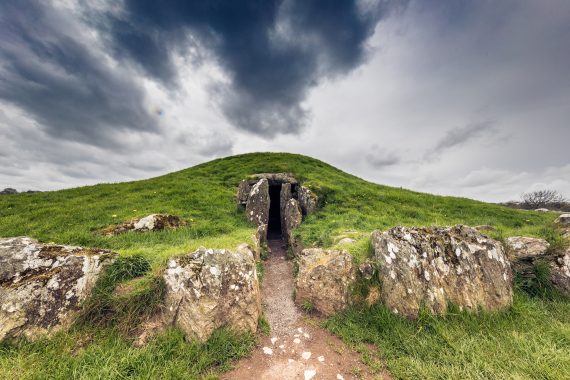
Cuiridh mi clach air do chàrn… I will put a stone on your cairn. This ancient Scottish Gaelic blessing takes us straight back to the belief that Highland clansmen would each place a stone on a pile before going into battle. Those who survived had to remove their own stone on their return; all the others went to form a ‘cairn’, a mound, to honour the dead.
However, the history of cairns goes back much further, all the way to the Neolithic. Today we will travel through time together to discover a few more curiosities about these remarkable structures, which still have a great deal to tell.
We know that Scotland has a large number of so-called ‘chambered cairns’: true monuments made up of a large inner chamber, almost always of stone, or a ‘passage grave’, around and over which a mound of stones was built. Neolithic cairns were built near settlements and are thought to have been burial grounds where the dead were laid to rest and, in some cases, honoured and regularly visited. This period can be divided into two phases: the Early Neolithic (4000–3300 BC), characterised in the east of Scotland by timber and earth monuments and in the west by stone chambered cairns; and the Late Neolithic (3300–2500 BC), which stands out for its huge circular enclosures and the spread of single burials.
Scotland’s cairns have been classified according to their features and the area where they were built. Here are the main types and where to find them:
- Clyde or Clyde-Carlingford cairns: These were first identified around the Firth of Clyde (which gives them their name), then also in south-west Scotland (where more than a hundred have been found) and in north-west Ireland, where very similar tombs exist. They are called “court cairns” after a kind of open semicircular forecourt used for rituals; the chamber, at one end of the cairn, was reached through a narrow passage (hence also the name ‘gallery cairn’). The chamber was very simple, made of large blocks of rock covered with flat slabs and divided into smaller compartments. Here the dead were laid with the objects they needed for the afterlife. Cairns in this group are considered the oldest in Scotland, dating from between 4000 and 3500 BC.
- Hebridean cairns: This group, which appeared relatively late in the Neolithic, has features similar to the previous one: a chamber and a short passage at one end of the cairn. These tombs are found mainly in the Outer Hebrides.
- Orkney-Cromarty cairns: This is the largest and most varied group. Their distinguishing feature was a rectangular chamber with dividing slabs on both sides, splitting it into a variable number of sections (from 4 to 24). As a result, the shape of these cairns ranged from a simple circular structure to a more complex one, with a series of side spaces like small ‘amphitheatres’. Some scholars think this reflects cultural and architectural influences from France and Spain, where similar tombs exist.
- Maeshowe-type cairns: this group, found only in Orkney, had a central chamber with fairly high ceilings and steep sides, off which small compartments opened where the dead were placed. Their name comes from a mound on the island of Mainland, built around 2700 BC.
- Bookan-type cairns: named after a site north-west of the Ring of Brodgar, also in Orkney. Tombs of this type are rather unusual: some of them were even built on two levels! They are among the oldest in Orkney.
- Shetland cairns: this group consists of fairly small passage graves; they had a cross-shaped chamber but no individual compartments.
- Clava cairns: during the Bronze Age, as individual burials became more important than collective ones, regional differences in architecture also became more marked. Around Inverness, some fifty cairns from this period have been found, with the remains of one or two burials. Scholars have divided these funerary monuments into two categories, both of which have a stone circle around the cairn. One group consists of passage graves with a single burial chamber and entrances facing the midwinter sunset; the other of ring cairns with an apparently entrance-less central area, suggesting that the dead were not regularly visited.
- Balnuaran of Clava: grouped along a north-east–south-west diagonal, these are three Bronze Age cairns belonging to the previous group. Two are passage graves and one is a ring cairn.
Visiting at least one of these sites could be a good reason for a trip to Scotland. What do you think? I promise it is an extraordinary experience, a real plunge into the past, made all the more special by the almost entirely natural setting in which they stand.
Silvia Miraglia