
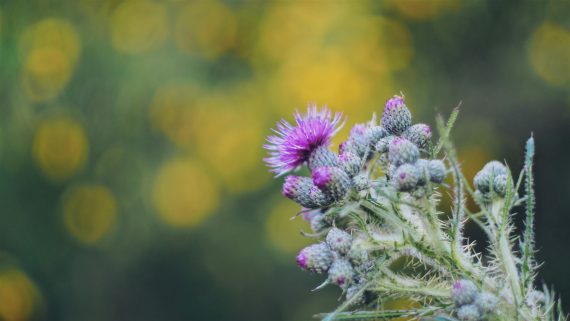
Among the many legends handed down in the Highlands, there is one that more than any other reminds us that help can sometimes come from the most unexpected directions. It is the story of a proud, tenacious plant that has always grown on the Scottish moors and whose tall, prickly stems make it resistant even to the fiercest winds and the harshest winters. We are talking about the thistle, a plant that for a long time nobody thought worth noticing, preferring fragrant, colourful, delicate flowers to it. It is said that even livestock and wild animals avoid its tough, spiny leaves and small purple flowers, preferring to feed on other plants.
The legend of the prickly sentinels
Today I will tell you about an ancient legend according to which the thistle’s fortunes changed completely one night in early October, sealing forever the destiny of a whole people too. The tale is linked to a historical event: the Battle of Largs, between the armies of Norway and Scotland. King Alexander III, like his predecessor, wanted somehow to regain the Western Isles, the Isle of Man and Kintyre, which for over a century had been ruled by Norwegian kings. King Haakon IV, for his part, worried that the Scots were planning to take back the northern territories, set sail in July 1263 with an imposing fleet. While it lay at anchor off an island in the Firth of Clyde, it was caught by a storm. Some of the ships, driven by the wind, ended up on the beach at Largs in Ayrshire.
Up to this point the events are documented; what follows comes from tales handed down over time, mixed with realistic elements. The legend I mentioned says that the Norse warriors, hoping to surprise the Scots asleep in their camp, took off their shoes, thinking they could move more stealthily, helped by the darkness. As they crept forward in silence, close to victory, precisely because of the dark they did not notice they had walked into a patch of ground covered in thistles. One of the Norsemen trod on a large, spiny plant whose prickles sank deep into his foot, causing him terrible pain. He began to scream, waking the Scots, who were able to face the invaders and defeat them.
And so these plants, thanks to their features and the role they played on this occasion, were likened to sentinels able to drive away the enemy by using the very thing that usually made them scorned. From then on, the wild thistle became the Guardian Thistle, Scotland’s protecting guardian, and was placed on war banners to protect Scottish armies. Before long it was chosen as the symbol of the whole country.
This legend, like the many others starring the wild thistle, tells of a miraculous event in an age of conflict between the Scottish people and foreign invaders, in which the courage and resilience of the clans find their symbol in a plant that, just as miraculously, managed to thrive in a hostile land. The thistle, the hero of the story, not only symbolises the strength of the Scots but also becomes an emblem of defence and unity against adversity.
In some tales handed down in the Highlands, the thistle is even said to have divine origins, born as a gift of the gods to protect the peoples of the high lands from invaders and outside threats! The wild thistle, with its sharp prickles, its tough foliage and its ability to grow wild among rocks and rough ground, stands for the untamed heart of the Highland peoples, able to withstand the hardships of climate and invasion. It is no coincidence that for centuries the thistle has been associated with the struggle for the independence and autonomy of Scottish lands, and has often been depicted as a symbol of defence against invasion and outside aggression. In Scotland you will find it pretty much everywhere: on coats of arms, banners, portraits of important figures, the national rugby and football team kits, police uniforms and company logos. Keep an eye out next time you visit Scotland!
The thistle, Scotland’s royal symbol
The first official use of the thistle as Scotland’s royal symbol was on the silver coins issued by James III in 1474. The Thistle Crown, on the other hand, is the gold coin minted after the son of Mary, Queen of Scots, James VI, was crowned King of England (as James I) and of Scotland (as James VI). The coin showed the union of the two crowns with the rose on one side and the thistle on the other.
Another landmark date is 1642, when the Scots Guards adopted the thistle as their regimental emblem.
The Thistle Chapel and the Order of the Thistle
In Edinburgh there is even a chapel dedicated to the thistle inside the famous St Giles’ Cathedral. Stepping inside, you feel as if you have been catapulted into a place frozen in time! The chapel, home of the Order of the Thistle, Scotland’s oldest and most important order, was built in 1911 as a meeting place for the knights on whom the monarch bestows this prestigious honour. Each member of the Order, including the sovereign, has a stall above which are their name and heraldic insignia; there are 16 in all, although there were originally 13, in honour of Jesus and his twelve apostles.
The present Order of the Thistle was founded in 1687 by King James VII; it is a true order of chivalry conferred by the monarch on those who have made an important contribution to Scotland and the United Kingdom. Women were once excluded from this honour, until Queen Elizabeth II changed the rules in 1987.
The badge still worn on the chest, over the heart, is a silver four-pointed star bearing the cross of Saint Andrew, also in silver. In the centre, on a green circle, is the order’s motto: “Nemo me impune lacessit”, meaning “No one provokes me with impunity”. The thistle sits in the middle of the motto.
The thistle in the kitchen
Have you ever tasted thistle? It is a plant that truly deserves to be appreciated in cooking! The Egyptians already knew its extraordinary properties, and Pliny the Elder, in his “Naturalis Historia”, even recommended it to get rid of excess bile.
Where to find thistles in Scotland
Thistles grow all over Scotland, from the Lowlands to the Highlands, and even on the islands! Travelling through Scotland you will find several wild species, the most common being spear thistle, creeping thistle and marsh thistle. Looking at the images on coins, banners and paintings of the past, we can identify Scotland’s national emblem as the spear thistle, Cirsium vulgare, which differs from Onopordum acanthium, which is not native.
Cirsium vulgare belongs to the Asteraceae family and is a biennial herbaceous plant able to adapt to poor and limy soils, often found on marginal land that is hard to farm. It stands out for its imposing height and its silvery leaves with toothed, prickle-covered edges that make it easy to recognise; it has a sturdy stem (which in some species can reach as much as 2 metres) and purple or pink flower heads, similar to an artichoke’s. It flowers in July and August, when its intense, vivid colour stands out sharply against the typical Scottish moorland. The roots and leaves are used in herbal preparations, to which folk tradition attributes anti-inflammatory, astringent and digestive properties.
In the past, the young, tender leaves were gathered and used in soups and broths, giving a typical slightly bitter, earthy flavour; the roots were used to make infusions and decoctions. Nowadays the use of wild thistle has declined considerably, but some kitchens keen to rediscover tradition have begun to use this ancient plant in contemporary dishes, building a bridge between past and present and a close link with Scotland’s rural roots.
The thistle as inspiration
In 1926 Hugh MacDiarmid wrote the poem A Drunk Man Looks at the Thistle, which can be seen as a long monologue by the author, half comic and half serious, on all kinds of themes. The poet, in a state of consciousness altered by alcohol, finds himself gazing at a thistle and, through it, receives a true revelation about the real essence of Scotland.
For the marriage of Margaret Tudor and James IV in 1503, the poet William Dunbar wrote the poem The Thistle and the Rose, a work inspired by the two figures at the heart of the royal union. The thistle stands for the Scottish king, the rose for the English princess.
Scotland, being part of the United Kingdom, does not have its own national anthem. Even so, the Scots chose (in a poll held in 2006) as their unofficial anthem The Flower of Scotland, the song written by Roy Williamson of the folk group The Corries, which is sung with passion and feeling at sporting events. The title is often associated with the thistle, Scotland’s flower, although the “flower” of the song rather refers to the brave Scottish warriors.
One last curiosity that might interest you for your next trip to Scotland: if you like tartan and have always wanted to wear one, you can buy the “Flower of Scotland” tartan, created in honour of the late Williamson, a sign of the affection the Scottish people feel for the Corries singer.
Silvia Miraglia