
If you are planning a trip to Scotland or have already been, you will almost certainly have come across the Scotch egg. Found in every self-respecting pub, this delicious dish is a culinary icon.
In this article we will discover together its origins and the reason for its name and, of course, we will go step by step through the traditional recipe.
Origins: a London mystery with international influences
The story of the Scotch egg is more complicated than you might think, and its roots lie not in the Highlands but in the heart of London.
- Fortnum & Mason: The most widely accepted theory credits the prestigious London department store Fortnum & Mason with inventing it in 1738. It is said to have been created as a filling, easy-to-carry snack for wealthy travellers setting off by carriage from Piccadilly. Originally it was made with a bantam egg (smaller than an ordinary hen’s egg), wrapped in forcemeat, breaded and seasoned with salt, pepper and mace.
- The Indian influence: Another theory suggests a link with an Indian dish called nargisi kofta, made of a hard-boiled egg wrapped in minced meat, fried and served with a sauce. It is possible that this recipe was brought to Britain by employees of the East India Company.
- Yorkshire: A third theory places the birth of Scotch eggs in Whitby, Yorkshire, under the name “Scotties”, supposedly because they were made at a restaurant called William J. Scott & Sons near the seafront. In this version they were coated not in meat but in a rich fish paste and then rolled in breadcrumbs. Over time the name “Scotch eggs” was adopted.
- Maria Rundell: The first printed recipe appears in Maria Rundell’s “A New System of Domestic Cookery”, published in 1809.
Scotch egg: a simple yet wonderfully tempting dish!
Its culinary history is intertwined with British food traditions and is an example of tasty cooking, the symbol of a firmly rooted heritage. Its origin, however, as we have seen, is still debated and remains shrouded in mystery.
While the first written record dates from the 19th century, many of its features point to older recipes. It is generally thought, though, that the Scotch egg as we know it today was born in the 1800s, at a time and above all in a setting where food needed to be quick to make, cheap, practical and filling, ideal for eating outdoors or as a portable meal for workers.
In fact, the recipe seems to have originated among railway workers or soldiers, who needed nourishing food that was easy to carry and, above all, would keep. This era saw a trend towards making the most of simple but tasty foods.
As the name suggests, the undisputed star of the Scotch egg is the hard-boiled egg wrapped in a layer of sausage meat and a delicious crunchy crumb.
Over time this dish has gone through many regional variations and adaptations to more modern tastes, giving rise to versions ranging from the traditional to the vegetarian or gourmet.
The Scotch egg has gone from simple street food to a dish enjoyed in more refined settings too, thanks to its versatility and many creative reinterpretations. It is still seen as a symbol of conviviality and tradition, a culinary heritage that has evolved in response to the needs of the past and modern culinary innovation, while keeping its link with its Scottish and British roots intact.
Indeed, its story is an example of how simple dishes can cross the centuries while keeping a strong link with local culture and continuing to be enjoyed today, at festivals, events and specialist restaurants. Its evolution shows how important it is to preserve and reinterpret traditions in an ever-changing food scene.
Now that you know the story, it’s time to get cooking! Making Scotch eggs at home is easier than it looks!
The main ingredients of a Scotch egg are eggs and meat. The original recipe calls for a method that needs care and precision! Here are the steps to a perfect Scotch egg: crisp outside and tender inside:
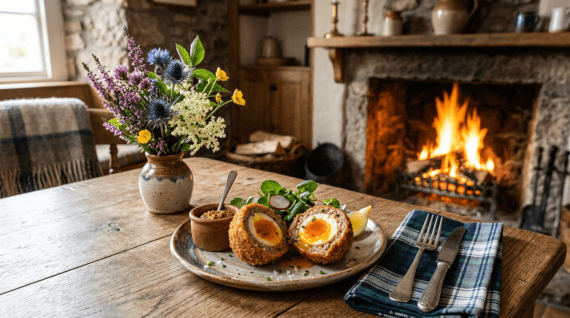
Traditional Scotch egg recipe
Ingredients:
4 large eggs (hen, quail or duck)
275 g meat (sausage meat, chicken, turkey, beef)
Spices to taste (salt, freshly ground black pepper, nutmeg)
125 g plain flour
1 beaten egg for coating
125 g breadcrumbs
vegetable oil, for frying
- Start by choosing the eggs, which should ideally be fresh and medium-large. Before cooking, it is a good idea to put them into lightly salted boiling water or water with a dash of vinegar, to make peeling easier and stop them cracking as they cook.
- Then boil the eggs at a moderate heat, making sure the yolk stays soft or becomes firm, depending on the result you want. Once the eggs are cooked and cooled, peel them carefully, taking care not to break them. Remember that the eggs must be firm enough to hold their shape.
- Meanwhile, prepare the meat, usually chicken, turkey, pork or beef. The meat is seasoned with spices, salt, pepper and herbs, and sometimes enriched with breadcrumbs to improve flavour and texture. Working the meat properly is essential to get a soft mixture that can wrap the egg without breaking during cooking. So don’t pack it too tightly!
- Next, wrap each egg, which must be completely cold, in the meat mixture, shaping it by hand until you have an even and, above all, sealed coating.
- And now one of the key steps for successful Scotch eggs: the coating! You can do it in two ways: with breadcrumbs alone if you want a thin crust or, if you want it thicker and crunchier, dip the coated egg in beaten egg and then flour before rolling it in breadcrumbs. This also gives you an even, well-stuck layer. The double coating also creates a kind of shell that protects the Scotch egg as it cooks.
- The last stage is frying, preferably in a large pan or a deep-fat fryer. The Scotch eggs are gently lowered into hot oil at about 170°C and usually cooked for 4–6 minutes, until golden and crisp. It is best to cook one or two eggs at a time so the temperature stays steady and you can easily turn them now and then with tongs or a slotted spoon, so the crust does not burn or the inside stay raw. If you have lots of Scotch eggs to make, change the oil regularly.
- After frying, drain them on kitchen paper to remove excess oil.
This is the method for the classic recipe, but there are many regional variations that enrich the traditional one. Recommended accompaniments include various sides and sauces such as sweet mustard, wholegrain mustard or a herb mayonnaise. As for drinks, the classic match is a light, aromatic beer such as an English ale or a lager.
All that remains is to wish you a hearty appetite!
Silvia Miraglia