
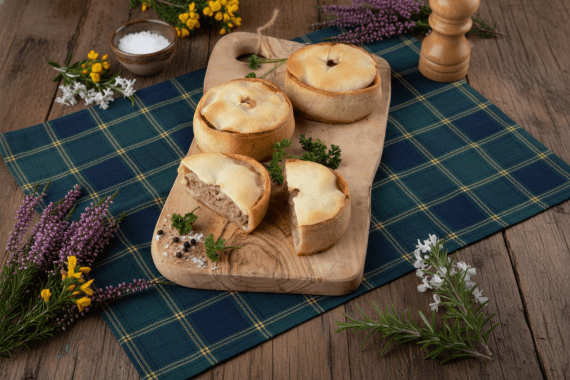
If you have been to Scotland and stopped even once in front of a Scottish baker’s window, you will almost certainly have come across the Scotch Pie. Small, round, golden and steaming, it is far more than a simple meat pie: it is an icon — in fact, for many Scots it is Scotland itself!
In this article we will discover together its origins, the reasons for its extraordinary success and the curiosities surrounding it. Above all, we will go step by step through the traditional Scotch Pie recipe, with every tip you need to bring an authentic piece of Scotland to the table.
What is a Scotch Pie
The Scotch Pie is a savoury double-crust pie, cylindrical in shape, filled with spiced minced meat. It was traditionally made with mutton, while today beef and lamb are mostly used. The case is made with hot water crust pastry and lard, sturdy yet crumbly, so it can be eaten with your hands, without cutlery or plates.
The detail that makes it unmistakable is the lid, set lower than the rim: this creates a small hollow that can be filled with hot gravy, mashed potatoes, peas or beans.
The origins of the Scotch Pie: five centuries of history
The roots of the Scotch Pie go back a long way and, as often happens with the best-loved dishes of Scottish cuisine, its birth remains partly shrouded in mystery. The first references to a pie of this kind are thought to date back about five hundred years.
Mutton, the people’s meat
The traditional filling was mutton, generously spiced. The choice was no accident: in Scotland sheep were everywhere and mutton was cheap compared with beef. What’s more, once minced and mixed with the other ingredients, it lost the toughness that set it apart from finer meats. Like haggis, then, the Scotch Pie was born of the desire to make the most of what the land offered, without waste.
The Penny Mutton Pie and the Tuppenny Struggles
The Scotch Pie we know today descends from the Penny Mutton Pie, small mutton pies sold hot for a penny between the late 18th and early 19th centuries. Bakers and street sellers offered them all over the country, right on the street, to the working class.
In Glasgow in particular (but also in other urban areas of Scotland), in the 1930s these pies were known by the curious nickname of Tuppenny Struggles. “Tuppenny” refers to the price of two pennies, while “struggles” may refer to the effort it took the poorer classes to scrape the coins together, or to another kind of effort… that of digesting a food made at the time with rather poor-quality meat.
A recipe written into law
In 1967 the Scotch Pie even received official recognition and an official name. British regulations on meat pies describe it as a low, cylindrical pastry case no more than five inches (about 12.7 cm) in diameter, filled with minced beef or mutton and strictly without jelly. This is precisely what sets it apart from, for example, the English pork pie.
Why the Scotch Pie is a symbol of Scotland
The workers’ meal
As we have seen, the Scotch Pie was born as food for ordinary people: cheap, filling and, above all, practical. Thanks to its solid crust it could be eaten with one hand. It is no coincidence that its popularity grew after the Industrial Revolution, when labourers and workers needed a hot, nourishing meal to take with them or buy on the street. Like the Scotch Egg, it is one of those dishes made to be eaten on the move.
Pie and Bovril: the football match ritual
To this day it is the undisputed queen of football grounds. Tradition has it eaten at half-time, with a steaming cup of Bovril, a hot beef drink that warms the coldest evenings in the stands.
The Scotch Pie World Championship
Since 1999 it has had a championship all of its own: the World Championship Scotch Pie Awards are organised every year by the Scottish bakers’ association. Hundreds of bakers and butchers from all over the UK compete for the title of best pie, judged strictly on the crispness of the pastry, the flavour of the filling and faithfulness to the traditional shape.
The original Scotch Pie recipe, step by step
Now that you know the story, it’s time to get cooking! Following the recipe at home is easier than it looks: it just takes a little care when shaping the pies. Here is how to make four perfect pies, golden and crisp outside, juicy inside.
Ingredients for 4 Scotch Pies
For the filling:
- 600 g minced mutton (or lamb or beef)
- 1 small onion, finely chopped
- 1 teaspoon mixed herbs (basil, marjoram, oregano and rosemary)
- ¼ teaspoon ground mace
- ¼ teaspoon nutmeg
- 5 tablespoons gravy or stock
- salt and white pepper to taste
For the hot water crust pastry:
- 360 g plain flour
- 120 g lard
- 160 ml water
- ½ teaspoon salt
- 1 egg yolk, beaten, for brushing
What you need
- 4 strips of baking paper, 5 cm high and 25 cm long
- 4 pieces of kitchen string
- a baking tray lined with baking paper
Making the filling
- Preheat the oven to 200°C.
- In a large bowl, mix all the filling ingredients and season with salt and white pepper. Mace and nutmeg are the aromatic heart of the pie: don’t skip them!
- Mix well, divide the mixture into four portions, shape them into balls and leave them to rest in the fridge while you make the pastry.
Making the hot water crust pastry
- In a small pan, heat the water with the salt and the diced lard, without bringing it to the boil, until the lard has melted.
- Put the flour in a bowl, make a well and slowly pour in the hot liquid, stirring constantly with a spoon.
- As soon as the dough is cool enough to handle, turn it out onto a floured surface and knead it quickly until smooth. Remember: as it cools, this pastry becomes less pliable!
Shaping and baking
- Cut off a quarter of the pastry and set it aside for the lids. Divide the rest into four balls and roll them out into circles about 18 cm in diameter and 5 mm thick. From the remaining pastry, cut four 10 cm discs.
- Place a ball of filling in the centre of each circle, gather the pastry around the meat and raise the sides to form a straight-sided pie that rises about 2 cm above the filling.
- Moisten the edges with a little water, place the lids on top of the meat, slightly below the rim, and seal well with your fingers.
- Wrap a strip of baking paper around each pie and tie it with string, so it keeps its shape while baking. Arrange them on the tray and make a small hole in the centre of each lid to let the steam escape.
- Brush with the beaten yolk and leave to rest in the fridge for 30 minutes.
- Bake for 35–40 minutes, until golden. Remove the paper and string and serve piping hot.
Tips for a perfect Scotch Pie
Here are a few little secrets so you get the Scotch Pie recipe right first time.
- Work the pastry while it is warm: this is the secret of hot water crust. If it cools too much, it cracks as you shape it.
- Don’t pack the filling: the meat must stay tender and juicy, so shape the balls without pressing them too hard.
- Don’t skip the rest in the fridge: it helps the pie keep its shape and straight sides in the oven.
- Make the spices your own: every Scottish baker jealously guards their own blend. Start from the classic base and then find yours!
Scotch Pie pairings and variations
The most classic accompaniments are mushy peas, mashed potatoes or baked beans, spooned straight into the hollow of the lid.
If you want to eat it like Scottish fans in the stands, try it with a steaming cup of Bovril. Otherwise, the ideal match is a smooth, malty Scottish ale, which balances the savouriness of the meat and the spices of the filling.
A simple dish that tells the story of a whole country
The story of the Scotch Pie is the perfect example of how a humble dish, born to feed workers, can travel through the centuries and become a symbol of identity and conviviality, bringing everyone together regardless of class or background. Bear in mind that, once baked and cooled, it can be kept in the fridge and reheated in the oven so the crust becomes crisp again. Now that you know the Scotch Pie recipe, all that’s left is to try it and let yourself be carried off to Scotland, at least for the length of a bite! For more Scottish stories and flavours, keep exploring our blog.
All that remains is to wish you a hearty appetite!
Silvia Miraglia