
Have you ever heard of “coopers”? The answer is probably no; and yet they play a key role in the Scotch whisky industry. They are the famous master coopers, whose work is an age-old art that guarantees the quality of the spirit’s maturation.
If you think whisky is made only of water and barley, prepare to change your mind. The real miracle happens in the silence of the warehouses, inside those oak shells built with a mastery that defies the centuries.
The ancient art of cooperage: the apprenticeship
Coopering is one of Scotland’s oldest trades. It is not learned from books but through a four-year apprenticeship governed by centuries-old traditions, where the only teacher is hands-on experience. A young apprentice must learn to “read” the grain of the wood before even touching a tool; they must learn to “hear” the sound of the staves they have assembled to tell whether they are cracked or not.
At the end of their training, the apprentice must pass a final practical test.
Many master coopers belong to the National Cooperage Federation, which guarantees quality standards throughout the UK, preserving a culture handed down intact like the old tales of the clans.
Tools and technique
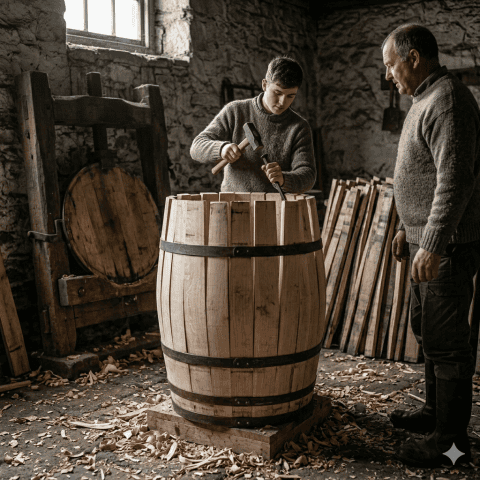
A cooper’s work is physically exhausting and demands pinpoint precision. A cooper must be able to raise a cask from around 30 or 40 wooden staves without a single drop of glue or a single nail. It is all a matter of millimetre-perfect joints and the “memory” of the oak.
The staves are set upright inside a temporary iron hoop; the wood is then softened with steam or heat so it can be bent, in a process called raising the cask. At this stage the craftsman must shape the “belly” of the cask, closing it with ever tighter metal hoops.
A wooden cask has three parts:
Staves: the curved wooden boards that form the body of the barrel.
Heads: the two circular ends that close the cask at top and bottom.
Hoops: the metal rings that hold the staves together.
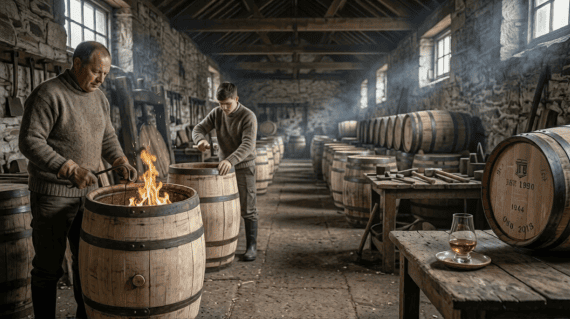
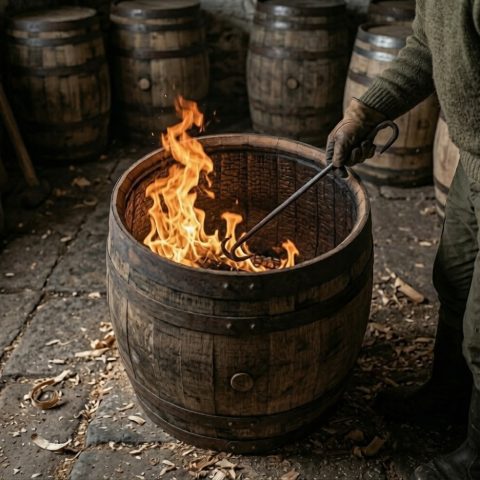
The cooper’s main tools are the cresset (a metal brazier placed inside the cask to heat the wood and make it pliable), the adze (an axe for shaping the heads) and the driving hammer, the heavy hammer used to drive on the metal hoops.
The fire that “wakes” the oak
One of the most fascinating moments in a cooper’s work is the heat treatment.
There are two stages:
Toasting: Slow, gentle heating that penetrates deep, warming the wood gradually.
Charring: A short, intense blast of flame that burns the inside of the cask.
This “burning” has a precise purpose: the layer of active carbon formed on the surface acts as a natural filter, breaks down the wood’s molecules and caramelises its natural sugars, releasing aromas of caramel, vanillin and spice that give whisky its characteristic flavour. The char is calibrated according to the kind of whisky the distillery wants to make. It is clear, then, that without this step the spirit resting in castle cellars and distillery warehouses would never acquire its amber colour and much-loved bouquet.
Why is the cask the secret ingredient?
In Scotland they say that 70% of a whisky’s final flavour and 100% of its colour come from the wood. Casks are not mere containers but lungs that breathe! During maturation the wood expands in the warmth and contracts in the cold. If the distillery is on the islands (such as Islay or Skye), the cask will even absorb the salty notes carried by the Atlantic wind!
Recycling and renewal: a second life
Coopers do not just build casks; they often rebuild them! These skilled craftsmen repair old barrels that once held Spanish sherry or American bourbon, replacing damaged staves and scraping the inside to “reactivate” the wood (re-charring). Coopers give new life to thousands of casks that have travelled the world, absorbed sweet wines or strong spirits and are now ready to pass on this precious treasure of aromas to Scotch whisky. Oak that once held bourbon gives notes of vanilla and caramel, while oak that held sherry gives notes of dried fruit and spice.
A craft that looks to the future
Despite today’s technology, the cooper’s work remains deeply manual and traditional. Visiting a cooperage means stepping through a real time portal! One of the best-known places to see these craftsmen at work is the Speyside Cooperage at Craigellachie, in the heart of Speyside. Here thousands of casks are repaired before being sent to Scotland’s leading distilleries. There are, however, also distilleries that prefer to manage the whole cycle, keeping full control over every stage of production.
A cooperage is a place where the smell of sawdust mingles with the pungent smell of smoke, and where every cask bears the invisible signature of the man who tended it with passion and dedication. It is certainly a job that demands physical strength, but also the ability to “feel” a cask’s character and tell, with a single tap, whether that barrel is ready to hold the amber spirit for which it is destined.
In a world that all too often pushes us to be fast, master coopers remind us that the best things still need time and a touch of craftsman’s magic.
Next time you raise a glass of whisky, spare a thought for these men: the silent guardians of time!
Silvia Miraglia