
In Moray, a beautiful rural county in the north-east of Scotland, there is a festival held every year on 11 January (unless the 11th falls on a Sunday, in which case it is brought forward to the 10th), and its meaning goes back to 1750, when the Calendar Act was passed.
Burning the Clavie is the name of this celebration, which involves the whole town of Burghead (and beyond!) and whose ancient origins are still being studied by the University of Aberdeen.
For one night a year, in the depths of winter, this quiet coastal village in the north-east of Moray burns brighter than anywhere else in Scotland! Today Burghead, with just over 2,000 inhabitants, is a small, unassuming place, but in the 4th century it was the site of a huge and influential Pictish settlement. Indeed, its emblem is carved on a stone slab (kept at the British Museum in London) showing the outline of a bull, a noble animal whose stubbornness perfectly sums up the character of the locals. The ancient tradition behind Burning the Clavie has survived precisely thanks to the tenacity of these people, who for centuries have repeated an almost mystical ritual that sets them apart even from the rest of Scotland. It is no coincidence that while elsewhere Hogmanay is celebrated on 31 December, here they wait until 11 January to welcome the new year with a ritual that has something magical and, in some ways, primeval about it.
The preparations: how the Clavie is made
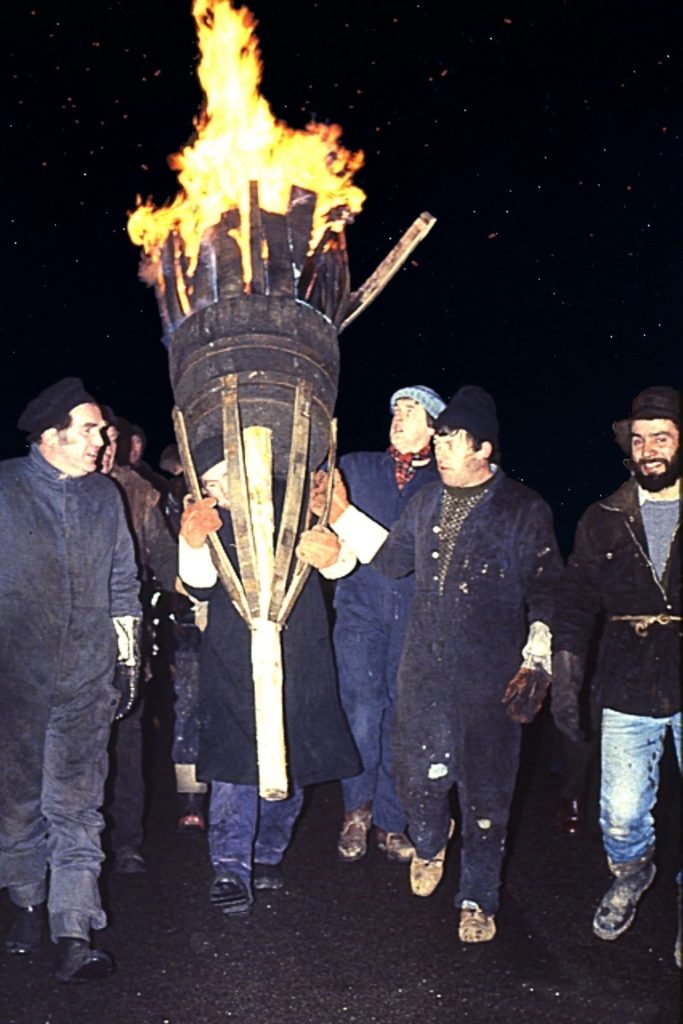
Preparations begin in December with the building of a 43-centimetre wooden barrel, supported by a frame of 6 staves arranged so that it can be carried. This task is entrusted to the members of a special group, the Clavie Crew, which by tradition is made up of Burghead residents who have someone in their family who once held the same role. It is, in other words, a “hereditary position” that embodies the continuity of the old customs even more strongly.
On the evening before the festival, the preparations end with a true ritual to fix the pole set at the base of the barrel: in a kind of handover, the oldest member of the group drives in the first nail, while the last one falls to someone who may one day join the Clavie Crew (usually a child).
The night of 11 January in Burghead
On 11 January, in the rest of Scotland, Hogmanay is just a faint memory… in Burghead, however, people are finally getting ready to celebrate New Year.
Let’s imagine we meet in Granary Street at 6 pm; among the crowd that has already gathered, we pick a spot with a good view of the lighting of the Clavie, which is filled with tar and pieces of wood. It is a solemn moment: the Clavie King approaches with a burning peat and flames burst from the barrel, timidly at first, then more and more fiercely. Straight afterwards, surrounded by the Clavie Crew, he puts his head inside the 6 staves and rests the frame on his shoulders.
The crowd of locals and visitors erupts in a roar of encouragement and the procession sets off along a fixed clockwise route through the streets of the old town. The blazing Clavie sways as the crackle of the fire blends with the chatter of the people.
The streets are gradually lit up by the glow of what now looks like a huge torch, carried in turns by the 15 men of the Clavie Crew. This task is considered a great honour, a sort of initiation; bearing the weight of the Clavie on one’s shoulders symbolises a unique heritage that, however hard it may be, is kept alive… just like a flame! At that moment the bearer is not alone: he is accompanied by all the ancestors who stood in that same place before him.
The smell of burning wood and tar fills the air; the excitement is palpable yet somehow restrained, as if respect for what is happening outweighed everything else. A trail of smoke, sparks and joyful people following the Clavie snakes its way through the streets of Burghead. On the last stretch it squeezes down a narrow lane before climbing to the top of the Doorie Hill, on the ramparts of the ancient Pictish fort: the pole holding the barrel is slotted into the hole in the middle of a stone altar, and buckets of fuel are added again and again to feed the flames. Even standing at a safe distance, we feel the heat of the fire on our faces, in sharp contrast with the cold wind rising from the sea, which makes the tongues of flame sway. The feelings that wash over us are indescribable: there is something primeval, something wild about them!
After about an hour the Clavie collapses to a roar of approval from the crowd, and the glowing embers are scattered all over the hill before being quickly gathered by onlookers with gloves and rags, as good-luck charms for the year ahead. Many families use the embers of the Clavie to light the first fire of the year in their own cottage. It seems that in the past the ashes were kept by the Brochers (as Burghead people are called) as charms against witchcraft!
The ancient fire festivals of Scotland
Burning the Clavie is one of the many fire festivals that have been celebrated in Scotland for centuries: in the past, ritual fires were linked to the seasonal cycles, marking moments of transition tied to the changes in nature and following the Celtic calendar. Fire was seen as a symbol of purification and was associated with the light that drives away evil spirits and brings wellbeing and health.
It is no coincidence that the climax of Burning the Clavie takes place right on the summit of the Doorie Hill: a site where the druids lit propitiatory fires and celebrated their rites.
Why Burghead celebrates New Year on 11 January
Now, though, let’s look more closely at the meaning of this festival, so dear to the Brochers – even those who no longer live in Burghead – that some have pieces of embers posted to them around the world to bring luck in the new year!
So let’s go back to the Doorie Hill, this mystical place still inhabited by ancient spirits that for centuries have been called upon to attend the celebrations. Even though it is 11 January, what we are experiencing on this cold winter night is a crucial moment marking the passage from the old year to the new. As mentioned at the start, 1750 brought an extraordinary change to the habits of the people living in Great Britain and throughout the British Empire: the Calendar Act was passed, adopting the Gregorian calendar in place of the Julian one (considered inaccurate) and therefore removing no fewer than 11 days, starting in 1752. As a result, New Year’s Day under the old calendar fell on 11 January under the new one.
As you might expect, this decision caused widespread discontent, which showed itself in many protests across the English-speaking world. In Burghead, unable to obtain what they loudly demanded but flatly refusing to give up their traditions, people decided to carry on celebrating New Year on the dates set by the Julian calendar. And so turning to fire at this particular moment takes on an even deeper meaning: the flames symbolically burn away the bad things of the past year before welcoming the new one, bringing light and warmth to the long winter nights.
A community united around the fire
The whole community of Burghead takes an active part in Burning the Clavie, marching together through the streets of the town and then gathering around the Doorie Hill, with the aim of driving evil spirits out of the village and purifying the land ahead of New Year. Through this rite, unchanged for centuries, the people of Burghead proudly show their identity, not only on this single night, but forever!
Silvia Miraglia