
On our journey through the Scottish lochs, today we come ashore on one of the most famous lakes in the world: Loch Ness. We stop for an imaginary visit not only to talk about what made it famous to most people, but also, and above all, to discover lesser-known sides of its story.
An abyss of dark water
Loch Ness lies in one of Scotland’s most spectacular fractures, the Great Glen. This is a fault, formed during the Caledonian orogeny, that cuts diagonally across the Highlands for about 100 kilometres from Inverness to Fort William. Glaciers scoured its floor to a depth of about 230 metres, over a length of almost 37 kilometres and a width that rarely exceeds two and a half kilometres. The result is a narrow, extremely deep basin that holds more fresh water than all the lakes of England and Wales put together.
The water is dark because of the peat carried by the streams that run down from the hills; just a few metres below the surface the light almost completely disappears. At depth the temperature stays around 5–6 degrees all year round, and the loch is so vast that it does not freeze even in the harshest winters.
Nessie: the story of a legend
Saint Columba and the river beast
The first appearance of the ‘monster’ at the heart of so many tales and in-depth scientific studies dates back to the 6th century. The Vita Columbae, written by Abbot Adomnán of Iona about a century after the Irish saint’s death, tells how Saint Columba, arriving on the banks of the River Ness in 565, rescued a man attacked by a monstrous beast that rose from the water. Columba made the sign of the cross and ordered the creature to return to the depths; at that, the monster fled in terror.
For many scholars this is just a symbolic tale, yet ever since, the waters of Loch Ness have never stopped having a ‘guardian’.
1933: a new road and a modern myth
The monstrous creature we know today was really born in 1933, the year the road along the north shore, today’s A82, was completed. For the first time thousands of motorists could drive along the loch and admire it at close quarters. In the spring of that year a local couple reported seeing “an enormous animal” appear on the surface; the Inverness Courier immediately published an article speaking of a “monster”. Within a few months the news had travelled around the world!
The Surgeon’s Photograph and modern research
In 1934 the image still automatically linked to the ‘loch monster’ was released: a black-and-white photograph showing the dark silhouette of a long, slender neck rising from the water. The photo, attributed to a respected London doctor, became for sixty years the “proof” par excellence of a prehistoric creature living in the depths of the loch. Only in 1994 was the trick revealed: it was apparently a model mounted on a toy submarine.
Despite everything, scientific research never seems to have given up on the creature who went down in history as ‘Nessie’. In 1987 Operation Deepscan swept the loch with a fleet of boats equipped with sonar. In 2018 a team of researchers analysed the environmental DNA in the water: no trace of prehistoric reptiles, but a surprising amount of eel DNA, which gave rise to the hypothesis of exceptionally large eels. And in the summer of 2023, hundreds of volunteers took part in the biggest hunt for Nessie in fifty years, using the most advanced technology available.
What to see on the north shore of Loch Ness
Inverness: the gateway to Loch Ness
Known as the capital of the Highlands, Inverness is the most northerly city in the United Kingdom. The River Ness cuts through the town centre and flows picturesquely under the Victorian footbridges that link the two banks and the charming river islands. On a hilltop stands the castle, a 19th-century red sandstone building that has housed a courthouse and a prison over the years. At the entrance, welcoming visitors, is the statue of Flora MacDonald, the woman who helped Bonnie Prince Charlie escape after Culloden.
Urquhart Castle, sentinel of the loch
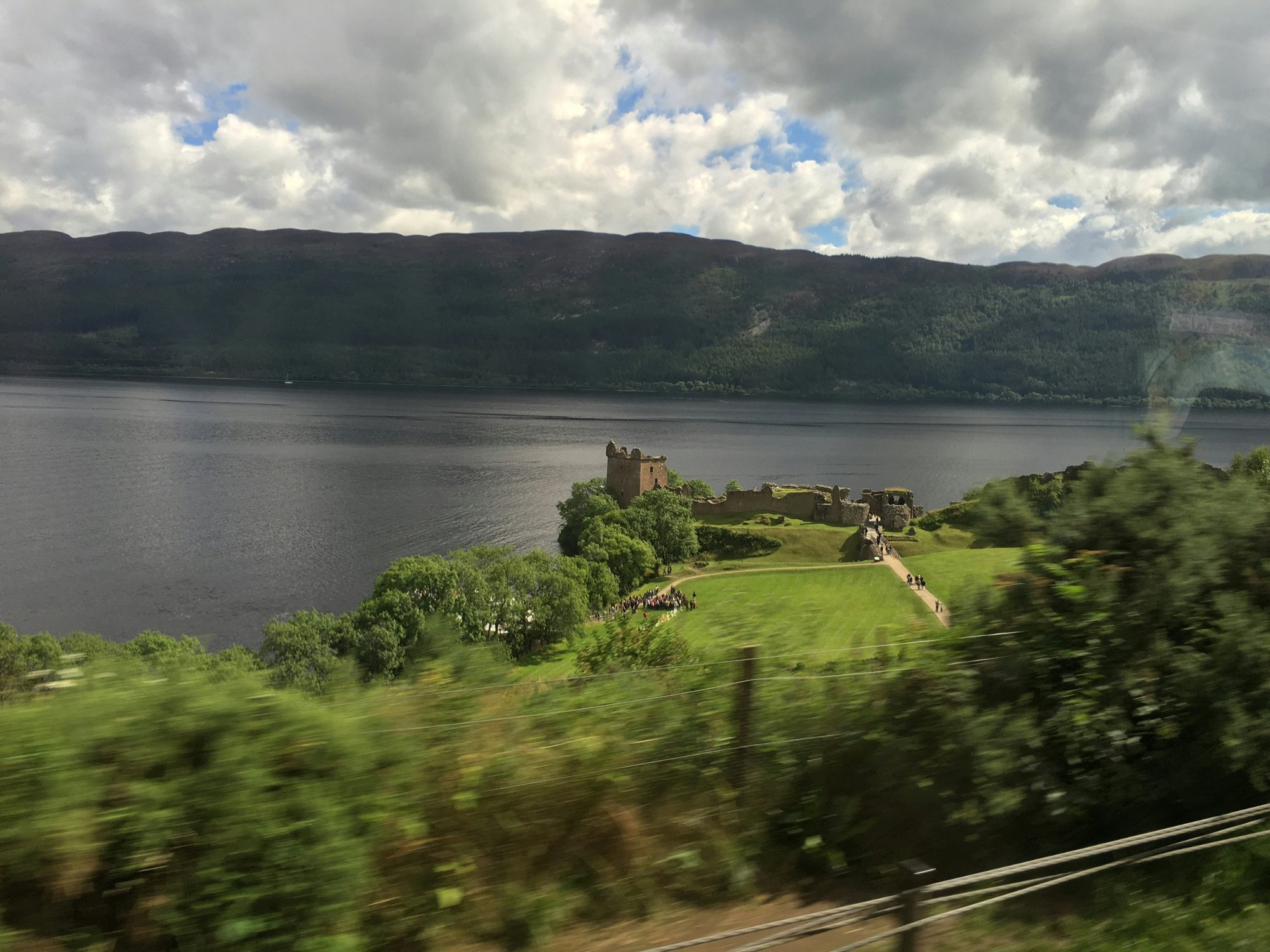
Besides the image of Nessie, there is another that immediately brings this legendary loch to mind: Urquhart Castle. Its ruins occupy a rocky headland halfway along the north shore, a strategic position fought over for centuries by Scottish kings, English invaders and rival clans. The castle changed hands several times during the Wars of Independence and was finally blown up by government troops in 1692 to stop it becoming a Jacobite stronghold.
Today you enter through a visitor centre built into the hillside, then walk down to the ruins and the Grant Tower, the best-preserved tower: climbing its stairs reveals the finest view over the whole loch. The castle is now managed by Historic Environment Scotland. Bear in mind that in summer tickets often sell out, so it is worth booking online in advance, together with parking, of course. Arriving at opening time or in the last hours of the day lets you avoid the largest groups.
Drumnadrochit, Nessie’s village
A few minutes from the castle, Drumnadrochit is the village that, more than any other, lives off the fame of the ‘monster’. Here you will find the Loch Ness Centre, which traces the geological history of the loch and the legend of Nessie through documents and photos. Many loch cruises leave from here; some boats are fitted with echo sounders to ‘scan’ the depths!
Invermoriston and Telford’s bridge
Continuing south along the A82, you come to Invermoriston. Near the village, the River Moriston tumbles down a series of foaming rapids beneath an old stone bridge built in 1813 by Thomas Telford, the same engineer who built the Caledonian Canal. It is one of the many places in Scotland where you decide to stop “just for five minutes” to take a few photos and then, in fact, stay much, much longer!
Fort Augustus and the Caledonian Canal
At the southern end of the loch lies Fort Augustus; its main attraction is the ‘staircase’ of five locks on the Caledonian Canal, the 19th-century waterway that links Scotland’s east and west coasts through the lochs of the Great Glen.
The village takes its name from the fort built after the Jacobite rising of 1715 and named after Prince William Augustus, Duke of Cumberland, the victor of Culloden. A Benedictine abbey later rose on the site of the fort, home to monks for over a century and now converted into private homes.
Cherry Island, the loch’s only island
At the southernmost point, not far from Fort Augustus, lies Cherry Island: the only island in Loch Ness. It is actually an ancient crannog, a dwelling built on an artificial islet made by people thousands of years ago (most probably in the Iron Age) from stones and logs. In the 15th century a fortified house was built there, though its remains are no longer visible.
The south shore: the secret face of Loch Ness
Anyone who really wants to get to know the loch cannot stop at the best-known places. You must explore the south shore, knowing, however, that ‘comforts’ give way to a more authentic setting, served by narrow roads, largely single-track, partly following General Wade’s old military road, built in the 18th century to control the Highlands. Here the traffic thins out, the coaches disappear and the loch becomes a place of silence once more.
The Falls of Foyers
The jewel of the south shore is the Falls of Foyers: a waterfall about 50 metres high that plunges into a wooded gorge. In 1787 the famous Scottish poet Robert Burns was so struck by it that he wrote a poem on the spot: Lines on the Fall of Fyers, near Loch Ness, also known as Written with a Pencil on the Spot. The verses conjure up a wild landscape dominated by the tumultuous roar of the falls, water crashing on the rocks and mist wrapping the gorge. A short but fairly steep path leads down from the village to the viewpoints.
Boleskine House and Inverfarigaig
A little further north stands Boleskine House, an 18th-century house that was home to the occultist Aleister Crowley and, later, to Jimmy Page of Led Zeppelin. Badly damaged by two fires, it underwent a long restoration completed in July 2025. It has become a centre for art, culture and education and is open to the public, including through guided tours. Nearby, the Inverfarigaig pass climbs between rock walls and woods up to viewpoints from which the loch appears in all its length.
Dores, the sunset beach
At the northern end of the south shore, Dores has a long pebble beach from which you can look down the whole length of the loch to the south-west. It could be the perfect place to end your exploration of Loch Ness, taking a last look at its waters, so rich in mystery and history.
Visiting Loch Ness with children
Loch Ness is a family-friendly destination. A boat cruise, perhaps with a sonar screen showing the depths of the loch and the odd suspicious “shadow”; the beach at Dores, where you can skim flat stones across the water and play chase; Urquhart Castle, which with its towers, dungeons and reconstructed trebuchet seems to have stepped out of an adventure book. Along the paths of the south shore, a small notebook for recording sightings (real or imagined) could turn a walk into an adventure for true explorers! More ideas for little ones await you in our Kids Corner.
Walking around the loch
For hiking lovers, visiting Loch Ness on foot is a completely different experience. The Loch Ness 360° is a loop of about 125 kilometres that goes all the way round the loch in six stages, joining two routes: the Great Glen Way, which follows the north shore, and the South Loch Ness Trail, about 58 kilometres long, which crosses hills, woods and villages on the south shore. If you have less time, you can choose short sections: the walk to the Falls of Foyers, for example, takes an hour and a half there and back.
Practical tips for visiting Loch Ness
When to go
May and June offer very long days and fewer crowds. July and August are the busiest months, so the castle and cruises need booking well in advance. September and October bring morning mists, golden woods and waterfalls in full spate: perhaps the most evocative time to visit Loch Ness. In winter the loch is silent and melancholy, but the days are short and many services cut their hours.
Getting there and getting around
The natural starting point is Inverness, linked by train to Edinburgh and Glasgow and served by a small airport. From here the A82 follows the north shore: Urquhart Castle is about half an hour away, Fort Augustus an hour. There are also local buses linking Inverness with the villages on the north shore, but to explore the south shore a car remains the best and almost essential option. Remember that on single-track roads you get by thanks to passing places: pull in to let oncoming traffic pass, always with a wave!
Loch cruises
Seeing Loch Ness from the water completely changes your perspective. Cruises leave mainly from Inverness, Drumnadrochit, the Urquhart Castle jetty and Fort Augustus, lasting from an hour to half a day. Some combine sailing with a visit to the castle.
The loch that keeps watching you
People often come to Loch Ness looking for a legendary monster that has filled the imagination of so many since childhood. They often leave with a memory that will hardly fade: a ruined tower against a sky that suddenly changes colour, the sound of a waterfall hidden in the woods, the silence of a pebble beach at sunset. Perhaps Nessie doesn’t exist. Or perhaps it is simply the name we give to the feeling of being watched by something very ancient that still hovers over the dark water.
Silvia Miraglia