
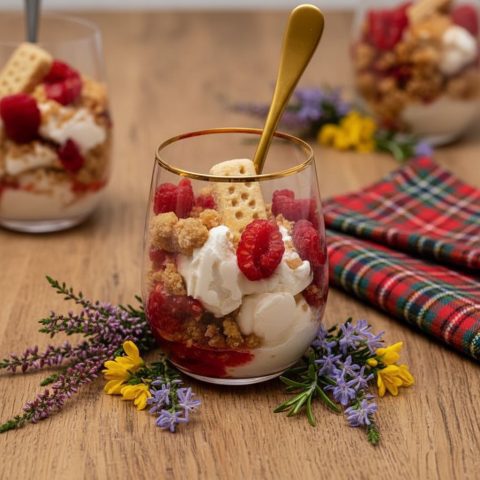
Soft whipped cream, juicy raspberries, golden honey, crunchy oats and a touch of whisky: these five ingredients are all you need to capture the whole soul of Scotland in a glass. Cranachan, considered by many the most famous and representative of Scottish desserts, is the undisputed star of festivities and important dinners.
In this article we will discover together its origins, the meaning of its name and the traditions that go with it and, of course, we will go step by step through the traditional cranachan recipe, with all the tips for a perfect result.
What is cranachan
Cranachan is a spoon dessert made of layers of whipped cream enriched with honey and whisky, fresh raspberries and toasted oats. It is traditionally served in tall glasses or glass bowls to show off its colourful layers: the white of the cream, the deep red of the fruit and the gold of the oats.
Its charm lies in the balance of contrasts: the creaminess of the cream meets the crunch of the oats, the sweetness of the honey marries the tartness of the raspberries and the whisky adds an unmistakable warmth. A simple dessert, yet one that tells the story of the Scottish land in every spoonful.
Its origins
A harvest celebration
Cranachan began as a dish to celebrate the harvest. It was made in summer, when raspberries were ripe and plentiful, to mark the end of work in the fields. Scotland is still raspberry country today: the cool climate and long summer days produce particularly fragrant fruit.
Originally cranachan was not a dessert but a breakfast. It was made with crowdie, a slightly sour Scottish fresh cheese made from skimmed milk, typical of the Hebrides. The crowdie was mixed with lightly toasted oats, cream and local honey; raspberries were added only when in season. That is why in some parts of Scotland the dessert is still known as cream crowdie. Over time the cheese gave way to cream alone and, above all, whisky arrived. In this way cranachan was transformed from a rural breakfast into the elegant dessert we know today.
The meaning of the name
The name cranachan (pronounced krænəxən) comes from the Scottish Gaelic crannachan, a wooden vessel used on Highland farms to turn cream into butter or cheese. It is a reference that captures the farming roots of this dessert, born of the ingredients every family had to hand: milk, oats, honey and berries.
The same word also refers to the action of vigorously shaking, churning or whipping fresh cream with the other ingredients needed for the dessert. That is why, over time, it ended up taking the name of the tool used to make it.
Cranachan in Scottish traditions
The Burns Night dessert
Today cranachan is enjoyed all year round, but it remains the dessert for special occasions. It is one of the best-loved desserts of Burns Night, the 25 January supper dedicated to the poet Robert Burns, where it rounds off the menu after the haggis with its inevitable neeps and tatties. It often appears on the table at Hogmanay, the Scottish New Year, and on wedding menus too.
Everyone makes their own
The custom has partly been lost today, but the purest tradition has the ingredients brought to the table in separate bowls, so that each guest can measure out and assemble their own glass to taste; a simple, fun way to share dessert, perfect for dinners with friends.
The key ingredients
The strength of cranachan lies in its apparent simplicity, built on five fundamental pillars of Scottish food:
- Raspberries: Choose firm, fragrant, deeply coloured ones. Wash them only at the last moment, gently, and dry them on kitchen paper, as they absorb water easily. Out of season frozen ones are fine, but use them only for the crushed layer at the bottom and keep fresh fruit for decoration.
- Oats: Scots use medium or coarse oatmeal: oat grains cut into small pieces, not rolled. The nearest widely available equivalent is rolled oats; what matters is that they are jumbo oats, so that after toasting they stay crunchier than small or instant ones. The option closest to the original is steel-cut oats, usually sold in health food shops. It is important to toast them slowly in the pan until the oats release an intense aroma reminiscent of roasted hazelnuts.
- Cream (or cheese): In Scotland, modern recipes use double cream, which is very rich (about 48% fat). Where double cream is not available, it is often replaced by a mix of fresh whipping cream (from the chiller cabinet: it is best to avoid UHT and plant-based cream, which whip less well and have less flavour) and cream cheese or mascarpone, for a fuller cream closer to the original.
- Heather honey: The most traditional is heather honey, from the plant of the Scottish moors. It has an intense, slightly bitter flavour and a jelly-like texture, so it should be stirred before use. The good news is that heather honey is also produced in many other European countries. Alternatively, a delicate wildflower honey or, if you like strong flavours, chestnut honey will do. Best avoid acacia honey, which is too neutral.
- Whisky: You need a dash of Speyside or Highland Scotch single malt; peated, smoky whiskies such as those from Islay are not recommended, as they would overpower everything else.
The cranachan recipe, step by step
Now that you know the story, it’s time to get to work! The cranachan recipe needs no cooking, apart from quickly toasting the oats, and is ready in less than half an hour. Here is how to make four perfect glasses, creamy, crunchy and fragrant.
Ingredients for 4 people
- 300 ml fresh whipping cream
- 300 g fresh raspberries
- 50 g rolled oats (jumbo if possible)
- 3 tablespoons honey, ideally heather honey, plus a drizzle to decorate
- 2–3 tablespoons Scotch whisky
- 1 tablespoon brown sugar (optional, for the oats)
Toasting the oats
- Heat a non-stick frying pan over a medium heat and add the oats, without any fat.
- Toast them for 3–5 minutes, stirring often, until golden and giving off a nutty aroma. If you like, add the brown sugar in the last moments to caramelise them slightly.
- Tip them straight onto a plate and leave to cool completely. Keep an eye on them: oats go from golden to burnt in an instant!
Making the cream
- Set aside a few whole raspberries for decoration. Lightly crush about a third of the raspberries with a fork to make a kind of compote.
- Whip the well-chilled cream until soft but not too stiff.
- Gently fold in the honey and whisky in a thin stream, then add two thirds of the toasted oats.
Assembling the glasses
- Spoon some crushed raspberries into the bottom of four tall glasses.
- Continue with a layer of whisky cream, then one of whole raspberries and more cream.
- Finish with the remaining oats, the raspberries set aside and a drizzle of honey.
Tips for a perfect cranachan
Here are a few little secrets for making the most of the cranachan recipe, even far from Scotland.
- The whisky-soaked oats trick: for a more intense flavour, some traditional recipes leave the toasted oats to soak overnight in a little whisky before adding them to the cream.
- Choose a smooth whisky: a gentle single malt or a blend with notes of honey and vanilla enhances the dessert without overpowering it. Avoid heavily peated whiskies.
- Well-chilled cream: whip it straight from the fridge, in a cold bowl; it will whip faster and stay more stable.
- Don’t make it too far ahead: in contact with the cream the oats lose their crunch. If you need to plan ahead, prepare the components separately and assemble the glasses at the last moment.
- Out of season: you can use frozen raspberries, well thawed and drained of their juice.
Variations and pairings
Alcohol-free cranachan
If you want a child-friendly version, replace the whisky with a few drops of vanilla extract or a tablespoon of orange juice. The result will be more delicate, but still delicious.
Modern versions
For a lighter cranachan, you can mix the cream with Greek yoghurt or, to recapture the flavour of the old recipe, with a creamy fresh cheese in place of crowdie. Blackberries or blueberries can replace the raspberries, while more creative versions add crumbled shortbread, orange zest or chocolate and hazelnuts.
What to drink
The most natural pairing is a dram of the same whisky used in the cream, or a Scottish honey liqueur. If you are planning a themed dinner, cranachan is the ideal finale after a Scotch Pie or a dish of traditional Scottish cuisine.
A dessert that tastes of Scotland
Cranachan captures the essence of Scotland: the short, bright summers that ripen the raspberries, the oats of the fields, the honey of the moors and the whisky of the distilleries. Now you too know the cranachan recipe: make it for the next Burns Night, for a special dinner or simply to treat yourself to a moment of Scottish sweetness. For more stories and flavours of Scotland, keep exploring our blog.
And, as always, enjoy your meal!
Silvia Miraglia