
In the heart of the Scottish winter, when the sun stays low on the horizon and the days shorten quickly, there is a tradition that in this country is far more than a simple Christmas decoration: it is a rite rooted in a distant past of Christian spirituality and, above all, in a Celtic heritage that still lives quietly in the folds of time.
Lighting the Advent wreath has a very deep meaning that is worth rediscovering to understand Scotland even better. Its light invites reflection, the warmth of home and the beauty of small things.
And, week after week, it tells the story of how Scots prepare for Christmas.
The Christmas “ban”
Scotland is a land where folklore, religion and the cycles of nature are deeply intertwined.
Although the Advent wreath is not a fully Scottish tradition, as Hogmanay is, its relatively recent adoption is a symbol of the rebirth of Christmas in Scotland.
After the Protestant Reformation of 1560, the (Presbyterian) Church of Scotland and Parliament strongly discouraged Christmas celebrations, and for a time even banned them, as they were considered too Catholic and tied to customs deemed “inappropriate”.
For centuries, then, Christmas was effectively pushed into the shadows and, as a result, Hogmanay (New Year’s Eve) became the main festival throughout Scotland. That is why many traditions that in other countries take place at Christmas moved to Hogmanay, to avoid punishments and bans.
Over the centuries Christmas gradually came back, but it was only in 1958 that 25 December was recognised as a public holiday in Scotland too. The Advent wreath only entered Scottish homes and churches in the 20th century, although, as mentioned, its features differ in part from the wreaths we know.
Ancient origins: the Celtic roots of the Advent wreath
In many Scottish homes, the Advent season is announced by simple objects with a powerful meaning: candles, evergreen branches, the scent of resin, holly… The Advent wreath as we know it is the result of a long journey through Celtic rites, Viking influences, rural Highland traditions and Christian symbols. Long before Christianity spread, the Celts lit fires and wove evergreen branches – above all holly, fir and heather – to celebrate Samhain, the passage into the dark season.
Nothing was left to chance; everything had a strong symbolic value and strengthened the bond with the spirit world and with Nature. Evergreens were woven into circles and hung on doors to protect the home from negative entities during Samhain and Yule. The circle, which returns in the shape of today’s Advent wreaths, stood for cyclicity, the absence of a true “beginning” and “end”.
The materials of the Scottish wreath and their meanings
Many elements of the Scottish Advent wreath come from this very custom:
- Scots Pine. It is Scotland’s emblematic tree. Its strong, fragrant wood evokes strength and rebirth;
- Ivy. With its ability to climb almost anywhere, it stands for tenacity and, at the same time, the ability to adapt to anything;
- Holly. Found in many Scottish legends, its prickles were seen as a barrier against evil spirits;
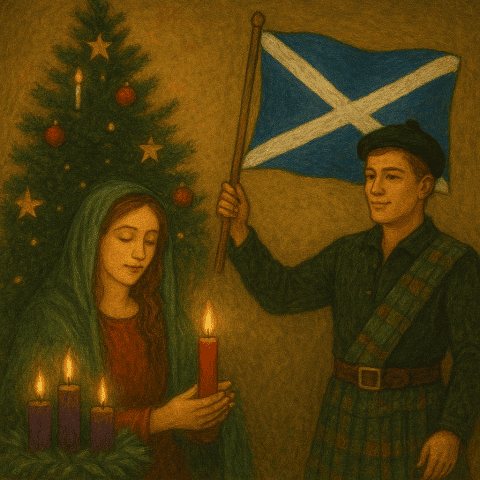
- Candles. Traditionally four, one for each Sunday of Advent, placed at the four points of the compass. In Scotland they are often red, the colour traditionally linked to the winter festivities. They symbolise the return of the Sun’s light. Sometimes a fifth candle is added in the centre and lit on Christmas Day.
Other materials closely tied to the land and the traditions of the Highlands are often woven in too:
- Heather. Instead of fir alone, there may be sprigs of heather, a Scottish symbol of good luck;
- Tartan and fabrics. It is not unusual for the wreath to be decorated with ribbons or bows in the family clan’s tartan, giving it a deeply Scottish touch and bringing together faith, identity and family traditions. To find out more, visit the section devoted to myths and legends.
The Scottish Advent wreath is not just a decoration: it is a bridge between the present and a past of forests, sacred fires, legends and ancestors. It is a celebration of nature and light, a form of gratitude and continuity.
Making one means bringing into your home a fragment of the Highlands’ winter landscape: wild, ancient and full of legends.
It is a way to slow down, light a light in the northern darkness and prepare for Christmas in a spirit of waiting, with the intention of reconnecting with your roots.
Whether in a little church in Orkney, on the table of a Highland cottage or in a home in the capital, the Scottish Advent wreath keeps lighting up December with its timeless simplicity.
Silvia Miraglia