
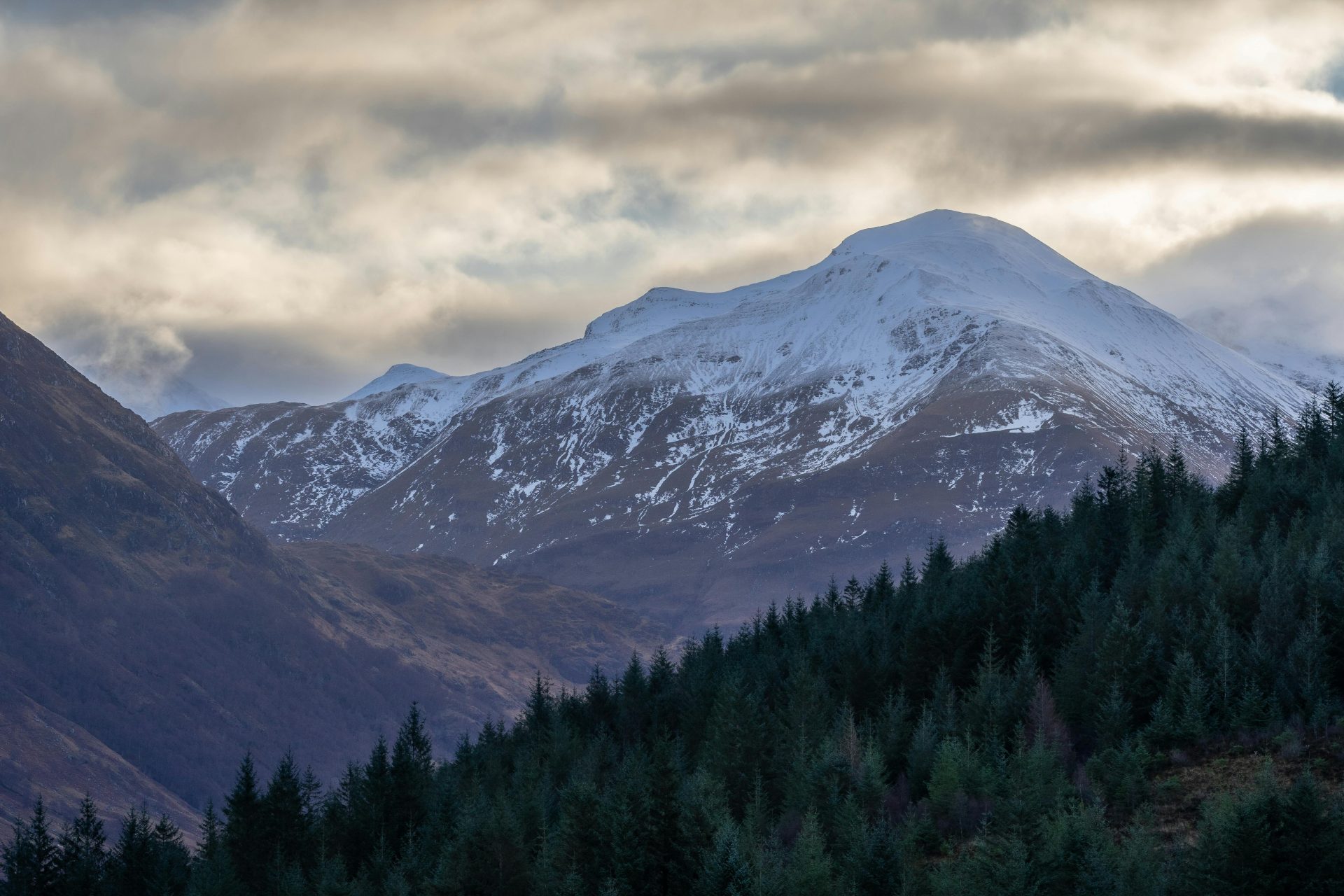
The legacy of an ancient volcano
In a remote age, the landscape around Scotland’s best-known mountain was ruled by fire and earthquakes caused by violent eruptions. Ben Nevis was a huge volcano of exceptional energy: rivers of lava kept covering the surrounding land, forming a thick layer of dark grey igneous rock called ‘andesite’, after the Andes mountain range in South America, where it is quite common.
Suddenly the volcanic activity stopped and for a long time everything grew quiet. Apparently… In fact, deep inside the Earth, an even more viscous magma was forming, cooling far more slowly and producing a granitic rock whose thrusts beneath the crust began to cause a series of parallel vertical cracks. The new magma found its way into these cracks and, once solidified, created distinctive streaks that geologists call ‘dykes’ or ‘veins’, referring precisely to the intrusive material that filled them.
On top of this already precarious situation, another great mass of molten rock that had formed in the meantime, driven by the pressure building up in the magma chamber, managed to lift the overlying dome with extraordinary force, so that it began to crack. Then, when the pressure dropped and the magma sank slightly, a huge cylindrical block broke away from the now unsupported roof. At the same time, a great quantity of lava and ash poured out of the fissures that had opened up, and an enormous crater, called a ‘caldera’, formed at the surface. The collapse of this side of the volcano in on itself caused an extremely violent explosion. The hollow visible today, surrounded by the Ben Nevis massif, as well as the paths that lead to the summit, cross what was once the inner dome of the volcano.
It is a unique experience to venture into this rugged, remote landscape and try to imagine what it must have been like hundreds of millions of years ago: an enormous crater holding a seething sea of lava which, as it solidified, gave rise to the ground beneath our feet. A setting, then, in stark contrast with today’s, cold and shaped by glacial erosion. It is thrilling to think that a ‘simple’ walk can bring us into contact with a precious treasure of volcanic and granitic rocks, some dating back to the Devonian, about 400 million years ago!
Ben Nevis, however, is not only the witness of an ancient and stormy past: at 1,345 metres it is also the highest peak in the United Kingdom and in all the British Isles! That is why every year thousands of people (around 100,000!) venture onto its slopes trying to reach the stony summit plateau, which covers more than 400,000 square metres. The top of Ben Nevis is not a single sharp peak, but rather a vast plateau from which you can take in an extraordinary view of the surrounding Highlands.
Accounts of the origin of its name differ: it is thought to come from the Gaelic beinn Nibheis, whose literal meaning might be ‘venomous mountain’ or ‘evil mountain’, probably referring to its notoriously unpredictable weather and steep slopes. While ‘beinn’ is almost unanimously translated as ‘mountain’, ‘nibheis’ has various interpretations: one of these would link it to the name of the Celtic god Lugh, who in some areas was worshipped on high ground.
Another interpretation traces it to beinn néamh-bhathais, meaning ‘mountain with its head in the clouds’, which fits Ben Nevis perfectly: its summit is in fact almost always covered in cloud and mist.
If you don’t yet feel like setting off to explore this giant for yourself, here are some of the reasons that keep drawing walkers from all over the world!
- From 1883 to 1904 the summit was home to a Meteorological Observatory, built to study how depressions and storms formed in the atmosphere. The first plans were drawn by Thomas Stevenson, a lighthouse engineer but, above all, the father of Robert Louis Stevenson and inventor of the “Stevenson screen”, while the building itself was designed by the architect Sydney Mitchell. Today’s most popular route, the “Pony Track” or “Mountain Track”, was laid out in 1883 precisely so that ponies could carry the materials needed to build and run the observatory. In the first winter, the plateau was swept by blizzards that buried the summit under up to 4 metres of snow, forcing the meteorologists to dig tunnels again and again to get out of their spartan quarters. During its years of operation, the staff faced truly extreme conditions, more than once risking their lives to record the data needed for their research. The observatory closed for lack of funds and now lies in ruins on the summit of Ben Nevis. It has, however, become an emergency shelter for those who make it up here.
- The first Ben Nevis Race was held in 1895. William Swan, a Fort William barber, set a time of 2 hours 41 minutes to the summit and back. The current men’s record is 1 hour, 25 minutes and 34 seconds for a distance of 14 kilometres and a climb of 1,340 metres!
- For those who would rather take things a little more ‘calmly’, there is the Pony Track I mentioned earlier. It is a zigzag path that takes 6 to 9 hours to walk, so it is by no means a stroll! The route starts from the Glen Nevis Visitor Centre or from Achintee.
- A much longer and more demanding alternative is the Carn Mor Dearg Arête: 10 to 11 hours, for experienced walkers.
- A bizarre piece of trivia dates back to May 1911, when Henry Alexander, Scotland’s first Ford dealer, came up with an extraordinary publicity stunt: driving a Ford Model T to the summit of Ben Nevis! The aim, of course, was to prove the superiority of American cars over hand-built British ones. It took five days to reach the top in the car, which had wooden wheels and no suspension. At the wheel was the Edinburgh dealer’s son, Henry Alexander Jr, who accomplished the incredible feat between 9 and 13 May. The film, rediscovered in 2015, has been described as a “bone-shaking journey”!
- At the foot of Ben Nevis, in the town of Fort William, is the West Highland Museum (free entry), famous for its collection on Jacobite history. You can see medals, weapons and even Bonnie Prince Charlie’s embroidered silk waistcoat.
- About ten minutes’ drive from the museum you can visit the historic Ben Nevis Distillery: founded in 1825, it is one of the oldest in Scotland.
A few recommendations for those who decide to set out and discover this true paradise for walkers and climbers: the summit is covered in cloud and mist 70% of the time, and temperatures rarely rise above freezing, even in summer, because of the altitude, the winds and the proximity of the North Atlantic. So you need warm, waterproof clothing, good ankle support and, above all, a map and compass. Bear in mind, though, that expert guides run walks for every level on the slopes of this ancient volcano. Ben Nevis is considered an excellent training ground for climbers planning tougher ascents, such as in the Alps.
Ben Nevis is a history book carved in stone that generously offers, from its summit, a panoramic view of up to 190 kilometres, taking in Ben Lomond and even the top of Knocklayd in Northern Ireland!
Silvia Miraglia