On our journey through Scotland’s nature parks, we landed on the shores of Loch Morlich and among the reindeer of Glenmore. Today we return to the Cairngorms National Park to stay a little longer: we will follow an ancient pass through the mountains, brave the legend of the Big Grey Man, wait for the ospreys to return and, when night falls, look up at one of the starriest skies in Europe! Are you ready? Pack your rucksack, lace up your boots and let’s set off on our next adventure!
A plateau outside time
In the Cairngorms National Park nature keeps a solemn, wild grandeur. Going there is not just a ‘day out in the hills’; it is not a place to rush through. It is a land that asks for time and reveals itself slowly to those with the patience to listen.
Covering more than 4,500 square kilometres, it is the largest park in the whole of the United Kingdom. On this journey we will cross its borders together to discover its legendary peaks, its enchanted forests and the secrets hidden in its glens.
The Lairig Ghru, the drovers’ road
Among the park’s mountains opens a deep wound, a pass that cuts across the plateau from north to south: the Lairig Ghru. For centuries it was the drovers’ road, along which cattle were driven from Strathspey to Braemar and the markets of the south. Today it is one of the most famous and demanding walks in Scotland: some thirty kilometres through a landscape of rock, lochans and silence, to be tackled in one long day and only in good weather.
If you don’t feel up to the whole route, you can walk for a few hours from Coylumbridge, through Rothiemurchus Forest, to the mouth of the pass. This stretch is more than enough to understand why travellers of old feared and respected it.
Legends and mysteries of the Cairngorms National Park
Am Fear Liath Mòr, the Big Grey Man
At 1,309 metres, Ben Macdui is the second-highest mountain in the British Isles. And, they say, it is far from uninhabited. In 1925 Professor Norman Collie, a respected scientist and mountaineer, described something that had happened to him years before: coming down from the summit in the mist, he had heard footsteps following him. Seized by terror, he ran down the mountain without ever looking back.
Since then other hillwalkers have told of similar experiences: a gigantic shadow, an invisible presence, a sudden sense of dread. Gaelic speakers call him Am Fear Liath Mòr, the Big Grey Man. Sceptics speak of suggestion, of shadows cast on the mist, of fatigue. It is one of the most fascinating legends in all of Scotland.
An Lochan Uaine, the fairy loch
More reassuring, but no less magical, is An Lochan Uaine, the “green lochan”, hidden among the pines above Glenmore along the Ryvoan path. Its waters are such an intense emerald colour that they look unreal. Folk tradition says that fairies come here to wash their green clothes, giving the water its colour. It is a short, easy walk, perfect for children too, who can look for traces of the little people among the tree roots.
The park’s nature: encounters that stay with you
One of the most precious treasures of the Cairngorms National Park is what remains of the ancient Caledonian Forest. This unique ecosystem can truly be called Scotland’s green lung! The rare combination of upland moor, woodland, rivers and glacial landforms makes the park an ideal place for wildlife; indeed, it is home to a quarter of the UK’s threatened species.
Guardians of the forest and the moor
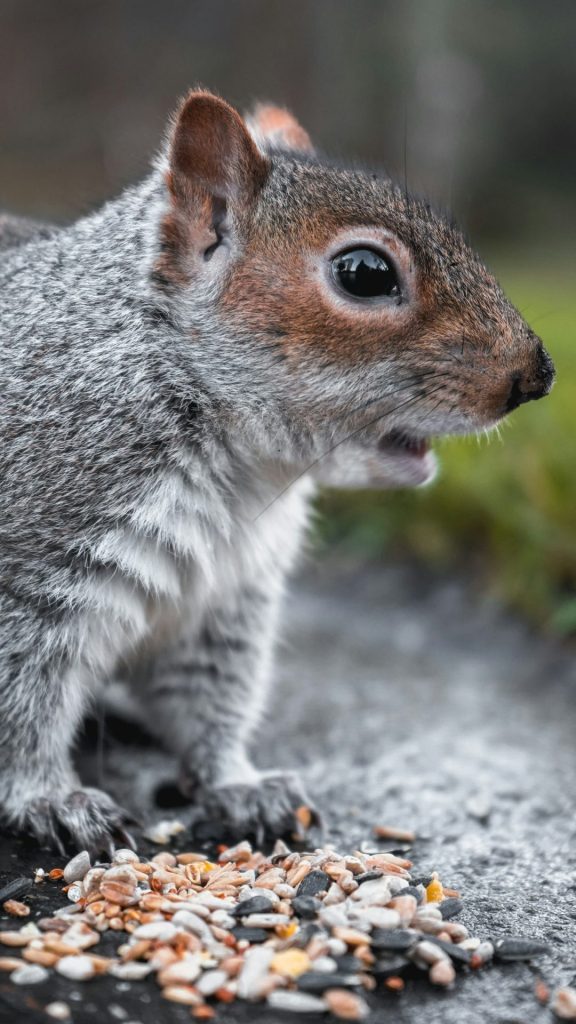
- Red squirrel: unlike other parts of Britain where the grey squirrel has taken over, the Cairngorms woods are a refuge for the red squirrel.
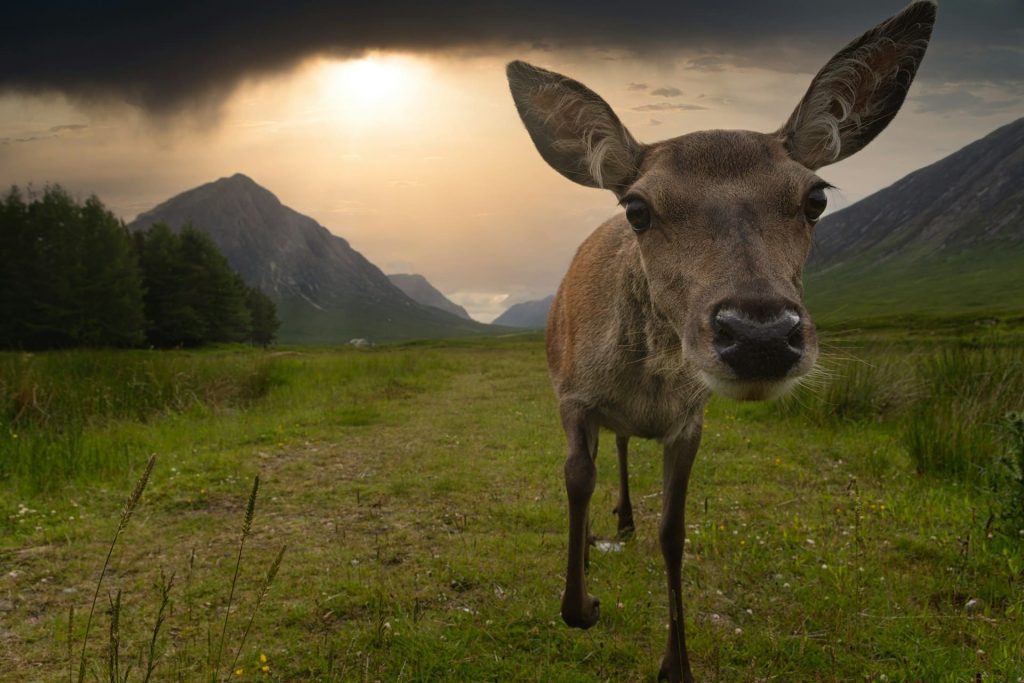
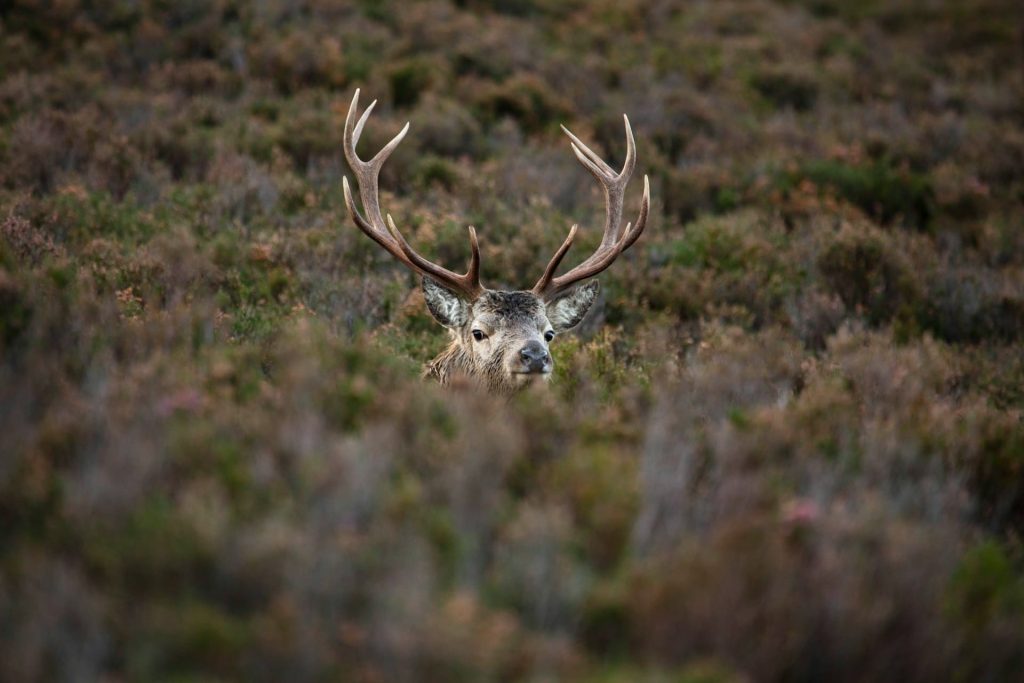
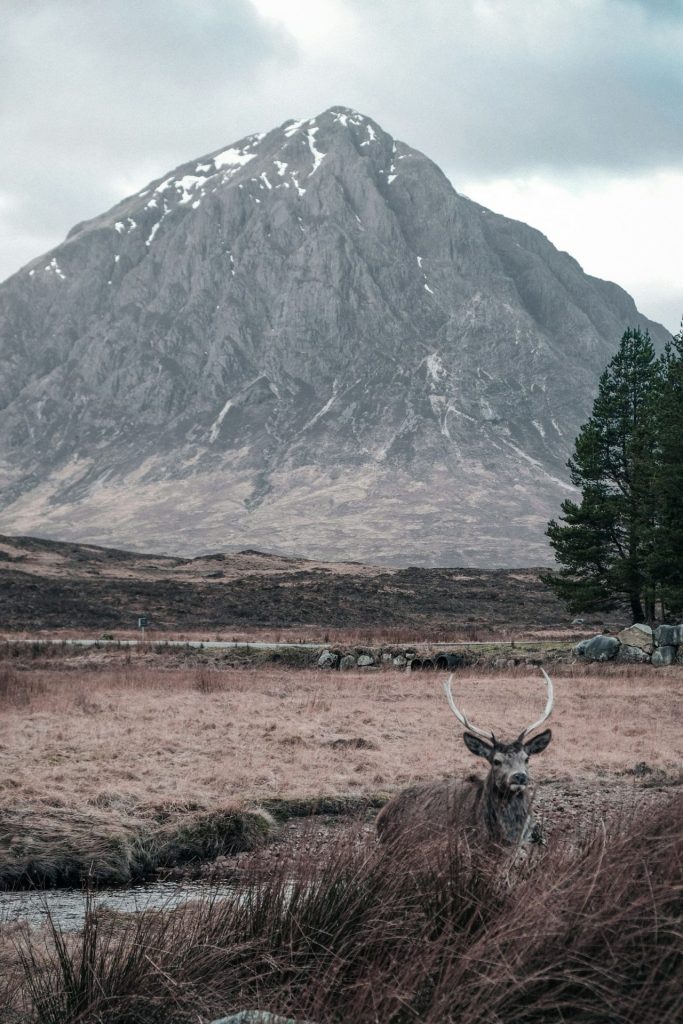
- Red deer and roe deer: the red deer is the undisputed king of the high moors and glens. In autumn, the rut offers one of the most striking natural spectacles in Scotland.
- Glenmore reindeer herd: the only free-ranging reindeer herd in the UK, reintroduced in the 1950s and now perfectly adapted to the arctic-alpine environment of the plateau.
- Pine marten and mountain hare: the pine marten lives in the dense pinewoods, while the mountain hare changes its coat from reddish-brown in summer to pure white in winter to blend into the snow of the plateau.
- Scottish wildcat: nicknamed the “Highland tiger”, it is one of the rarest and most threatened mammals in the world. Shy and solitary, it is almost impossible to see in the wild, but at the Highland Wildlife Park in Kincraig you can see it up close. This wildlife park, run by the Royal Zoological Society of Scotland, takes part in programmes to save the species from extinction. It differs from the ordinary domestic cat in its sturdy build and its thick tail with bold black rings.
Guardians of the skies: from eagles to capercaillie
- Golden eagle: at the top of the Highland food chain, the golden eagle soars over the peaks hunting grouse, hares and small mammals.
- Osprey and crested tit: by the early twentieth century the osprey had vanished from Scotland. Then, in 1954, a pair returned to nest among the pines of Loch Garten, in the Abernethy reserve. Every spring you can watch them back from West Africa building their nests. The crested tit lives in the crowns of the old pines.
- Capercaillie: an imposing and rare woodland bird. The Cairngorms are home to around 85% of the entire remaining UK population.
- Ptarmigan: a bird living in the highest, most rugged parts of the plateau. Like the mountain hare, it moults into snow-white plumage in winter.
- Scottish crossbill: with its crossed bill, specialised in prising open pine cones to get at the seeds, it is the only bird found nowhere in the world but Britain.
Where to see the park’s wildlife
- Rothiemurchus: ideal for spotting red squirrels, roe deer and pine martens.
- Glenmore Reindeer Centre: to get close to the reindeer herd and get to know it.
- RSPB Loch Garten: the top viewpoint for ospreys and woodland birds.
- Cairn Gorm plateau: for those wishing to see arctic-alpine wildlife such as ptarmigan, mountain hare and capercaillie.
Villages, castles and traditions of the Cairngorms National Park
Braemar and the Highland Games
On the eastern side of the park, Braemar is a village of grey stone surrounded by hills. Every year, on the first Saturday of September, it becomes the centre of the Braemar Gathering, the most famous Highland Games in Scotland. From the morning a series of sporting contests follow one another, such as tossing the caber (throwing a heavy log about 6 metres long), putting the stone and the Scottish hammer throw. During the day you can also watch the pipe bands march to the unmistakable sound of the bagpipes, and displays of traditional dancing. The British royal family, who spend the summer at nearby Balmoral, often attend.
Ruthven Barracks and the last act of the Jacobites
Near Kingussie, on a mound overlooking the Spey valley, stand the Ruthven Barracks. These barracks, now in ruins, were built by the government to control the Highlands after the first Jacobite rising. In 1746, after the defeat at Culloden, around 3,000 surviving soldiers of Bonnie Prince Charlie’s army gathered here, waiting to fight again. On 17 April the Prince ordered them to save themselves because the cause was lost. Before dispersing, the Jacobites set fire to the buildings so that the enemy army could not use them again.
Highland Folk Museum and the Carrbridge bridge
In Newtonmore you will find the Highland Folk Museum, the first open-air museum in Britain. It is a real journey into the past that is sure to move you! A whole 17th-century township (Baile Gean) has been painstakingly rebuilt, along with a 1930s farm and school and a small town complete with post office, craft workshops and shops. It is an unmissable opportunity to discover how Highland families lived in centuries past.
Further north, in Carrbridge, a slender stone bridge dating from 1717 has spanned the river for 300 years. It is the oldest stone bridge in the Highlands, and on days of spate it seems to defy the raging force of the water.
Glenlivet and the starry sky
In the Glenlivet valley a protected area has been created, the Cairngorms Dark Sky Park. The park’s sky has proved to be one of the darkest in Britain and in the world. Light pollution is so low that, on clear winter nights, the Milky Way is visible to the naked eye and conditions are ideal for watching the northern lights.
Experiencing the park: practical tips
Getting there and getting around
The easiest way to reach the Cairngorms National Park is by train: from Edinburgh or Glasgow the Highland line reaches Aviemore, Kingussie and Newtonmore in about three hours. From Aviemore buses run to Glenmore and the base of Cairn Gorm, but to explore Braemar, Tomintoul and the more remote villages a car remains the most convenient choice. Alternatively, a bike is perfect on the forest tracks of Rothiemurchus and Glenmore.
When to go
Spring and summer are the seasons of ospreys, flowers and long walks. Autumn brings heather in bloom, golden woods and the roaring of the stags. Winter turns the park into a Nordic landscape, with the ski slopes of Cairngorm Mountain and Glenshee, snowshoeing and starry nights. Whatever the season, remember that on the high ground the weather changes in minutes: layered clothing and caution are never too much.
Farewell among the red hills
A wild heritage to protect
Leaving the Cairngorms National Park means taking with you something you cannot photograph: sounds, scents, emotions… and the awareness of having been welcomed by a unique ecosystem.
Have you already chosen your next stop in ancient Alba?
Silvia Miraglia