Highland wildlife: where the mountains breathe
In the Highlands, silence has a voice. It is the rustle of a red squirrel running up a pine trunk, the gurgling call of a capercaillie at dawn, hidden in the heather; it is the wind rising from the lochs carrying the sharp smell of peat, while up on the ridges an eagle traces slow circles.
Highland wildlife lives in a world that seems to belong to another age. There are ancient pinewoods, survivors of the great forest that once covered Scotland. There are moors that turn purple in August, and plateaux that in winter resemble the Arctic. At the heart of the Highlands lies Cairngorms National Park, home to about a quarter of the UK’s rare and threatened species.
In these pages we will meet the animals of the Scottish mountains family by family: the large grazers, the woodland dwellers, the birds of prey, the moorland birds, the high-altitude creatures and those that live in the water. For each one, we will look at where and when to find it.
If you love Scotland at its wildest, our Wild Alba section is the right place to continue the journey.
The large grazers of the Highlands
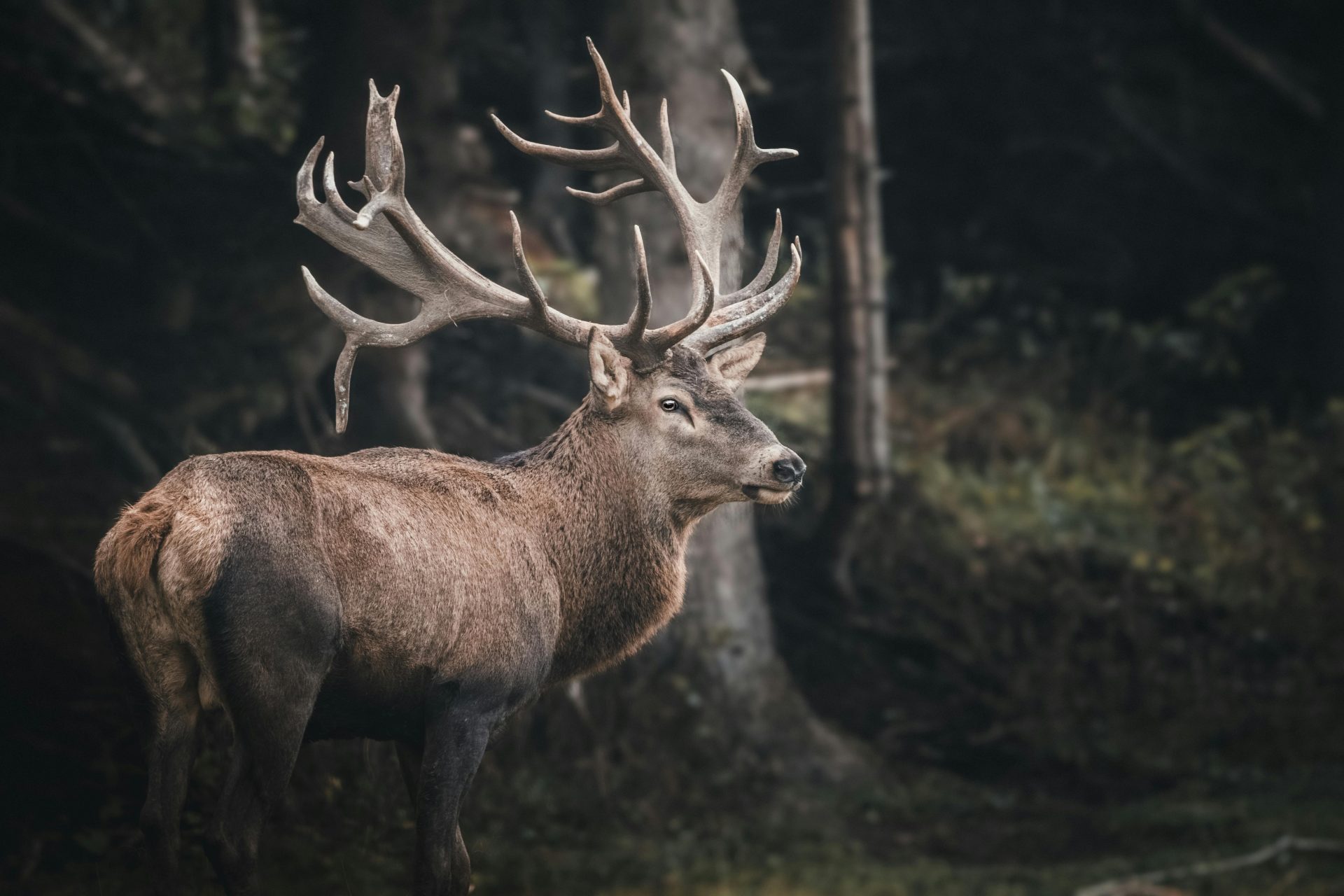
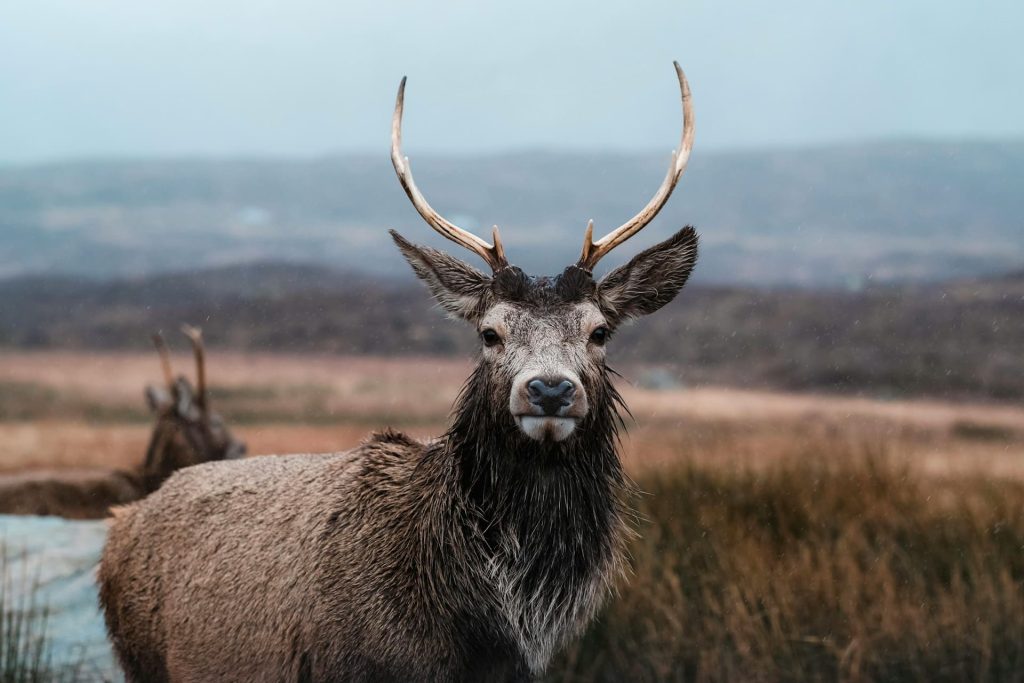
If one animal sums up the soul of the Highlands, it is the red deer. It is the UK’s largest land mammal and lives in herds that move with the seasons. In summer it climbs towards the ridges, in winter it comes down into the glens in search of shelter and food, and then you may meet it by mountain roads at dusk.
The most thrilling moment comes between late September and October, when their roaring echoes across the Highlands. The stags, their antlers now fully grown, give deep bellows that boom between the walls of the glens, the long, narrow Scottish valleys. Then they challenge each other, sometimes clashing antlers, to win a group of hinds. Witnessing this spectacle in Glen Feshie or Glen Affric, in the morning mist, is something you never forget.
On the edges of the woods lives the roe deer, smaller and more elegant, with a dark muzzle and a pale patch on its rump. It is more solitary than the red deer and is mostly seen at dawn and dusk, grazing in meadows, perhaps along the River Spey or in the clearings of Rothiemurchus.
And then there are the most surprising residents of all: reindeer. Yes, there are reindeer in Scotland! A small herd was brought here in 1952 and today it is the only free-ranging herd in the UK, on the hills above Glenmore. Every day a guided walk sets off from the Cairngorm Reindeer Centre to the grazing grounds. The reindeer are calm and used to people, and for children feeding them by hand is a precious, thrilling memory. You will find more ideas for travelling with little ones in our Kids Corner.
Pinewood dwellers: squirrels, pine martens and wildcats
Entering a Caledonian pinewood is like entering a sacred place: the Scots pines are centuries old, the ground is a carpet of moss and blaeberry, and the light filters softly through the branches. This is where some of the most fascinating mammals of the Highlands hide.
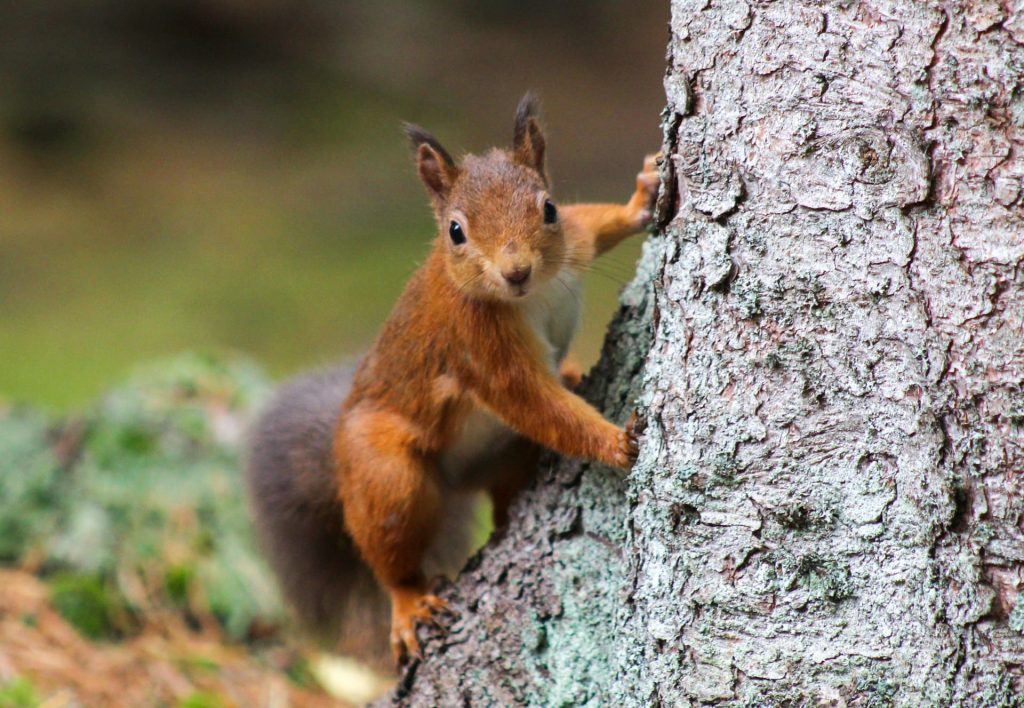
The easiest to spot is the red squirrel. Around three quarters of all the UK’s red squirrels live in Scotland, and in the woods around Aviemore they are almost at home. A walk around Loch an Eilein, with its castle ruin standing on an islet near the shore since the 14th century, is enough to see them scampering up trunks or stopping to nibble a pine cone.
More elusive is the pine marten, an agile predator with chocolate-coloured fur and a creamy bib. After almost disappearing for a century, it has returned to the Highland forests. It is mainly nocturnal, so the best way to see one is from a wildlife hide at dusk, in Speyside or at the Beinn Eighe reserve in Wester Ross. When it emerges from the dark, curious and confident, the wait is rewarded!
And then there is the most mysterious of all: the Scottish wildcat, known as the “Highland tiger”. It looks like a big tabby cat, but has a bushy tail with clear black rings and a blunt tip. It is one of Britain’s most endangered mammals, mainly because of interbreeding with domestic cats. Under the Saving Wildcats project, wildcats are bred in captivity at the Highland Wildlife Park in Kincraig and then released into the wild in the Cairngorms. While meeting one in its natural habitat remains almost a mirage, at Kincraig you can see it up close and learn its story.
Lords of the sky: golden eagle and osprey
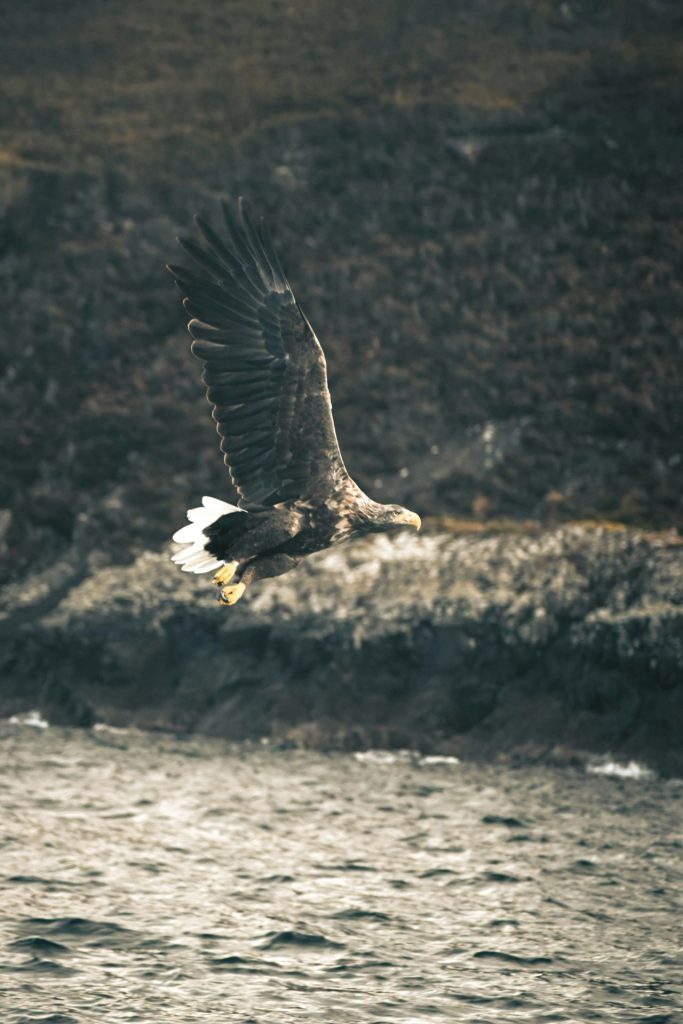
In the Highlands it pays to walk with your eyes on the sky. Scotland is home to over 500 pairs of golden eagles, almost all in the mountains and western isles. With a wingspan of over two metres, the eagle rides the air currents to patrol huge glens almost without moving its wings. Windy days are the best for seeing it circling over the ridges of Glen Feshie, the Monadhliath or Glen Affric. It is often confused with the much more common buzzard. The secret is to recognise its silhouette: the eagle is bigger, has a long tail and glides with flat wings.
The other great bird of prey of the Highlands has a true story of rebirth. The osprey had vanished from Scotland until, in 1954, a pair returned to nest at Loch Garten, in the heart of Abernethy Forest. From that nest the species began its recovery and now once again graces the Highland lochs. Between April and August you can see it flying over the water, hovering and then plunging to snatch a trout. Loch of the Lowes reserve in Perthshire also offers a viewpoint overlooking a nest.
Birds of the woods and moors
Pinewoods and moors are home to birds that are rare in Europe and that, within the UK, are found only in Scotland.
The most imposing is the capercaillie, the world’s largest grouse. The male is black, with green sheen on the breast and a “beard” of feathers under the beak. It died out in Scotland in the 18th century and was reintroduced from Sweden in 1837. Today only a few hundred remain, almost all in the pinewoods of Strathspey. It hates being disturbed, especially in spring, when it nests on the ground. So the best way to protect it is not to go looking for it!
The black grouse, on the other hand, is famous for its courtship ritual. In spring, at first light, the males gather in open spaces (called leks), puff up their feathers, fan out their lyre-shaped tails and “dance” amid bubbling calls and hisses to win the females. Some reserves run guided viewings from hides, so you can enjoy the show without disturbing it.
The heather moors are home to the red grouse; higher up, on the Cairngorm plateau, lives the ptarmigan, which turns white in winter. Thanks to its superb camouflage, you often only notice it when it takes flight, realising it was just a few steps away.
To round off this brief tour of Highland birds, let’s pause on two small songbirds that hide shyly among the pine branches. The first is the Scottish crossbill, the UK’s only endemic bird: it lives only in Highland pinewoods and uses its beak like pliers to extract seeds from pine cones. The second is the crested tit, recognisable by its little black-and-white crest, which in the whole UK lives only in Caledonian pinewoods. To look for them, the woods of Abernethy and Rothiemurchus are the best places.
High-altitude animals: life on the Arctic plateau
Above 900 metres, the Cairngorms change face. The trees disappear, the wind blows hard and snow can linger until late spring. It is the largest high-altitude plateau in the British Isles, and here nature looks more like Scandinavia than Scotland. The animals that live up there have learned to camouflage themselves and endure.
The mountain hare is the only hare truly native to the British Isles. In summer its coat is grey-brown, blending with the rocks and heather; in autumn it begins to lighten, turning snow-white in midwinter. The most curious time to see it is late winter: the snow melts, but the hare, still white, stands out against the dark ground. The slopes of the Cairngorms and the Monadhliath are its realm.
The plateau is also home to two rarities from the far north. The dotterel, a small bird with a rust-coloured breast, has a very unusual habit compared with other species: it is the male that incubates the eggs, while the more brightly coloured female courts him. The black-and-white snow bunting is one of the UK’s rarest breeding birds. Both are fragile and should only be admired from a distance, never leaving the paths.
Water creatures: lochs, rivers and marshes
In the Highlands water is everywhere: it rushes in streams, rests in dark lochs, spreads out in marshes. And it carries a precious part of Highland wildlife, together with many Scottish stories and legends.
Along the River Spey and its tributaries lives the otter. Here it is shyer than its coastal cousins and moves mainly at night. Seeing one is a stroke of luck, but you can learn to recognise its signs: webbed footprints in the mud, small droppings (spraints) left prominently on stones to mark territory, slides on the banks…
Then there is an animal that has returned after centuries of absence: the beaver. Extinct in Scotland for about four hundred years, it is now busy again in the rivers of the southern Highlands, especially in the Tay catchment. With its dams it turns streams into small wetlands full of insects, frogs and birds.
From late summer into autumn the rivers tell another story, that of the Atlantic salmon. After years at sea, salmon swim upstream to spawn exactly where they were born. At Pitlochry in Perthshire, a fish ladder built next to the dam has an underwater window from which to watch them go by. At the Falls of Shin in Sutherland you can see them leaping the waterfall one after another, with moving determination.
Finally, when autumn arrives, the Insh Marshes and Loch Insh fill with new voices. These are the whooper swans, arriving from Iceland to spend the winter here alongside geese and ducks. Their call is one of the loveliest soundtracks of the cold season.
When and how to watch Highland wildlife
Every season brings different encounters. Spring is the time of the black grouse’s dances, the return of the ospreys and hares still white on the melting snow. Summer brings roe and red deer calves, moors in bloom and very long days, perfect for climbing to the plateau. Autumn is perhaps the most intense season: the stags’ roaring fills the glens, the salmon run upriver and the first swans arrive from Iceland. Finally, winter turns the Cairngorms into a Nordic landscape, where hares and ptarmigan blend with the snow and the reindeer at last seem at home. Red squirrels and eagles, on the other hand, are around all year. Whatever time you choose, the best hours are early morning and dusk, when animals are most active and the light makes everything more magical.
Meeting Highland wildlife is a privilege, and like every privilege it must be respected. In Scotland there is a code of conduct, the Scottish Outdoor Access Code, which lets you walk almost anywhere, provided you behave responsibly, respect the interests of others and care for the environment. In spring, when many birds nest on the ground, it is important to stay on the paths and keep dogs on a lead near woods and moors. If a wild animal stops feeding or stares at you, it is a sign you have come too close. No recorded calls and no approaching nests for photos; the best encounter is the one in which the animal does not even notice it is being watched.
It is worth remembering that for up-to-date information on paths, reserves and conservation projects, the most reliable sources are the Cairngorms National Park Authority, NatureScot, RSPB Scotland, the Saving Wildcats programme, the Royal Zoological Society of Scotland and the Scottish Wildlife Trust.
The slow time of the mountains
In the Highlands, as anywhere else, you do not look for animals in a hurry, driven by the urge to reach your goal. Sometimes you need to wait patiently for a long time; other times you may be surprised by an unexpected encounter that fills your heart with joy… and at other times the object of your search may decide to stay hidden. True, having the good fortune to see a stag lift its head to meet your gaze, a squirrel stop to study you or an eagle vanish over the highest ridge is a privilege that will stay in your memories forever. But it is just as true that the chance to spend time in nature, without distractions, worries or the tight schedules of everyday life, is already a balm for the soul and for our all-too-busy minds.
And when you are ready to come down from the mountains to the sea, seals, otters and puffins will be waiting for you along the coasts of the many islands. For all the other stories of Scotland, our blog is always open.
Silvia Miraglia