
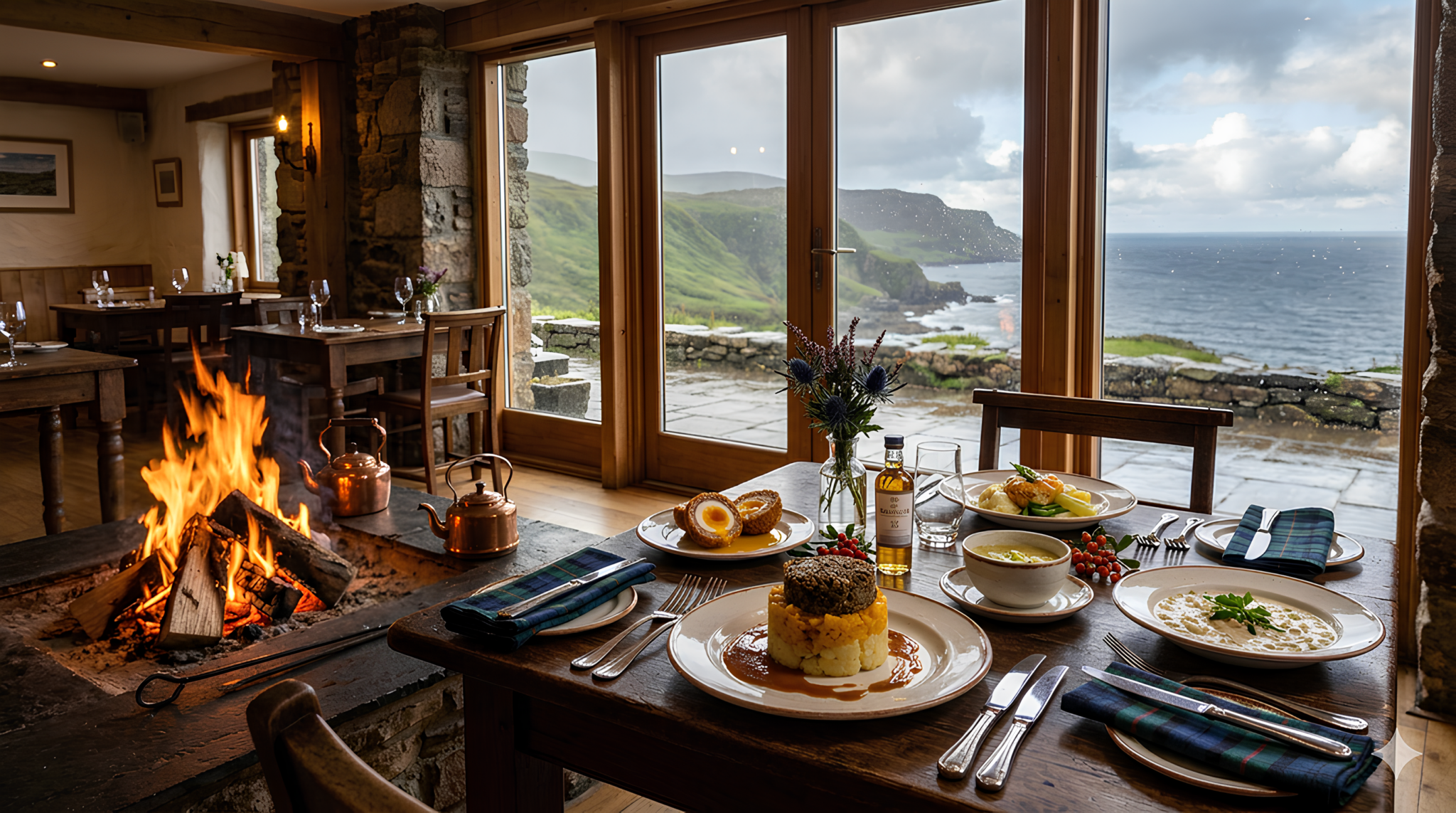
The wind is blowing hard off the sea and the rain is lashing sideways against the windows. It is a cold evening, and yet all you feel is warmth and wellbeing. The fire crackles cheerfully, an orange glow fills the whole room and the warmth of a woollen blanket wraps around you. To keep you company, a good book and a fragrant, steaming herbal tea in a mug beside you. This feeling of being sheltered and needing nothing else was presented by VisitScotland, the Scottish tourist board, as Còsagach.
Have you ever heard of it? Today we will look at the meaning of this Gaelic word, the advertising campaign that put it in the spotlight between late 2017 and early 2018, and the controversy that followed. We will also try to find the right balance of elements that could turn our everyday gestures into a small wellbeing ritual to enjoy every day, in Scotland or at home.
From etymology to wellbeing trend
Còsagach is a Gaelic adjective pronounced roughly KAW-sa-gach, with the final “ch” breathed as in the Scottish word loch. The root is còs, which in Gaelic means a hollow, a recess, a small shelter in the rock; by extension, then, còsagach should describe a place full of nooks and crannies. If that is its meaning, how did we end up talking about the feeling of being “snug, sheltered and warm”?
At the start of 2018, VisitScotland chose to put forward so-called Scottish Còsagach as an answer to Danish hygge and Swedish lagom, and from then on it began circulating in newspapers and on social media around the world.
Not everyone liked it, though; in fact, it sparked a real controversy. Some linguists and native Gaelic speakers pointed out that the tourist board had misunderstood the term, since in modern Gaelic dictionaries it literally means “full of holes, crevices, nooks” and is often used to describe damp, unwelcoming places. Instead, they suggested seasgair as the right word for the idea being promoted. VisitScotland, for its part, replied that it had taken the definition “snug, sheltered and warm” from a 1911 historical dictionary, and it never withdrew the campaign, which was meant to promote Scotland as an ideal destination for wellbeing and relaxation, especially in the autumn and winter months.
What the Còsagach controversy teaches us
The Còsagach story reminds us that words are much more than a simple dictionary entry: they belong to the community of people who use them and who link them to memories, sensations and emotions. Scottish Gaelic is spoken by a few tens of thousands of people, mostly in the Outer Hebrides and the western Highlands, but it is by no means a dead language; it is a living language that evolves with its speakers. Generations of Scots were discouraged from speaking Gaelic… and, even earlier, thousands of Scots were banned by law from using it. It is therefore a sensitive issue, rooted in a difficult past in which Highland culture was denied.
In the wake of what happened, a moral and institutional duty was established to consult academic experts and native speakers before launching any advertising campaign built around Gaelic.
“Scottish Còsagach” according to VisitScotland
The advertising campaign for winter 2018 defined “Còsagach” more or less as “an ancient Gaelic word that roughly translates as feeling snug, sheltered and warm”, and it rested on four key ideas, designed specifically to turn the weak points of a Scottish winter into strong tourist attractions:
- “Wild nature / cosy refuge”: on the one hand, the appeal of Scotland’s winter landscapes (wind, snow and rain); on the other, the attraction of a warm, safe refuge, such as a pub or a cottage with the fire lit.
- “Off-season” tourism: overturning the idea that Scotland was a summer-only destination, and showing that the harsh climate and short winter days were not a limitation but, on the contrary, the very conditions needed to create the perfect atmosphere for fully experiencing Scottish wellbeing.
- The “cosy living” trend: VisitScotland followed the success of the Scandinavian lifestyle (including Danish hygge). The aim was to offer the international market a Scottish alternative to that model, drawing to Scotland travellers looking for holidays centred on relaxation, reading and digital detox.
- Showcasing local excellence: the campaign promoted not only places to visit but also local products perfect for winter: traditional Scottish comfort food, whisky tastings by the fire, warm fabrics such as tweed and tartan, and the convivial hospitality of the people of the North.
a corner sheltered from the wind, where you can curl up safely. It is a very concrete image, born in an age when finding shelter in the surrounding landscape was a necessity even before it was a pleasure.
The roots of Còsagach in the Highlands
The feeling is still authentic
Whichever word we choose, I am convinced that the need to feel sheltered while “the storm rages outside” is deeply rooted in each of us. In Scotland, as in other places, especially in the past, this search for warmth and togetherness shows itself in many ways: the blackhouses with their peat fire always burning, the ceilidhs on winter evenings, the bothies in the mountains.
The blackhouse hearth. In the Hebrides, families lived in blackhouses (taigh dubh), low houses with thick walls and thatched roofs. In the middle of the room burned a peat fire that was almost never allowed to go out, and around it the life of the family unfolded: cooking, working wool, telling stories. Even today, for many Scots, the sweet, smoky smell of peat is the very scent of home.
The ceilidh, shared warmth. Before it became a party with music and dancing, a ceilidh was simply an evening visit to the neighbours. People sat by the fire, sang, played music and told legends. It was the truest expression of the warmth of a community drawing together to face the long winter nights.
Bothies, shelters in the wild. Even today, in the Scottish mountains, there are hundreds of bothies: small stone shelters, free and always open, looked after by volunteers from the Mountain Bothies Association since 1965.
How to create a Còsagach corner at home
What if we tried to bring this philosophy into everyday life? Small gestures can turn our homes into a source of positivity where we can recharge.

1. Rethink your spaces: warm light and fire
Our home should welcome us like a hug as soon as we step through the door. To achieve this, it is best to banish lights that are too cold or harsh, choosing natural light whenever possible or, at least, warm-light lamps and candles. Place an armchair by a window from which you can watch the seasons go by, wrapped in a tartan blanket with soft cushions to nestle into… and the warmth of a stove or a crackling fireplace to keep you company!
2. Practise mindful disconnection (digital detox)
Our psychological wellbeing inevitably depends on what we choose to let into our minds. Spending even just thirty minutes a day on an analogue activity — leafing through a book, keeping a journal, writing down your plans, listening to good music, gardening, cooking or simply enjoying a hot drink — drastically reduces stress, improves concentration and gives value back to the present moment. That is why it would be ideal to create reading corners free of electronic devices.
3. Embrace your inner season
Just as nature goes through winter in order to regenerate, we too have cycles when our energy is lower. It is important to welcome them without fighting tiredness or the need for introspection, turning moments of solitude into precious moments of listening to your inner SELF.
A quick recipe for everyday Còsagach
So here, in a few steps, is the way to carve out a moment just for ourselves. Twenty minutes to devote to ourselves in the evening or on grey days:
- Switch off the screens and dim the lights in the room.
- Light a candle and make your favourite hot drink.
- Wrap yourself in a blanket and sit by the window.
- Listen for a few minutes to the sounds outside: the rain, the wind, the silence.
- Write three lines in a notebook: something good about the day, something you want to improve, a plan for the future.
- Read or simply rest, without hurrying.
Conclusion: the warmth that comes from within
Wellbeing does not come from the absence of storms, but from the ability to create a shelter when they arrive. It is not achieved by ticking off to-do lists, but is a state of being.
If you would like to discover more curiosities and traditions of the Highlands, keep exploring our blog.
Silvia Miraglia