
Scotland, with its many landscapes ranging from rugged mountain peaks to wind-lashed coasts, offers a surprising mosaic of habitats reflected in a rich and varied flora. Far from the monochrome image sometimes associated with it, Scottish flora tells stories of resilience, adaptation and an extraordinary, ancient past.
From the iconic purple moorland covering the hills to the ancient forests that grew up after the last Ice Age, Scotland offers a unique botanical heritage, shaped by wind, rain and time.
So let’s set off together on a journey through this land so full of surprises, to get to know it better.
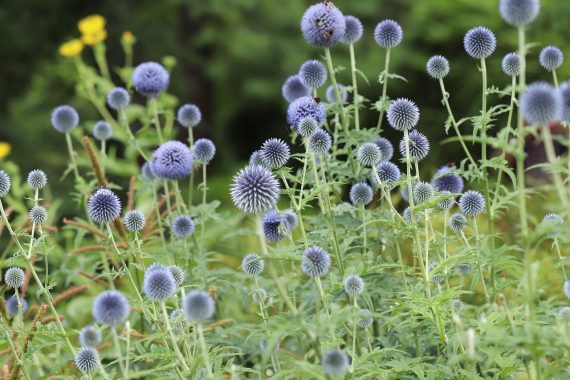
The thistle: symbol of a tenacious country
Let’s start with the thistle, a plant that stands for tenacity, resilience and adaptation and best reflects the spirit of the Scottish people; it is no coincidence that it became the symbol of a whole nation. Its story is tied to a legend of ancient warriors who were saved from a bloody invasion precisely by the presence of a great many thistles. For this reason it is also known as the ‘Guardian Thistle’.
A member of the Asteraceae family, this sturdy plant has an upright stem that can reach up to 2 metres and large, spiny purple flower heads that bloom in late spring and summer. It is not found only in the Highlands but in various parts of the country, from the Lowlands to the islands. The thistle’s vigorous root system makes it particularly well suited to surviving in poor soils.
The purple moors: the realm of ling heather
The most familiar image of the Highlands, the one that comes to mind when we think of Scotland, is probably that of vast moors cloaked in deep purple between late summer and early autumn. This sight, which can stir strong nostalgia in those who have seen it in person, is the work of a plant commonly known as Scottish heather (heather), which is in fact ling (Calluna vulgaris). This hardy plant dominates the hills and peat bogs, creating a vital habitat for local wildlife and providing the nectar for an extraordinary, delicately flavoured honey. Ling is the true star of Scotland’s wild expanses, which in Italian are even named after it: ‘brughiere’, from brugo. It is a small evergreen shrub that loves acid, damp soils and has many properties that have always made it precious to local people.
The ancient forests born after the last Ice Age
Scotland is home to a priceless treasure: part of the ancient Caledonian Forest, which after the last Ice Age covered much of the country.
This forest has survived especially in the Cairngorms and the Grampian Mountains, and is dominated by the Scots pine. This tree, with its coppery trunks and distinctive crowns, is a true symbol of Scotland’s woods: native, it is perfectly adapted to the local climate. As well as pines, Scotland’s forests are home to other native species such as birch, oak, willow and hazel, creating the ideal habitat for rare animals such as the red squirrel and the pine marten. The undergrowth, just as rich and colourful, is full of brightly coloured wild flowers that mirror a delicate ecological balance.
Coastal machair: a carpet of wild flowers
On the western islands, such as the Outer Hebrides, the flora reveals one of the most extraordinary surprises Scotland has in store for first-time visitors: the machair, a rare habitat of coastal grassland growing on shell-rich sand dunes. Looking out over the shores of these Atlantic islands, you are struck by such beauty: dense carpets covered with countless wild flowers that bloom in spring and summer host, against all odds, orchids, primroses and other native species that defy the cold northern winds. What takes your breath away is the show of intense, contrasting colours: the dazzling white of the sand, the blue of the sea and the multicoloured explosion of flowers that seems to want to compete with everything else.
Flora of the wetlands and coasts
To close this brief but meaningful overview of Scottish flora, I would like to introduce you to a perhaps little-known aspect: Scotland’s peat bogs and rocky coasts are home to ‘highly specialised’ plant species, used for centuries by the civilisations that followed one another in these lands.
Along the rocky coasts, various species of seaweed, such as carrageen moss, grow in abundance and have traditionally been gathered for many uses.
In the vast peat bogs you will find sundew, an insect-eating plant that has adapted to nutrient-poor soils and harsh temperatures.
On the moors and in the forests, meanwhile, grows wild juniper, an evergreen shrub with typical bluish berries that are a key ingredient in many Scottish gins and herbal preparations, as it has many balsamic, antiseptic and anti-rheumatic properties.
Silvia Miraglia