
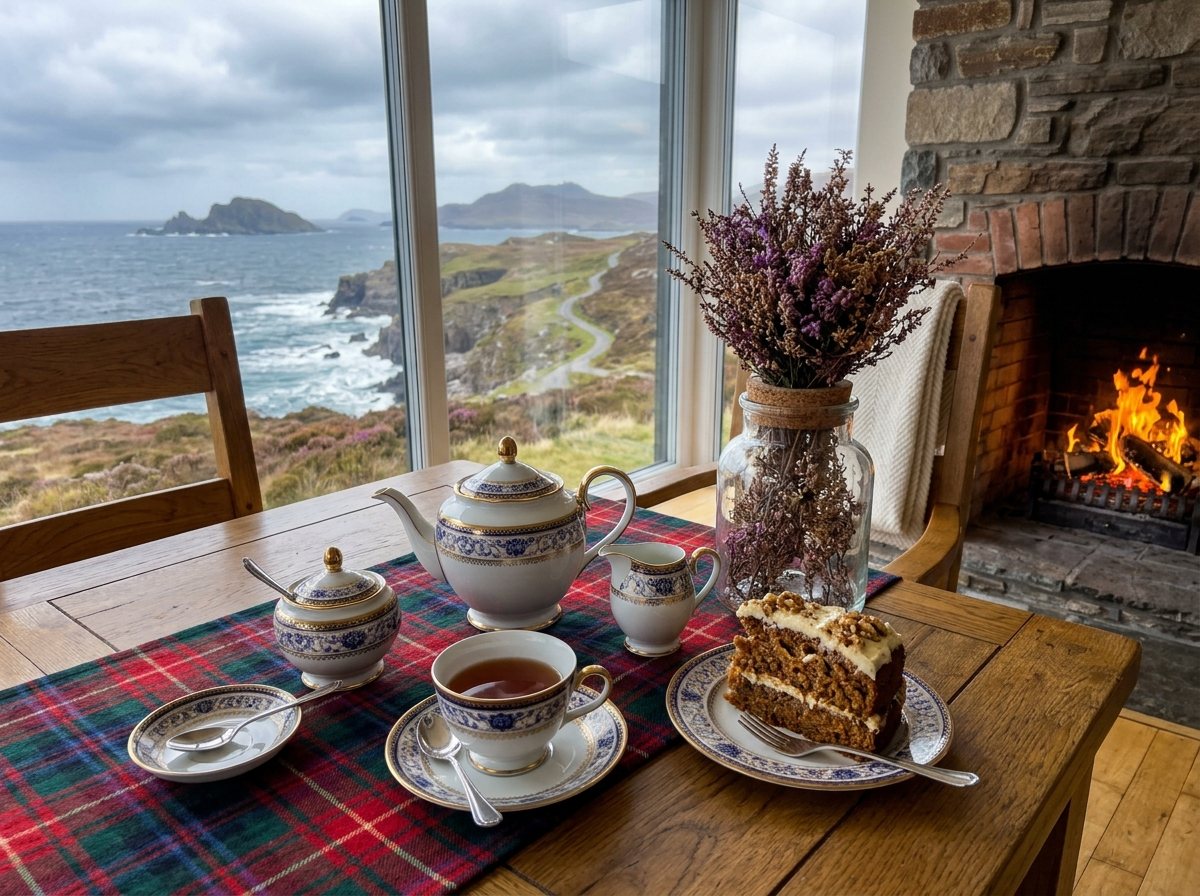
At the end of August the Highlands change colour. The hills, green and brown for months, light up with a rosy purple that stretches to the horizon. It is the heather in bloom, and its sweet, slightly honeyed scent can be smelt from the road. For centuries Scots have gathered those tiny flowers for all kinds of uses: beds, roofs, ale, dyes. And for a hot drink that is coming back into fashion today, heather tea, the simplest way to bring a little moorland into your cup!
In this article we’ll discover together where this tradition comes from, what properties folk medicine attributes to it and how to make it at home, with a few variations for the coldest evenings.
Heather, the flower that clothes Scotland
When people speak of Scottish heather, they mainly mean three plants. The most widespread is Calluna vulgaris, known as ling or common heather, which flowers between August and September with tiny lilac bells. Then there is Erica cinerea, bell heather, with deep purple flowers that open as early as July. Finally, Erica tetralix, cross-leaved heath, pale pink, which loves damp ground. Calluna is the one traditionally used for tea.
In Gaelic heather is called fraoch, and it is so bound up with the country’s identity that it is the plant badge of Clan Donald: warriors wore a sprig of it in their bonnets to recognise one another in battle.
A flower that was used for everything
Before it ended up in a cup, heather was a precious resource for everyday life in the Highlands:
- Mattresses: the stems, laid with the flowers facing upwards, made soft, fragrant beds. Sleeping on them was said to bring deep sleep.
- Roofs and walls: mixed with peat and clay, it insulated cottages from the wind.
- Brooms, ropes and baskets: the woody stems were flexible and strong.
- Dyes: the flowers and tips gave a yellow-orange used to colour the wool for tartans.
History and legends of heather tea
Heather infusions were part of the household medicine chest, along with heather ale, perhaps one of the most unusual recipes in Scotland.
The ale of the Picts
A legend tells that the Picts, an ancient people of Scotland, held the secret recipe for a heather ale. When the Scottish king defeated them, the last two keepers, father and son, chose to die rather than reveal it. Robert Louis Stevenson turned the story into a ballad, Heather Ale: A Galloway Legend (1890). In the 1990s a Scottish brewery revived an ancient Gaelic recipe, and today Fraoch heather ale can be found in pubs too.
White heather brings luck
Rare in the wild, white heather is considered a lucky charm. It was said to grow only where no blood had been shed, or where fairies had rested. The tradition became popular in Victorian times: in 1855, at Balmoral, Prince Frederick William of Prussia is said to have offered a sprig of white heather to Princess Victoria when he proposed to her. To this day a white sprig appears in Scottish brides’ bouquets.
From moorland to cup
In country homes, the flowering tips were dried at the end of summer and kept for the winter. Heather tea was drunk in the evening, after a day in the fields, often sweetened with a spoonful of heather honey, the finest product of Highland bees: dark, aromatic and jelly-like in texture.
The properties of heather tea according to tradition
In European folk herbalism, Calluna has always been considered a “cleansing” plant, to be drunk at the change of seasons. The properties traditionally attributed to it are:
- Diuretic and purifying: this is the oldest use, linked to urinary tract wellbeing. The plant contains arbutin, a substance also found in bearberry.
- Relaxing: a cup in the evening is associated with more peaceful sleep.
- Antioxidant: the flowers and tips are rich in flavonoids and tannins.
- Soothing: in the past it was also used lukewarm, for skin compresses and as a gargle.
A note of caution
These are traditional uses, not medical advice. The tea should be drunk in moderation and for short periods. It is not suitable during pregnancy or breastfeeding, for young children, or for anyone with kidney problems or taking regular medication: in these cases it is best to consult a doctor or herbalist first.
How to make heather tea at home
Gathering and drying heather
The right moment is full bloom, between late August and September. Only gather the flowering tips, cutting them with scissors and without pulling up the plant. The Scottish Outdoor Access Code allows small quantities to be gathered for personal use, but never in protected areas. So if you’re in Scotland at this time of year, bear it in mind, and remember to choose areas away from roads and from treated moorland.
To dry them, tie the tips into small bunches and hang them upside down in a dry, shady place for one or two weeks. When the flowers crumble between your fingers, store them in a glass jar in the dark. If you’re not in Scotland, you can find dried heather at a herbalist’s.
The basic recipe
Ingredients for one cup
- 1–2 teaspoons of dried heather flowering tips (or a small bunch of fresh flowers)
- 250 ml of water
- 1 teaspoon of heather honey (optional)
Method
- Bring the water to the boil and let it rest for a minute.
- Pour it over the heather, in a teapot or a cup with an infuser.
- Cover and leave to infuse for 5–10 minutes: the longer you infuse it, the stronger and slightly more bitter the taste will be.
- Strain, add the honey once the tea is lukewarm, and sip it slowly.
The flavour is delicate and floral, with a woody note reminiscent of hay.
Three Scottish variations
- Evening Còsagach: heather with a pinch of chamomile and a strip of orange peel, for your bedtime ritual.
- Winter shield: heather and rosehips in equal parts, for a tea rich in vitamin C.
- Summer moorland: heather, a few blaeberries and two mint leaves, cold-infused in the fridge overnight.
A wellbeing ritual to bring home
From the ale of the Picts to the brides’ white sprig, heather tells the story of Scotland better than any guidebook. Making heather tea means bringing a piece of Scotland into your home, treating yourself to a small ritual, a slow, warm gesture for autumn evenings. So light a candle, wrap yourself in a tartan blanket, choose a good book and let the scent of the moorland reach you. This tea can become the simplest form of Còsagach, the feeling of being warm and sheltered, which we talk about in our article on wellbeing in Scotland.
Have you ever tasted it?
More recipes and traditions await you in our blog.
Silvia Miraglia