
Cailleach: keeper of frost and fate
Among the most powerful and ancient figures of Celtic mythology, the Cailleach holds a special place. Still known today as the Queen of Winter, this deity embodies more than any other the natural cycle of life, death and rebirth. She is the bringer of frost, the sculptor of mountains, the primordial force that rules the darkest months of the year.
She is a figure who has lived for centuries in the tales of the Highlands, in windswept villages and in the whispers of fishermen scanning the icy sky above the Atlantic.
In a landscape where winter is as beautiful as it is harsh, the Cailleach is not just a folklore figure but represents the force of nature: unpredictable, powerful, sometimes cruel, but always necessary. She is the ancient Goddess of Winter, older than the stones of the Neolithic circles. The Cailleach is the very heart of winter.
In this article we will discover who she is, her most fascinating legends, how she appears in the different regions of Scotland and why she is still a living presence in modern culture.
Origins and nature of the Cailleach
The Cailleach is considered a pre-Christian goddess, perhaps of Indo-European origin. Some scholars link her to deities of the earth and creation, since many Scottish mountains and hills are attributed to her hand. Indeed, as we shall see, in some myths she is the creator of Scotland’s entire landscape.
Over time she became the personification of winter, frost, blizzards and biting wind.
In Scotland her name is pronounced “KAL-yakh”, and it comes from Gaelic, meaning “old woman” or “veiled one”; she is not evil, but stern, relentless and deeply natural.
According to many traditions, the Cailleach existed before the gods themselves. She is the sovereign of winter and the one who decides when spring may be reborn.
What the Cailleach looks like
Her description varies slightly from place to place, but there are some common features:
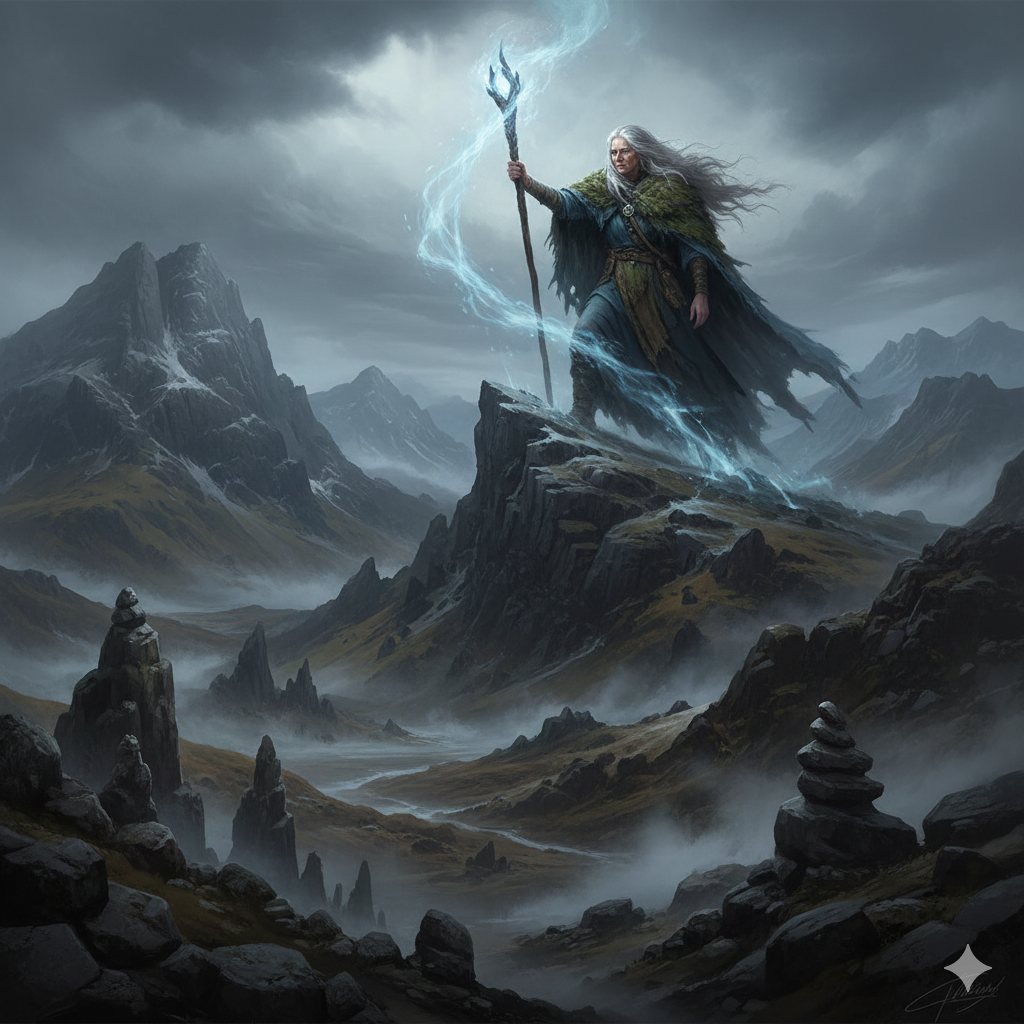
- she is a gigantic woman
- her skin is blue with cold or grey as stone
- her hair is white as snow
- she wears a dark or blue cloak
- she wields a staff or a hammer
The Cailleach and the cycle of the seasons
The Cailleach rules the months from Samhain (31 October) to Beltane (1 May). During this time she holds Ireland and Scotland in her grip with storms, ice and wind.
In winter she freezes the rivers, stirs up storms, lengthens the nights and protects deer and wild herds from the cold. At the festival of Imbolc (1 February), dedicated to the goddess Brigid, it is said that the Cailleach goes out to gather firewood to make winter last longer: if the day is bright, it means she is gathering supplies to stay on; if it is dark and stormy, the goddess is asleep and spring will soon arrive.
With the coming of the fine season comes the transformation: in many tales the Cailleach does not die but turns into a young woman, Brigid (or Bride), goddess of light and spring.
Here, then, is the eternal cycle: the Cailleach and Brigid are often seen as two aspects of the same energy – the old woman and the maiden, frost and fire, dark and light, sleep and awakening.
Mother, witch and sculptor: the identity of the Cailleach
The Cailleach is a complex deity whose role varies in the Gaelic traditions of Scotland and Ireland. In the Highlands, her functions are intrinsically bound to the land itself:
- The Sovereign Lady: The Cailleach is the archetype of the Crone, the third aspect of the Triple Goddess, representing wisdom, destruction and winter. Her reign stretches from Samhain to Beltane.
- Creator of mountains: According to Scottish legends, the Cailleach does not merely rule the mountains; she made them. It is said she let rocks fall from her apron as she walked, forming mountain ranges and cairns (piles of stones). Ben Nevis, Scotland’s highest mountain, is said to be one of her homes, and the sudden storms that shroud its summit the expression of her anger.
- Guardian of life: Despite her terrifying appearance, the Cailleach is not purely evil. She is the necessary force that brings rest to the land, allowing the cycle of life to renew itself. She symbolises the power of regeneration hidden beneath cold and frost.
The magic of the staff and the water of youth
The Cailleach’s power lies in a magic staff, often made of holly or hawthorn, able to transform the landscape in an instant.
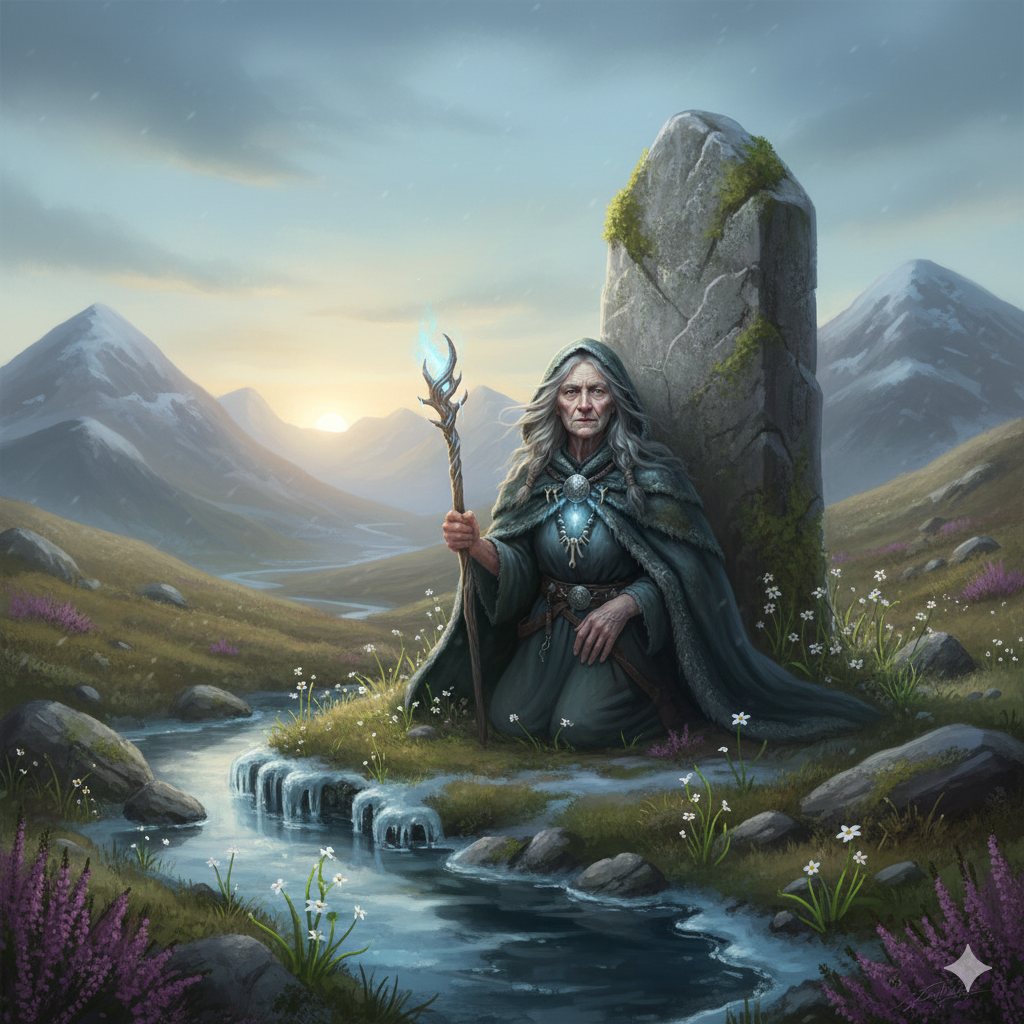
- Casting down the staff: The crucial moment in Cailleach folklore comes at the start of spring. According to tradition, the Cailleach turns into a great stone on Beltane, throwing down her staff. This marks the end of her icy reign and the return of the sun’s dominion.
- The eternal spring: In many stories it is said the Cailleach could renew herself completely by bathing in a secret spring in the early hours of Beltane, changing from a decrepit old woman into a beautiful young one. This myth strengthens her link with the endless cycle of destruction and rebirth.
The Cailleach and the folk calendar
The presence of the Cailleach was deeply rooted in the practices and weather lore of Scottish folk tradition:
- Weather oracle: Farmers and shepherds watched the weather closely on particular days (such as St Patrick’s Day) to predict how long her reign would last. Her mood could be read in the sky: a clear, warm sky foretold a long, hard winter, because it meant the Cailleach was gathering a great store of firewood for the months ahead.
- The death of winter: A sudden storm after a brief spell of spring was often seen as the Cailleach’s last, fierce resistance before giving way to the goddess of spring, Brigid.
The powers and symbols of the Cailleach
The Cailleach is associated with elements that embody strength, transformation and wild nature:
- Stone: with her hammer or staff the goddess strikes the earth, creating hills and mountains. It stands for eternity.
- Ice and snow: they are her breath, her touch, her presence. They stand for renewal.
- The raven: messenger and symbol of change.
- The sacred fire that does not warm: the flame of intuition and ancient wisdom.
- The staff: the power of nature.
- The deer: it stands for protection and guidance.
The Cailleach in the Celtic isles
Scotland: Cailleach Bheur is considered the oldest of all deities. She is said to have lived many lives, and every winter to grow young again by drinking water from a sacred well.
Ireland: Here she is known as Cailleach Bhéara. According to the tales, she created the coastal landscapes by dropping huge stones from her skirts.
Isle of Man: A similar figure, the Caillagh ny Groamagh, appears as a spirit of winter who brings gloomy days but also protection.
The Cailleach today: the spirit of place
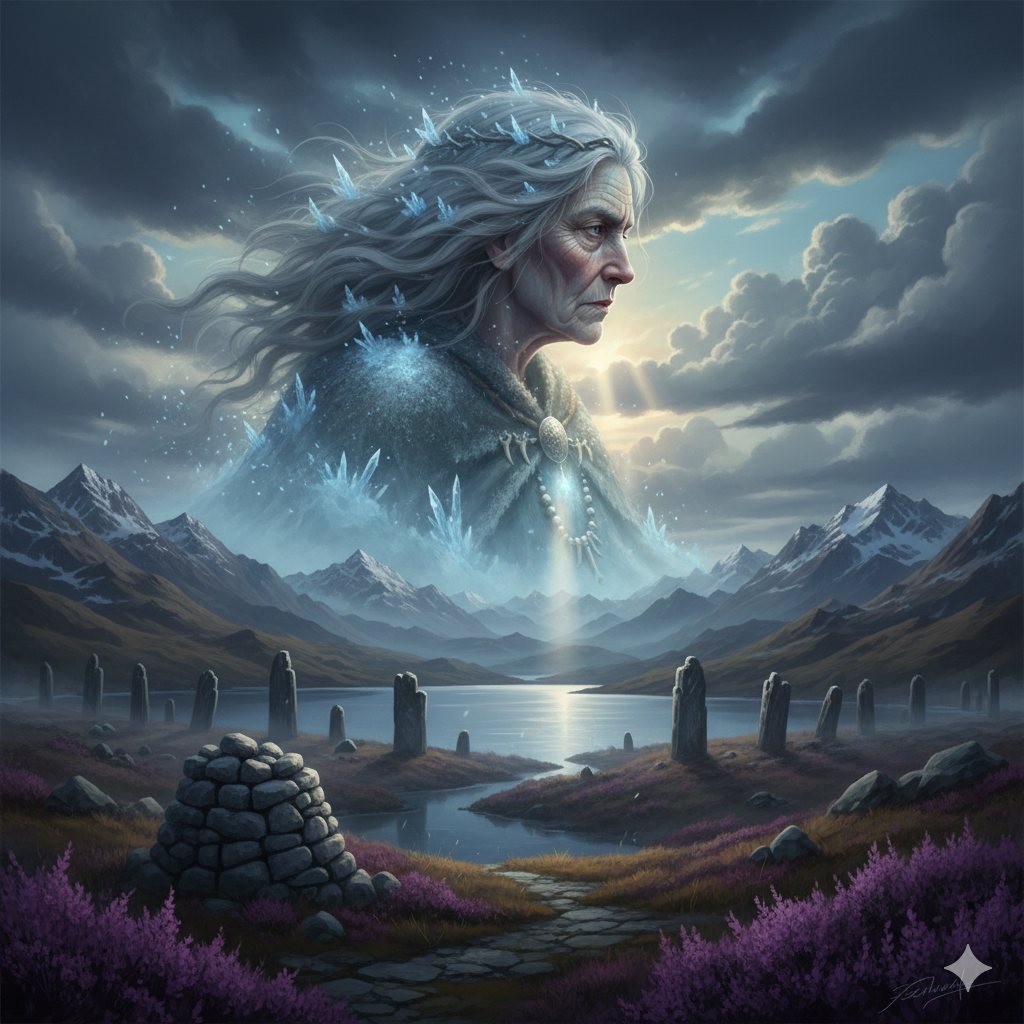
Today the Cailleach is much more than a folklore figure; she is regarded as the genius loci of the Highlands, the guardian spirit of wild and inhospitable places. She reminds us that in Scotland winter is not something to be harnessed and tamed, but a powerful force that deserves respect and that shapes the landscape and the character of those who live beneath her mountains.
She has become a symbol of female strength, deep connection with nature and respect for the rhythms of the Earth.
The wise goddess who teaches
The Cailleach is not just a goddess of winter: she is a teacher of balance, transformation and inner strength. She reminds us that frost is not only death but a necessary phase for rebirth; that wisdom comes with time; and that every winter, inner or outer, carries within it the promise of spring.
A powerful, mysterious archetype that still speaks to souls today just as it did centuries ago.
Silvia Miraglia