
On the last day of November, when the mornings turn icy and darkness falls ever earlier, comes the feast of Scotland’s patron saint: a chance to immerse yourself in the richness of Scottish culture and traditions. It is the day on which a nation that proudly defends its roots celebrates its patron saint. Saint Andrew’s Day marks the start of Scotland’s enchanting “Winter Festival”, a season full of celebrations that carries the country through to Hogmanay (New Year’s Eve) and Burns Night. Saint Andrew is a key figure in the Christian tradition, but in Scotland he has taken on an even deeper role. The most curious thing is that this man not only wasn’t Scottish… he never even set foot in Scotland! According to tradition, Andrew was a fisherman from Galilee, the first disciple of Jesus and the brother of Peter. He travelled widely to spread the teachings of the Gospel and was martyred by the Romans in Patras, Greece. He asked to be crucified on an X-shaped cross (crux decussata) because he felt unworthy of dying in the same way as Christ.
History and symbols of Saint Andrew’s Day
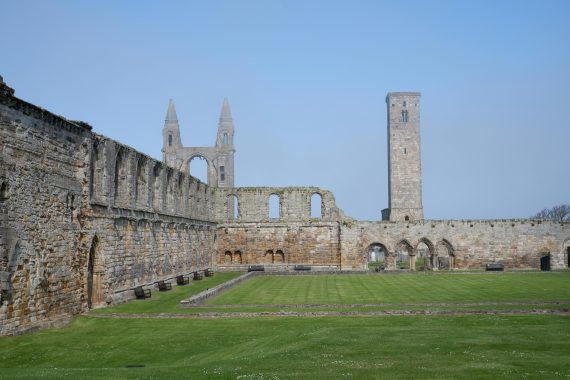
Even so, many legends link Saint Andrew to Scotland. One of the most fascinating tells of a Greek monk called Regulus (or Saint Rule), who was ordered in a dream to carry the saint’s relics to safety “to the ends of the earth”. Regulus hurriedly took the saint’s remains and, after an epic voyage, landed on the east coast of Scotland (Fife), in the Pictish village of Kilrymont, which would later become St Andrews. Around 1130 a church was built in his honour, with a 33-metre tower to guide the pilgrims who came there to pray. St Rule’s Tower still rises, imposing, beside the ruins of the old Cathedral, although sadly the relics were lost during the Scottish Reformation.
Another legend handed down for hundreds of years tells that in 832 AD Saint Andrew appeared in a dream to Angus, king of the Picts, before a battle, promising him victory. The next day, in the middle of the battlefield, Angus saw the saint’s X-shaped cross shining in the blue sky: a clear omen of victory for the Picts.
What is certain, on the other hand, is that as early as 1286 the Great Seal of the Guardians of Scotland, used to authenticate official documents, bore the cross of Saint Andrew.
This saint from afar has been celebrated in Scotland for over a thousand years; however, it was only in 1320, with the historic Declaration of Arbroath asserting Scottish independence, that Saint Andrew officially became the country’s patron saint. A few decades later, in 1390, Saint Andrew appeared as a national symbol on a coin during the reign of Robert III.
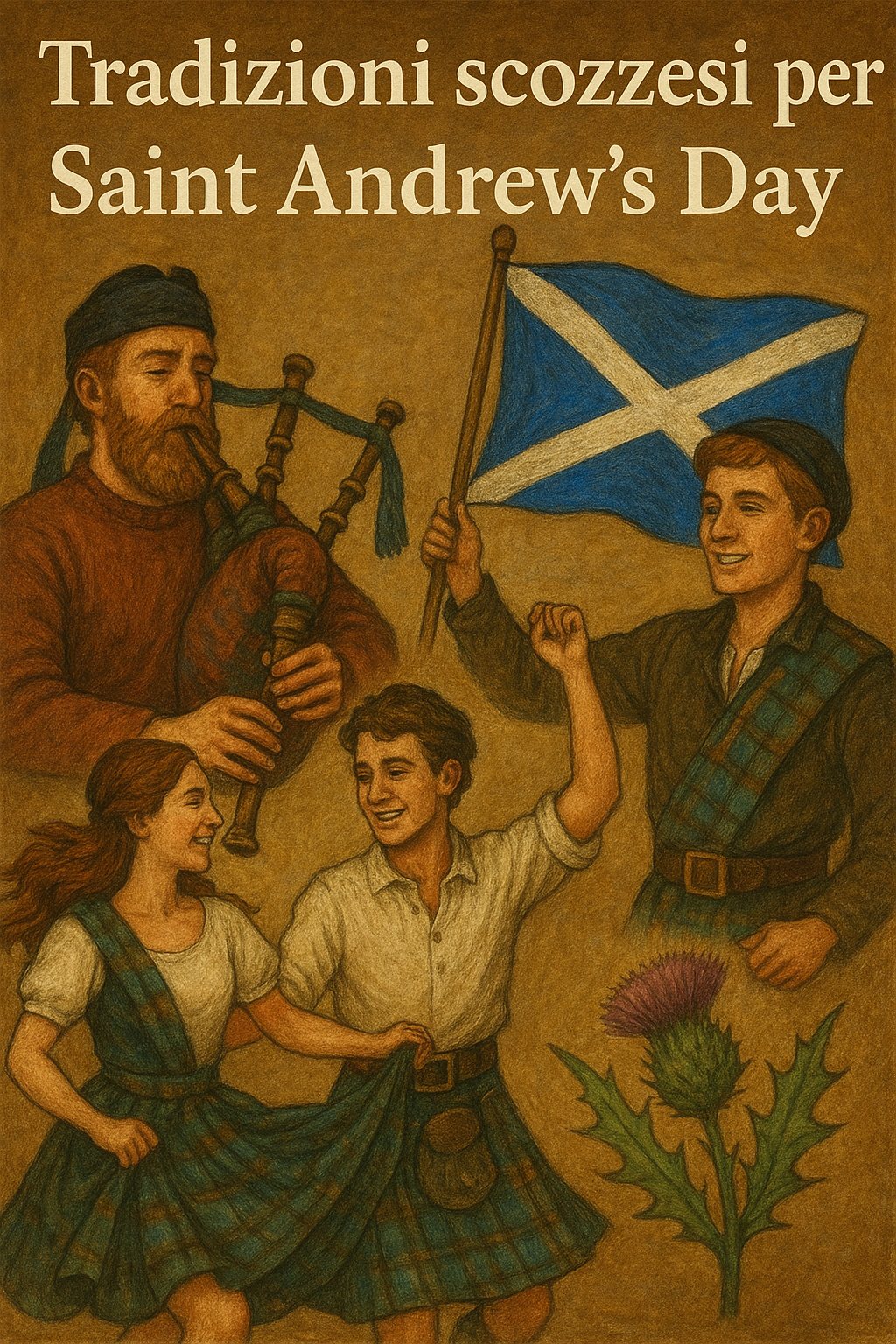
The famous blue and white Scottish flag, the Saltire, represents the very Cross of Saint Andrew on which he was martyred, and is considered one of the oldest in Europe. Naturally, many legends have also grown up around the Saltire, featuring the diagonal cross and various figures from Scottish history.
How Saint Andrew’s Day celebrations spread around the world
30 November has been celebrated as Scotland’s national day for centuries, but its spread abroad began in 1729, when a group of Scots who had emigrated to the American colonies founded the “Saint Andrew’s Society of Charleston” to help the city’s orphans and widows. From then on, dozens of societies devoted to charity and to preserving Scottish traditions sprang up all over the world.
Scottish traditions for Saint Andrew’s Day
All over Scotland, from little pubs tucked away in the Highlands to the elegant restaurants of the lively capital, Edinburgh, and the tables of families gathering with relatives and friends for the occasion, you will find classic dishes of Scottish cuisine: the tasty fish soup Cullen Skink, the famous Haggis, Cranachan, a dessert made with cream, raspberries and whisky, or the traditional Clootie Dumpling.
Celebrations take place across the country. If you are in Scotland at this time, here are a few suggestions. In Edinburgh, entry to the Castle is free for the whole day (book your tickets in advance!) and around the city you will find markets and traditional music concerts. In the historic town of St Andrews, the festivities last a whole week, with pipe bands and street parties. Dundee also comes alive with live music, street theatre and a moving torchlight procession on the night of 30 November. In Perth, meanwhile, you can enjoy tastings of local food and whisky.
Finally, the Isle of Skye hosts the “Saint Andrew’s Day Ceilidh” (dates to be confirmed) that closes the Festival of Small Halls, a celebration of the culture of the Highlands and Islands through music and art.
Whether you are lucky enough to be in Scotland or thousands of kilometres away, Saint Andrew’s Day is a wonderful opportunity to celebrate the cultural richness, history and welcoming spirit of this extraordinary land.
Happy Saint Andrew’s Day!
Silvia Miraglia