
If you close your eyes and think of Scotland, what is the first sound that comes to mind? Probably the powerful, solemn lament of the bagpipes, or perhaps the irresistible rhythm of a fiddle.
Scottish music is not simply a genre to listen to: it is a sensory experience, a journey through time rooted in centuries of legends, clan stories, lost loves and rebellions. It is the memory of a people who still want to tell us something!
If you have read our article on Flower of Scotland, you already know how a single song can fire the pride of a whole nation. Today, though, I am taking you further: to discover the instruments, genres, voices and places where Scottish music lives on.
The origins of Scottish music: a Celtic heritage
To understand where this tradition comes from, we have to go back many centuries, to when the lands we now call Scotland were inhabited by Picts, Scots and Britons. It was above all with the arrival of the Gaels from Ireland that a musical culture of bards, harpers and singers took root. These figures lived at the courts of clan chiefs and had a precise task: to keep the family’s history, celebrate its deeds and mourn its dead.
There was no sheet music. Everything was handed down by word of mouth, from master to pupil, from mother to child. And it is precisely this oral transmission that has kept traditional music so alive and changeable: every glen, every island, every family had its own version of the same tune.
The clarsach, the bards’ harp
Even before the bagpipes, the noble instrument par excellence was the clarsach, the small Celtic harp with metal strings. Its crystalline sound accompanied the bards’ tales in castle halls. With the decline of the clan system the clarsach lost its role, but in the twentieth century it was reborn thanks to new generations of musicians. Listening to it today is like opening a window onto a world of legend and folklore.
The bagpipes: the voice of Scotland
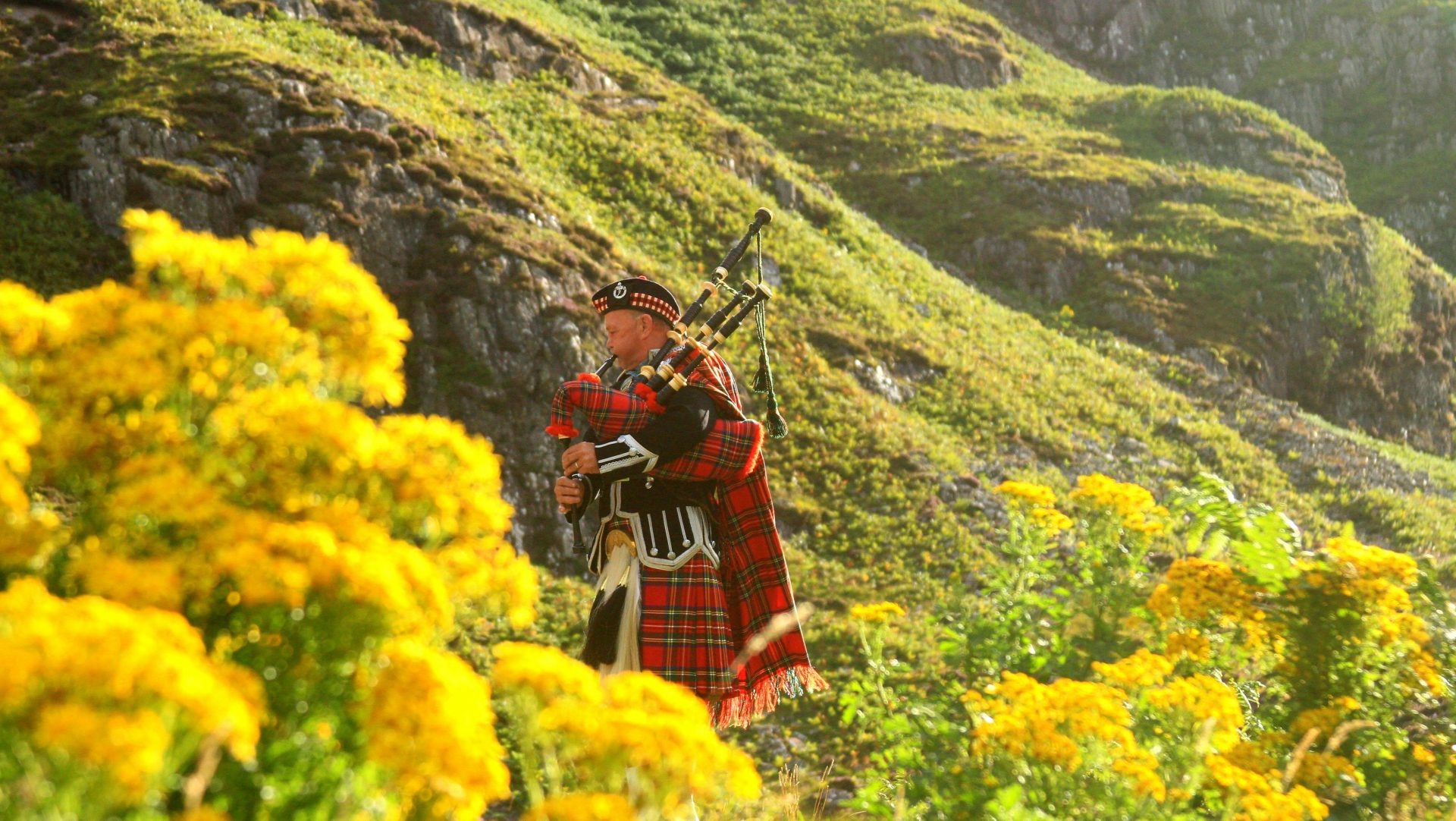
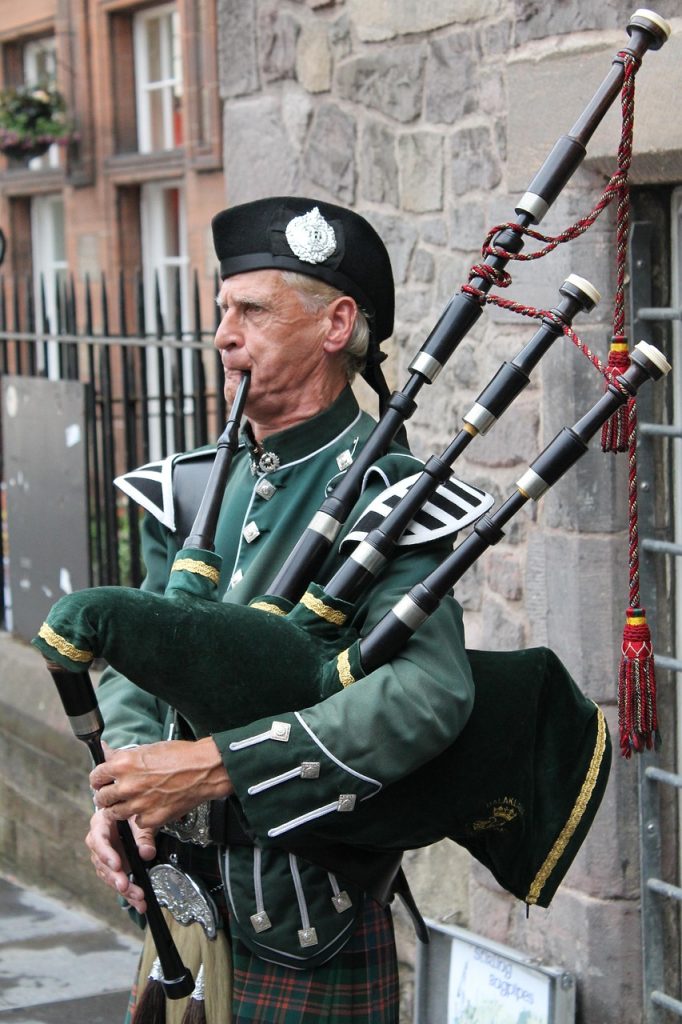
It is impossible to talk about Scotland without thinking of them: the Great Highland Bagpipe. A bag (once made of sheepskin), a blowpipe, the chanter on which the melody is played and three drones that produce that deep, continuous note that makes the air vibrate. The result is a powerful sound, able to carry across whole glens and go straight to the heart.
The bagpipes were not born in Scotland (similar instruments exist all over Europe, including Italy’s zampogna), but it is here that they became a true symbol. Their unmistakable tone could be heard miles away on the battlefield, to strike fear into enemies and rally the clans. They were used to announce weddings and to bid farewell to those leaving for ever.
After Culloden: music that could not be stopped
After the Jacobite defeat at Culloden in 1746, the British government passed very harsh laws to break Highland culture: weapons, kilts and tartan were banned. It is often said that the bagpipes were banned too; in fact the law did not mention them, but one piper, James Reid, was sentenced to death because the court considered his instrument an “instrument of war”. Paradoxically, it was the Scottish regiments of the British Army that saved the tradition, taking their pipers to every corner of the world.
Pibroch, the classical music of the bagpipes
Unlike dance tunes or marches, pibroch (in Gaelic ceòl mòr, “the great music”) is a slow, solemn composition built on a theme that is taken up and enriched in increasingly complex variations. The main types are pieces honouring a clan chief or celebrating an important event, mournful laments written in memory of someone who has died, and gatherings to call the clan together.
Pibroch was handed down orally through a system called canntaireachd. Among the most famous families who carried on this tradition were the MacCrimmons, hereditary pipers to the MacLeods on the Isle of Skye.
The fiddle and the dances: reels, jigs and strathspeys
If the bagpipes are Scotland’s solemn voice, the fiddle is its dancing heart. In the eighteenth century lived one of its best-loved players, Niel Gow, who played for the aristocracy and for ordinary people and whose tunes are still played today.
The tunes fall into lively rhythms such as reels (perfect for spinning dancers round non-stop!), jigs and strathspeys (the most Scottish of all, with their “bouncing” rhythm).
The ceilidh: the party where nobody stays seated
And where do people dance reels and jigs? At a ceilidh, the traditional Scottish party. Originally it was simply an evening gathering of neighbours, with stories, songs and chat; today it is an evening of group dances in which a “caller” explains the steps to everyone, beginners included. It doesn’t matter if you get it wrong: at a ceilidh you laugh, you spin, you swap partners and you go home breathless.
Gaelic song: the Scottish music of the islands
There is a more intimate and mysterious side to Scottish music, which lives mainly in the Hebrides and the western Highlands, where Gaelic is still widely spoken. Gaelic is a language that holds an extraordinary poetic heritage, telling stories of lost sailors, impossible loves and mythical creatures such as selkies (seals able to turn into humans).
Work songs
Waulking songs were sung unaccompanied: women sitting around a table rhythmically beat wet tweed to make it dense and waterproof, and the song kept time with their hands. One voice sang the verse and the chorus answered. There were songs for rowing, for milking, for rocking babies: every task of the day had its tune.
Puirt à beul, mouth music
And when there were no instruments? People used their voices! Puirt à beul (literally “tunes from the mouth”) are very fast songs, often with playful or nonsense words, designed to get people dancing as if there were a fiddle. A musical tongue-twister that tests anyone who tries to sing it.
The Gaelic psalms of Lewis
On the Isle of Lewis survives one of the most remarkable sacred music traditions in the world: Gaelic psalm singing. A “precentor” lines out a verse and the congregation responds, each with their own ornaments, creating a wave of sound that seems to rise from the sea. Those who have heard it say it is impossible to forget.
Robert Burns and the ballads the world still sings
Every 31 December, all over the world, millions of people join hands and sing Auld Lang Syne. Few know that we owe those words to Robert Burns, Scotland’s national poet, who at the end of the eighteenth century collected and rewrote hundreds of old folk songs, saving them from oblivion.
Traditional ballads tell of impossible loves, exiles and heroes. The Skye Boat Song recalls Bonnie Prince Charlie’s flight to the Isle of Skye; Loch Lomond tells of a farewell on the loch’s “bonnie banks”. Melancholy tunes, as so often in Scotland, yet sung by everyone together, at full voice.
From tradition to rock: modern Scottish music
From the 1960s the folk revival brought the old songs back to the stage, thanks to groups such as The Corries, the same group behind Flower of Scotland.
Then came Runrig, who from the 1970s took Gaelic into rock and filled stadiums, and Capercaillie, with the enchanting voice of Karen Matheson. Today Gaelic singer Julie Fowlis has lent her voice to the soundtrack of the animated film Brave, while the Red Hot Chilli Pipers play bagpipes to a rock beat in front of wild crowds.
And let’s not forget pop and rock: The Proclaimers, Simple Minds, Franz Ferdinand, Biffy Clyro, Lewis Capaldi. Very different artists, but with the same Scottish spark that blends irony, melancholy and energy.
Scotland through the eyes of the great composers
Scotland has enchanted classical music too. In 1829 Felix Mendelssohn visited Fingal’s Cave on the Isle of Staffa and drew from it the overture The Hebrides, in which you can almost hear the waves crashing among the basalt columns. A few decades later Max Bruch composed the Scottish Fantasy for violin and orchestra, weaving in folk melodies.
Where to hear Scottish music live
If you want to experience Scottish music up close, here are some events and places to put in your diary.
Festivals and major events
- Celtic Connections, in Glasgow every January: one of the biggest Celtic and folk music festivals in the world.
- Royal National Mòd: since 1892, the great festival of Gaelic language and music, held each year in a different place.
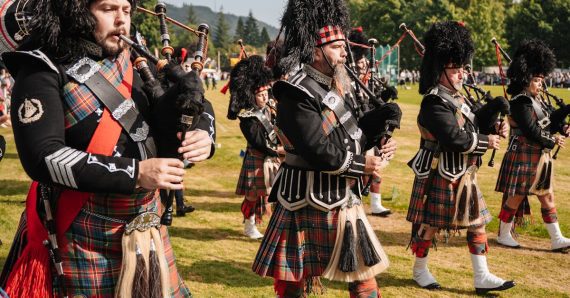
- Royal Edinburgh Military Tattoo: in August, on the esplanade of Edinburgh Castle, pipe and drum bands parade in a thrilling show.
- World Pipe Band Championships: in August in Glasgow, hundreds of bands compete for the world title.
- Highland Games: in summer, amid caber tossing and feats of strength, there are always pipers and traditional dancing.
Pubs and sessions
The most authentic way to hear traditional music, though, is still the pub. In many towns and villages there are “sessions”: musicians who sit round a table with fiddles, whistles and guitars and play together, with no set list, simply for the joy of it.
Curiosities about Scottish music
- Highland Cathedral, one of the best-loved bagpipe tunes, was not written by a Scot: it was composed by two German musicians in 1982!
- Glasgow has been a UNESCO City of Music since 2008.
- In military bands, pipers wear kilts in their regiment’s tartan: a way of carrying their history with them even as they play.
Next time you hear the sound of the bagpipes, close your eyes for a moment and let your thoughts run to where these melodies were born. That is the greatest gift of Scottish music: it always takes you back there, to Scotland, wherever you are. And if you want to continue the journey, you will find many more stories on our blog.
Silvia Miraglia