
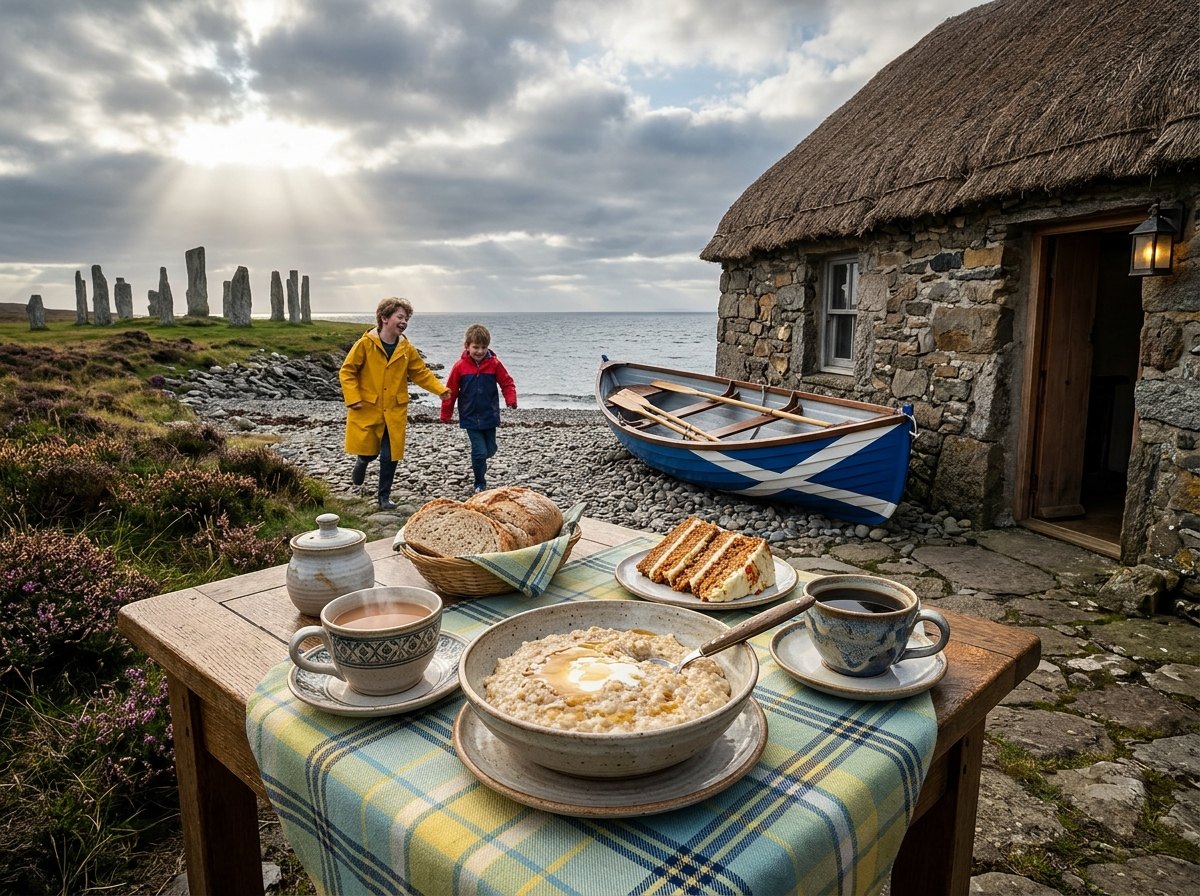
On the stove, a pot simmering gently; a wooden stick stirring round and round a thick, fragrant cream that smells of toasted grain. For generations of Scots, the day has begun in front of a steaming bowl: an ancient dish, deeply rooted in the Highlands, that has conquered the world.
In this article we’ll discover together the history and curiosities of Scottish porridge: much more than a simple oat soup, it is a true waking ritual, a warm embrace that brings together history, nutrition and a philosophy of life that invites us to rediscover ‘slowness’.
A thousand-year history: the grey gold of the Highlands
The history of porridge has its roots in centuries past, when oats were one of the few cereals able to withstand Scotland’s harsh, rainy climate. For centuries this dish was the staple food of Highland people, who needed slow-release energy to face long days of hard work outdoors.
Making porridge was almost a sacred rite. It was cooked in large iron pots and stirred strictly with a wooden stick resembling a small rolling pin, called a spurtle, whose cylindrical shape was designed specifically to stop the oats being crushed and, above all, to prevent lumps from forming.
Historical curiosities
Spurtle. According to tradition, the spurtle, found in Scottish kitchens since the 15th century, was to be turned only with the right hand and clockwise, to ward off evil spirits (and keep bad luck away from the house!).
Eating standing up. In Gaelic culture, oats were considered a divine gift essential for survival, so eating porridge standing up was a sign of deep respect for the dish that gave you the strength to face the day.
The porridge drawer. In country homes, porridge was made in large quantities at the start of the week and poured, still boiling hot, into a special drawer of the dresser. Once cool, it set solid and was cut into slices to be eaten over the following days.
Samuel Johnson’s dictionary. He defined oats as “A grain, which in England is generally given to horses, but in Scotland supports the people”. The reply of the Scot James Boswell went down in history: “And that is why England has such fine horses, and Scotland such fine men”.
The World Porridge Championship
Every October, the village of Carrbridge, in the Cairngorms National Park, hosts the Golden Spurtle, the World Porridge Making Championship, founded in 1994. Cooks from all over the world compete to make the best traditional porridge, using only oats, water and salt. The prize is, of course, a golden spurtle.
Why Scottish porridge is good for the soul (and the body)
The secret of Scottish porridge lies entirely in its raw ingredient: oats.
The benefits of oats
- Lasting energy: oats are rich in complex carbohydrates, which release energy gradually and keep you full for a long time.
- Precious fibre: they contain beta-glucans, soluble fibres which, according to the European Food Safety Authority (EFSA), contribute to the maintenance of normal blood cholesterol levels and keep blood sugar stable.
- Minerals and vitamins: they are a good source of magnesium, iron, zinc and B vitamins.
- A warm embrace: a hot, creamy breakfast, eaten slowly, is a small wellbeing ritual.
Which oats to choose
Rolled oats can be found everywhere. Pinhead (steel-cut) oats and medium oatmeal are available in health food shops or online.
Traditional Highland porridge
Quantities are for one person. The same ratio applies to all recipes using oats: 50 g of oats to 300 ml of liquid.
Ingredients
- 50 g of pinhead oats or medium oatmeal
- 300 ml of water
- a pinch of salt
- cold milk or cream, served on the side
Method
- The night before, soak the oats in the water (if using pinhead oats).
- In the morning, bring to a gentle boil, stirring clockwise with the spurtle or the handle of a wooden spoon. If you are not using pinhead oats, bring the water to the boil, lower the heat and sprinkle in the oatmeal, stirring constantly to prevent lumps from forming.
- Lower the heat and cook gently for 15–20 minutes, stirring often. Cover with a lid. The oats should absorb the liquid and release their starch, becoming creamy.
- Add the salt only towards the end: tradition says that adding it at the beginning would harden the oats.
- Remove from the heat and let it rest for 1 or 2 minutes, so that it thickens to a rich, velvety consistency.
- Ladle into a bowl. Custom has it that porridge is served with a small separate bowl of cold milk or cream, dipping each spoonful of hot porridge into the cold cream before eating it.
The secrets of perfect Scottish porridge
- Ratios and ingredients. Tradition (like the Golden Spurtle rules) allows only three ingredients: coarse stone-ground Scottish oatmeal, water and sea salt. Avoid milk during cooking: it burns easily and hides the pure flavour of the grain.
- A steady sprinkle. Pour the oats into the boiling salted water in a steady stream with one hand, while stirring continuously with the other.
- The spurtle. Stir clockwise, “sunwise”.
- Don’t rush. A low heat and slow stirring make porridge creamy.
- No sugar. Never add sugar; any sweetness comes only from toppings or garnishes.
- The resting time. Turn off the heat once it has thickened, cover the pot with a lid and leave to rest for a few minutes before serving.
- Play with the seasons: add raspberries and blueberries in summer, apples and pears in autumn, nuts and spices in winter.
Conclusion: a bowl of Scotland
Scottish porridge is much more than a breakfast. It is the story of a people who turned a humble grain into a symbol of strength, a slow ritual that warms body and mind before facing the day. Try it tomorrow morning, stirring strictly clockwise, and discover more tips on wellbeing in Scotland and more stories from the Highlands in our blog.
Silvia Miraglia