Among the best-loved Scottish recipes, shortbread holds a special place. It is simple, fragrant, crumbly and incredibly elegant in its simplicity. At Christmas you will find it everywhere: in homes, at markets, in gift boxes. Have you ever tried baking it? I promise your home will fill with a scent like nothing else you have ever baked: a warm, enveloping aroma… that tastes of Scotland!
But shortbread is not just a traditional biscuit: it is a piece of Scottish history, a simple dough of just three ingredients (butter, sugar and flour) that tells of centuries of tradition, ingenuity and festivity.
This article explores the origins of shortbread, how it evolved, its traditional shapes and, of course, guides you through the authentic Highland recipe.
The ancient origins of shortbread: much more than a simple biscuit
Some say shortbread evolved from the ancient Celtic “bannocks” made of water and flour and cooked over the fire. Over time, for special occasions, sugar – then considered a luxury – would have been added to the dough.
The medieval ancestor. However, the first real forerunner of shortbread is “biscuit bread”. Leftover dough was dried for a long time in a low oven until it became crisp (from the Latin bis coctus, twice-cooked). This kind of biscuit was cheap and easy to keep on journeys.
The royal touch. The breakthrough came in the 16th century, when the yeast was dropped and the dough was enriched with a huge amount of butter. The change is said to have been championed by Mary, Queen of Scots, who apparently loved the “petticoat tails” version, a thin, crisp and particularly buttery shortbread flavoured with caraway seeds.
A symbol of wealth. Especially in pre-industrial times, butter was an expensive ingredient. That is why, for many centuries, shortbread was a treat kept for special occasions such as Christmas, weddings and Hogmanay (New Year). Being able to afford butter and sugar was a way for families to show their prosperity. In the Highlands, offering shortbread was a sign of great respect for a guest.
Shapes and folklore: ritual symbolism
The shape in which shortbread is traditionally baked and served is no accident, but is rich in meanings linked to Scottish folklore:
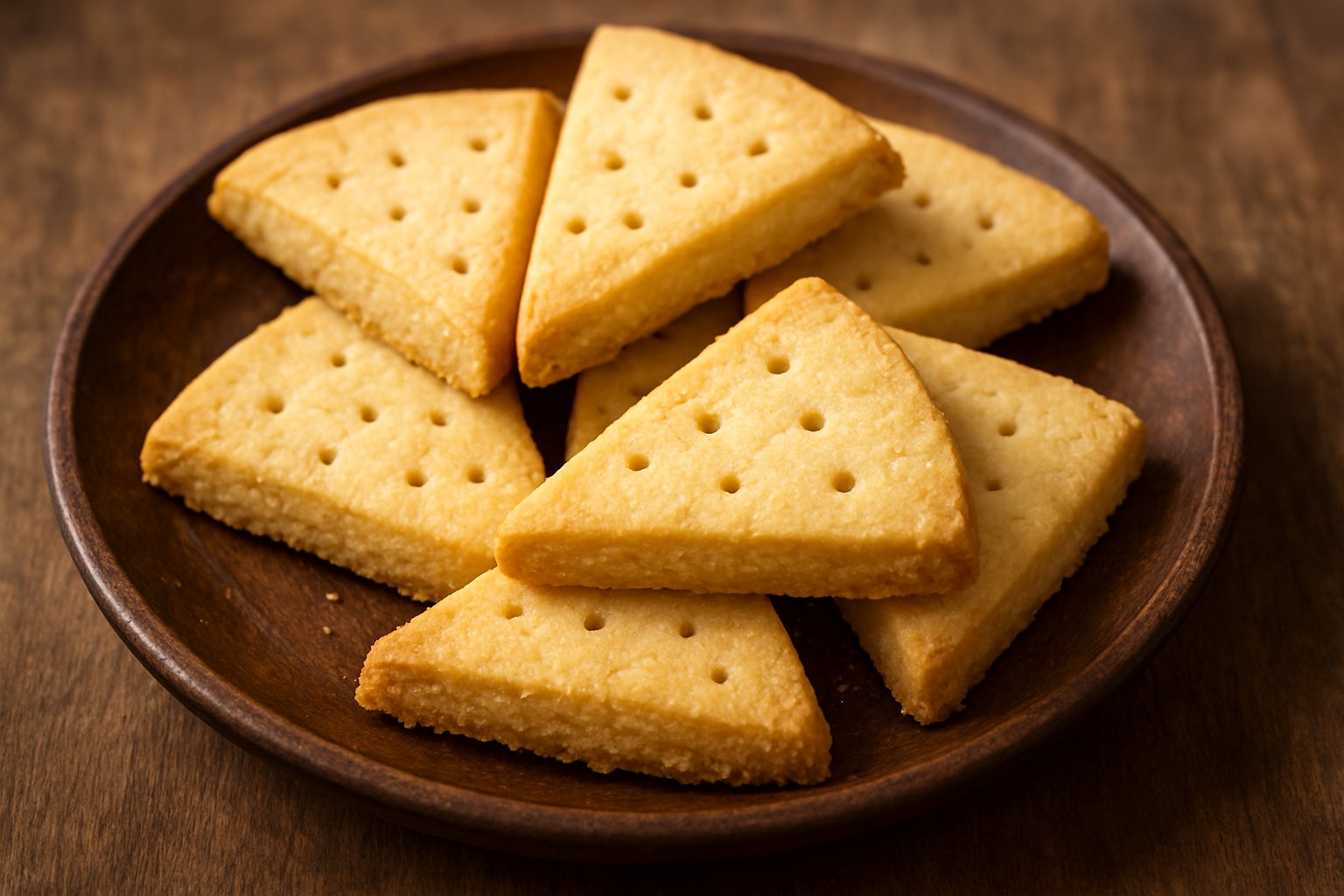
Petticoat tails: The oldest shape, Mary Queen of Scots’ favourite. They are large round discs cut into triangles straight after baking (like slices of cake). The name is associated with the cut of fabric for petticoats, but some also link it to the sun (a good omen for sowing).
Fingers: Thick, long rectangular bars, crumbly and the most practical for dunking in tea or enjoying with a good glass of whisky. This is now the best-known version.
Rounds: Simple little round biscuits, often decorated with a thistle pattern, Scotland’s national flower.
Shortbread in Scottish legends and superstitions
In Shetland it was a tradition to break a shortbread cake over the bride’s head on the threshold of her new home, for good luck.
The custom of eating these delicious biscuits at New Year goes back to the ancient Yule cakes that symbolised the sun. To this day, at Hogmanay, they are traditionally offered when “first footing”, as a gesture of peace and with the wish that plenty will enter the house with the new year.
Shortbread and Christmas: a living tradition
Although shortbread is now eaten all year round, during Advent and Christmas baking it becomes a true act of love with roots in the distant past. In Scottish homes it is customary to bake it with the children in the weeks before 25 December, turning it into a ritual that brings the generations together.
Why is it called “shortbread”?
Contrary to what you might think, the word “short” does not refer to length but to crumbliness.
In English, a “short” dough is one in which the butter stops gluten from forming, creating a unique, melt-in-the-mouth texture. So it is the large amount of butter that guarantees shortbread’s perfect crumbliness!
The magic of three: the perfect ratio
The strength of shortbread lies in its apparent simplicity. The traditional recipe follows a combination that is almost a ritual: one part sugar, two parts butter and three parts flour.
The crucial ingredient, of course, is the butter.
Ingredients (for a 20 cm tin or 12 biscuits)
- 150 g very cold butter
- 75 g caster sugar
- 225 g plain flour
- A pinch of salt
- Optional: 1 teaspoon cornflour or rice flour (for extra crumbliness)
1. Mix the cold butter and sugar with a spatula or your fingertips. It should not be whipped: it should stay creamy but firm.
2. Add the flour and salt. If the mixture looks sandy, you are on the right track! That’s just how it should be!
3. Bring the dough together into a ball, pressing it firmly with your hands. Don’t overwork it or it will become tough.
4. Shape the biscuits
- For fingers: roll out and cut into small rectangles.
- For rounds: shape into a log and slice.
- For petticoat tails: roll out a disc and score the wedges.
5. Prick the surface with a fork: it is the traditional decoration and helps the biscuits bake evenly.
6. Bake slowly at 160°C for 25–30 minutes, until the edges are just golden.
7. Let the shortbread cool completely. This is important, because it only firms up once cool.
Traditional Scottish variations (perfect for Christmas)
1. Orange & Clove
Flavour the dough with orange zest and a pinch of spice.
2. Whisky Shortbread
Add a tablespoon of Scotch whisky.
3. Heather Honey Shortbread
Replace some of the sugar with heather honey.
4. Cranberry & White Chocolate
A modern variation very popular in the Highlands.
Perfect pairings
- Strong black tea
- Earl Grey
- Whisky
- Spiced hot chocolate
Shortbread around the world: a Scottish ambassador
Today, historic brands have taken shortbread to every corner of the globe, but its essence remains unchanged. Whether it is made in a Highland home or bought in a decorated tin, eating shortbread is a celebration of ancient Scottish traditions.
It is the taste of hospitality from a land that, even with just three ingredients, can create unforgettable magic! Baking it means bringing a little Scottish Christmas into your home!
Silvia Miraglia