
Try closing your eyes. Imagine walking through the Highlands as a light breeze brushes the still-damp grass. What do you smell? The scent of wet heather, the sharp note of rich earth and the salty touch drifting in from the islands. Anyone who has been to Scotland even once knows that in this country nature does not just let itself be admired; you can literally breathe it in!
That is why skilled craftspeople began making soaps and scents following old recipes and traditional methods, capturing aromas that “taste” of Scotland! This is not mere cosmetics but a true art form that unites botany with technique… and with a passion for their land.
But how do you turn peat, a piece of ground that has crossed the centuries, into a fragrant beauty product? Scottish handmade soap does not follow industrial logic; it is a slow process that respects nature’s rhythms and the delicacy of essential oils.
Peat: black gold for the skin
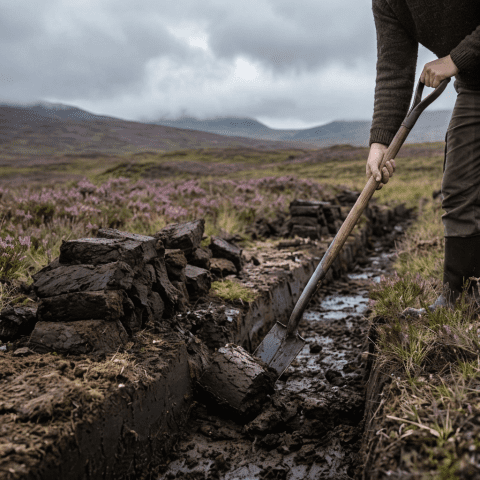
Peat is the very essence of Scotland. Known for its key role in whisky making, it has now become a highly prized ingredient in body care. Rich in minerals and antioxidants, Scottish peat is carefully extracted to become the base of purifying soaps and detoxifying masks.
It all begins in the peatlands, the vast bogs that cover much of the Highlands. The peat used in soap making is taken from deep layers, where nutrients are most concentrated. Before going into the soap, the peat is dried, purified and ground to a very fine powder or a silky mud. It acts as a very gentle natural exfoliant, but its real strength lies in fulvic and humic acids (formed in the soil as leaves, trunks and roots break down in damp conditions), which encourage cell renewal and have natural anti-inflammatory properties documented since ancient times. The scent of a peat soap is unmistakable: musky, deep, almost ancestral. The craftspeople who work with it know that every bar carries thousands of years of geological history. Washing with peat soap is a ritual that connects you directly with the soul of the Scottish land!
Highland botany: magical herbs and flowers
Among the main ingredients of these soaps with an ancient soul, besides peat, is the wild flora. Scottish soap makers gather ingredients that seem to come straight out of an old grimoire:
Heather: Known for its soothing properties, it gives a floral yet wild note.
Bog myrtle: Once used to keep midges away, it is now loved for its spicy, citrusy scent.
Scottish thistle: The national emblem, used in oils for its regenerating properties.
Seaweed: Gathered along Scotland’s rugged coasts, it brings the mineral salts of the Atlantic into the soaps.
The art of sensory distillation
Creating a scent that smells of “Scotland” is a challenge that calls for a very fine nose. It is not about reproducing synthetic fragrances but about distilling pure essential oils. A few small craft workshops, scattered between the Isle of Skye and the Argyll coast, use stills similar to those of distilleries to extract the soul of local plants.
The result is fragrances that smell not of “perfumery” but of woods after rain, crackling fires and windswept cliffs. It is a craft that speaks of sustainability: many producers use only organic ingredients and eco-friendly packaging, respecting the very nature that inspires them.
The cold process method
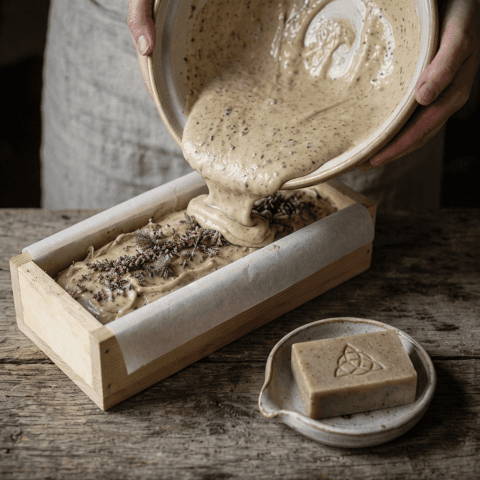
To preserve the properties of wild herbs, Scottish soap makers almost always use the cold process, the most widespread traditional technique. Unlike industrial production, the cold process makes it possible to:
Keep the oils intact: The plant oils (often olive, coconut or local beeswax), mixed with a lye solution (caustic soda and water), are not overheated.
Preserve the glycerine: A natural humectant that leaves skin moisturised, essential in Scotland’s harsh climate.
Curing: Every soap must rest for 4–6 weeks in a well-ventilated place. During this time the water slowly evaporates, saponification is completed and the soap hardens properly.
Some producers in the Hebrides use pure, locally collected rainwater, known as “Angel’s Tears”, to mix their soap.
Adding the wild herbs
While the soap is still fluid, the makers add herbal infusions or pure essential oils. Herbs such as heather or nettle are left to steep in oil for weeks before production. Bog myrtle is steam-distilled to obtain a precious oil known for its antiseptic qualities.
The cut and the maker’s “signature”
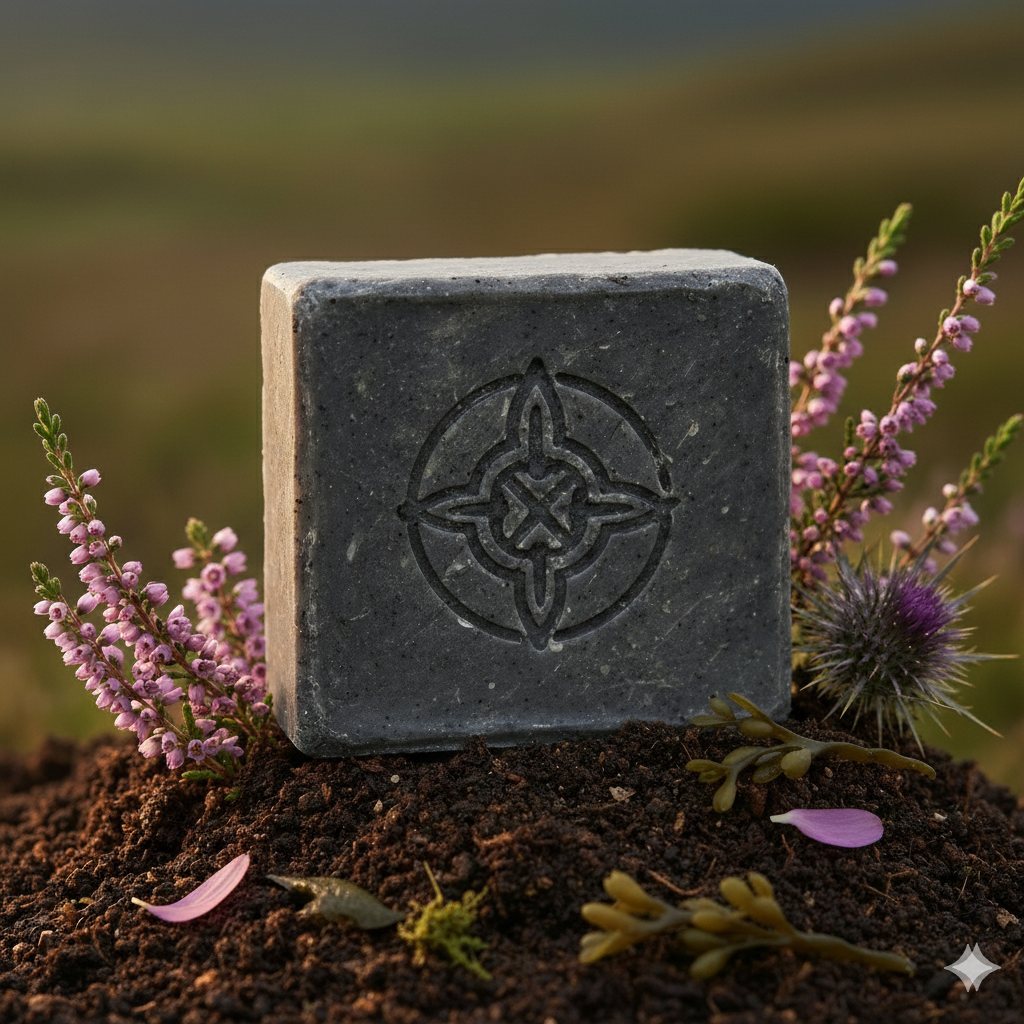
Once set in large blocks called “loaves”, the soap is cut by hand with steel wires. Every bar is unique: the dark veins of peat create patterns as they mingle with the brighter tones of the herbs. Many workshops hot-stamp their logo or Celtic symbols, making each bar a small work of art.
Why choose a Scottish handmade product?
Choosing a handmade peat soap means supporting small rural economies and preserving know-how that was in danger of disappearing. These precious treasures are a sensory portal that transports us into the thick morning mists, the wind-brushed moors, the rugged coasts lashed by Atlantic waves or in front of a fire giving off the warmth of peat… Buying such a handmade product means quite literally bringing home a fragment of Scottish soil, transformed by the alchemy of fire and water into a timeless wellbeing ritual.
Silvia Miraglia