
Where the noise ends
While the most famous destinations such as Skye or Mull capture the imagination of millions of travellers, there is a more secret Scotland of remote archipelagos and lonely windswept skerries. When the urge to get away turns into a search for absolute peace, the Scottish islands offer extraordinary refuges where the noise of the modern world simply fades away. Here silence is not an absence of sound but a symphony made of the wind in the grass, the waves lapping against the cliffs and the distant calls of seabird colonies. Setting out to discover these faraway lands means making a real inner journey, leaving the frantic pace of everyday life behind.
Perhaps, in your daydreams, you have already imagined that silence: the white sands of Harris, the sacred stones of Callanish at sunset, the village of Skara Brae re-emerging from the dunes, the peace of Iona, and then Canna and Rum, two real gems of the Small Isles which, lying between the Ardnamurchan peninsula and the Isle of Skye, form a fascinating, protected microcosm. These last destinations among the Scottish islands offer, in particular, a slow travel experience where the only clock to follow is the local ferry timetable.
The islands of silence
Eight destinations, from the Outer Hebrides to Orkney and Shetland, by way of Iona and the Small Isles. Bear in mind that the crossing times given are approximate and should always be checked against the latest timetables.
Skye: the gateway, not the destination
On this journey, the Isle of Skye becomes the gateway to an experience that will change the way you see nature for ever and make you rethink your idea of a holiday. The spectacular volcanic landscape of the Quiraing, the Cuillin range and the fairytale Fairy Pools are certainly worth a stop. But for those seeking silence and tranquillity, Skye is not the end point so much as the starting point: it is from the port of Uig, in the north of the island, that ferries leave for Harris and North Uist.
So a day or two is ideal to visit the most famous places, ideally at dawn or after 6pm, making the most of the quieter moments and of the light that brings out the colours and makes the landscapes magical, and then set off straight away to explore a dimension that is out of the ordinary.
Now let’s cross the threshold together that will lead us to discover an unusual Scotland: let’s board the ferry and set sail for the largest Scottish island, part of the Outer Hebrides.
Harris: white sand and wind
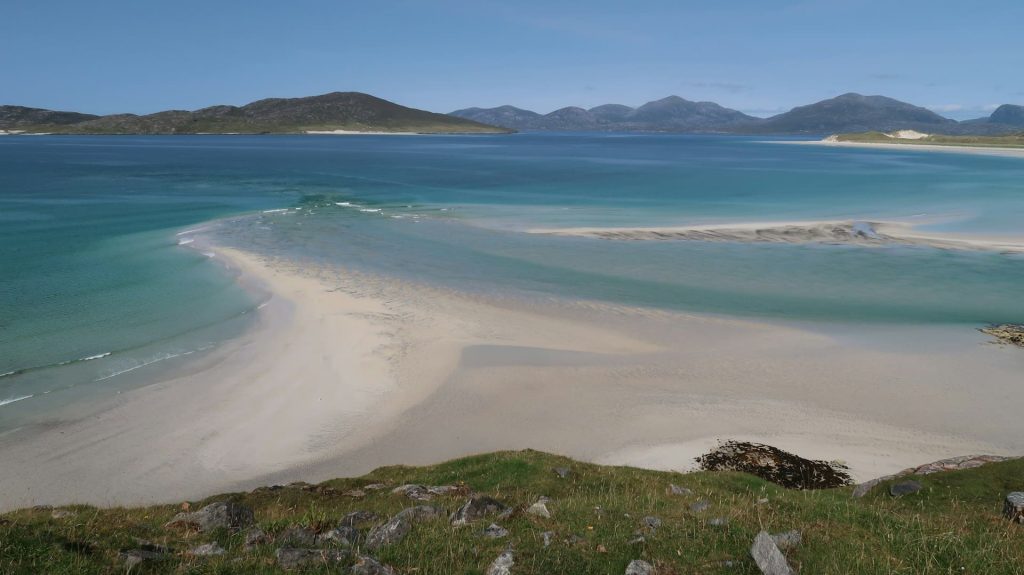
Why go. Harris is the island with beaches that look tropical but come with the fierce Atlantic wind. On the west coast the roads run along dazzling white bays; on the east coast, the Golden Road winds among grey rocks and lochans in an almost lunar landscape.
Getting there. CalMac ferry from Uig (Skye) to Tarbert, a crossing of about one hour forty minutes. Alternatively, you can drive from Lewis: Lewis and Harris are the same island, divided only by a range of hills.
Not to be missed.
- Luskentyre and Seilebost, two beaches of white sand and turquoise water edged by machair, the region’s typical rich coastal grassland. They are worth admiring even just from above, stopping by the roadside.
- Scarista, the spectacular, almost always deserted beach stretching for more than 3 kilometres south of the previous two.
- Hushinish, another bay of very fine sand at the end of a long, winding single-track road. It is not unusual to find Highland cows grazing on the sand.
- A Harris Tweed workshop: the cloth is still woven by hand in islanders’ homes.
The moment of perfect silence. Luskentyre at low tide, at the end of the day, when the few visitors have already headed back to Tarbert.
Lewis: the stones that watch the sky
Why go. Lewis is the northern half of the island: wider, flatter, richer in peat. It also stands apart from Harris for its Gaelic, still in everyday use; you will hear it at the bakery counter as well as at the petrol station. On Lewis stands the megalithic site of Callanish, one of the most powerful places in all of Scotland.
Getting there. CalMac ferry from Ullapool to Stornoway, about two hours and three quarters. Stornoway, on the east coast, also has a small airport with flights from Glasgow, Edinburgh and Inverness.
Not to be missed.
- The stone circle of Callanish (Calanais in Gaelic), erected about five thousand years ago. From July 2026 the new visitor centre is open Monday to Saturday (9am–5pm), with a ticket of about £15 valid for a year. Outside opening hours, the stones can still be reached by the footpath.
- Gearrannan, a village of blackhouses, the old stone houses with thatched roofs.
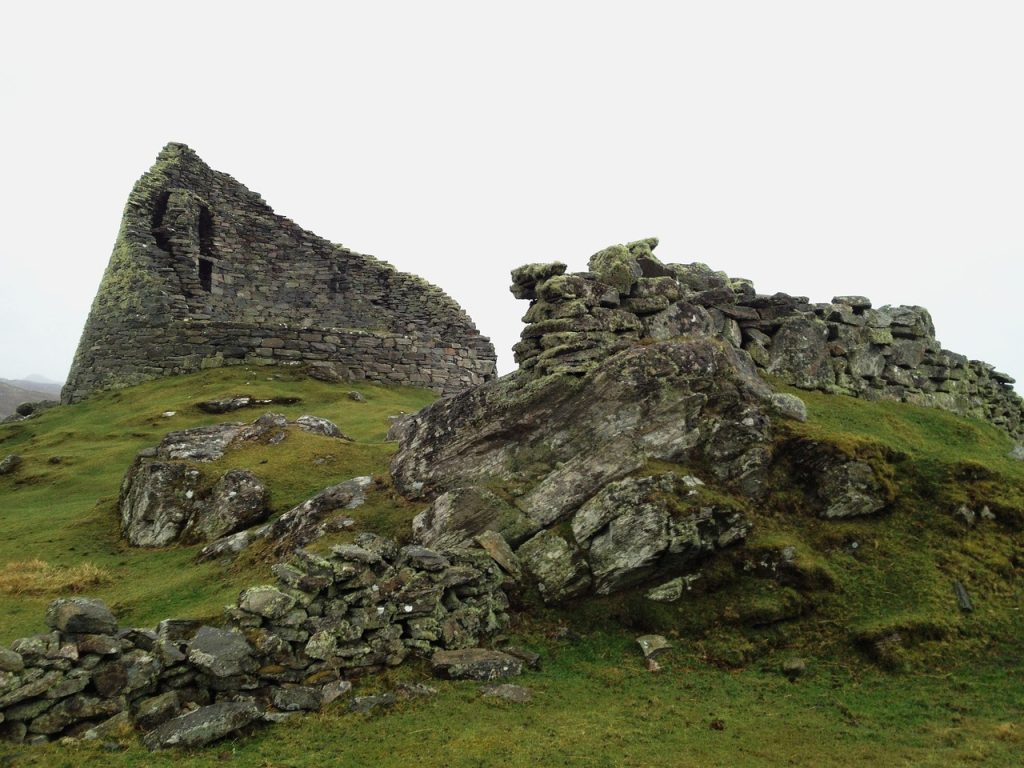
- Dun Carloway Broch, an Iron Age round tower of dry stone (one of the best preserved in Scotland), stands imposingly over a valley.
- Uig Bay (the one on Lewis, not on Skye), where the famous Lewis Chessmen were found in 1831.
The moment of perfect silence. Callanish at sunset or dawn, outside visitor centre hours. It is a precious chance to connect directly with the stones without the chatter of tourists, wrapped in the Atlantic wind and the rhythmic lapping of the waves.
North Uist, South Uist and Barra: where the road really ends
Why go. If Harris and Lewis already feel remote, the Uists are the next step. This is a very unusual chain of low-lying islands linked by causeways that seem to defy the tides, a mosaic of lochs, dunes and machair, the coastal grassland that in June and July becomes a carpet of flowers. A visit to the island of Barra will offer breathtaking views and the chance of unique experiences.
Getting there. There are three options: from Uig (Skye) to Lochmaddy (North Uist), about one hour and three quarters; from Mallaig to Lochboisdale (South Uist); from Oban to Castlebay (Barra), about five hours. From Harris you go south on the Leverburgh–Berneray ferry, and from South Uist to Barra on the Eriskay ferry.
You can also fly to Barra with Loganair from Glasgow. The plane lands right on the beach at Traigh Mhòr. Barra Airport is the only one in the world with scheduled flights whose timetable depends on the tides!
Not to be missed.
- The flowering machair on the west coast of South Uist, in June and July.
- The Prince’s Beach on Eriskay, where Bonnie Prince Charlie landed in July 1745.
- Kisimul Castle, the castle of the MacNeils, a medieval fortress perched in the middle of Castlebay bay.
- Vatersay, linked to Barra by a causeway, with two facing beaches separated by a strip of dunes.
The moment of perfect silence. A restorative walk along any stretch of the Uists’ west coast. Miles of sand, and often not a single human footprint!
Orkney: five thousand years in a flat landscape
Why go. Orkney is another Scotland, as you realise the moment you land: no mountains, but endless horizons, cliffs teeming with seabirds and the highest concentration of Neolithic sites in Europe. An important note for visitors: in summer the sky never gets truly dark, so the days seem endless.
Getting there. Three ferries from the north coast: NorthLink from Scrabster to Stromness (about an hour and a half, passing the Old Man of Hoy); Pentland Ferries from Gills Bay to St Margaret’s Hope (about an hour); and in summer a foot-passenger ferry from John o’ Groats to Burwick (about 40 minutes). There is also the overnight ferry from Aberdeen to Kirkwall and Loganair flights to Kirkwall.
Not to be missed.
- Skara Brae, the best-preserved Neolithic village in Europe. As it is very popular with cruise-ship passengers, it is best to book your entry time online.
- The Ring of Brodgar and the Standing Stones of Stenness, free to visit.
- Maeshowe, the chambered tomb with Viking runic inscriptions; entry is by guided tour only, to be booked in advance.
- The Italian Chapel on Lamb Holm, built by Italian prisoners of war during the Second World War.
The moment of perfect silence. The Ring of Brodgar in June, around midnight, takes on a truly enigmatic look, bathed in a bluish light that never fades. As for Skara Brae, in summer there are limited-number evening visits outside opening hours. Or, better still, go early in the morning when the site opens, or late in the afternoon, when most organised groups have already left.
Iona: Scotland’s ancient spiritual heart
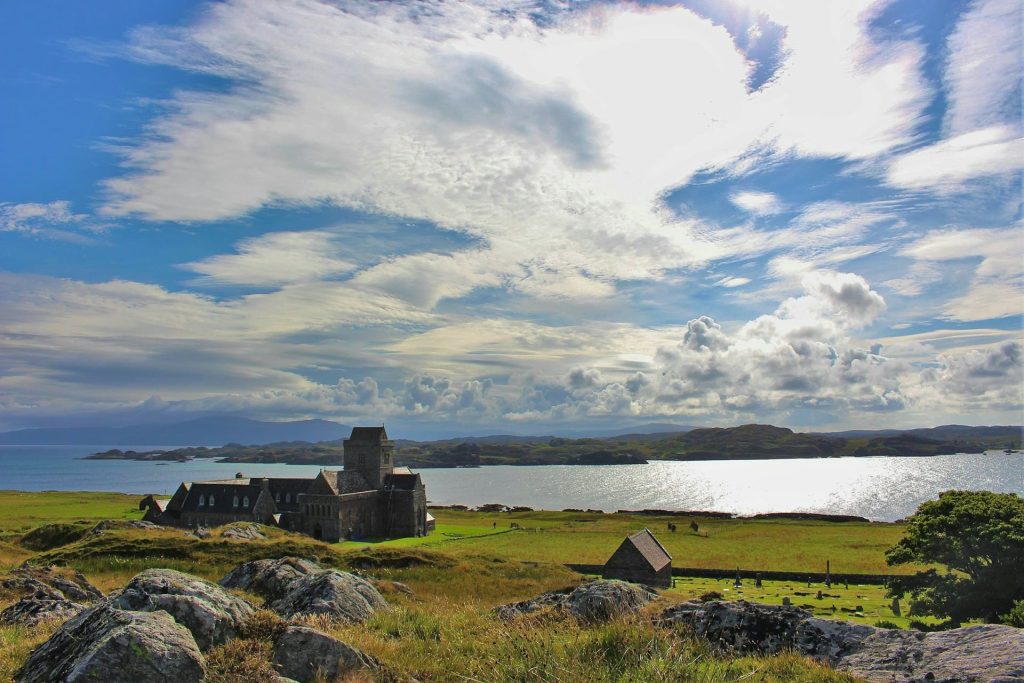
Why go. Iona is small and can be explored on foot in a single day. Here Saint Columba founded his monastery in 563, and from here Christianity spread throughout Scotland. Visitors’ cars are not allowed.
Getting there. CalMac ferry from Oban to Craignure (Mull), about 50 minutes. Then a good hour on a single-track road to Fionnphort, by car or on the bus that meets the ferry. Finally, the foot-passenger ferry to Iona, about 10 minutes. You leave the car at Fionnphort.
Not to be missed.
- The Abbey and the ruins of the nunnery.
- The white beaches in the north of the island.
- The Bay at the Back of the Ocean, on the west coast, about an hour’s walk from the pier.
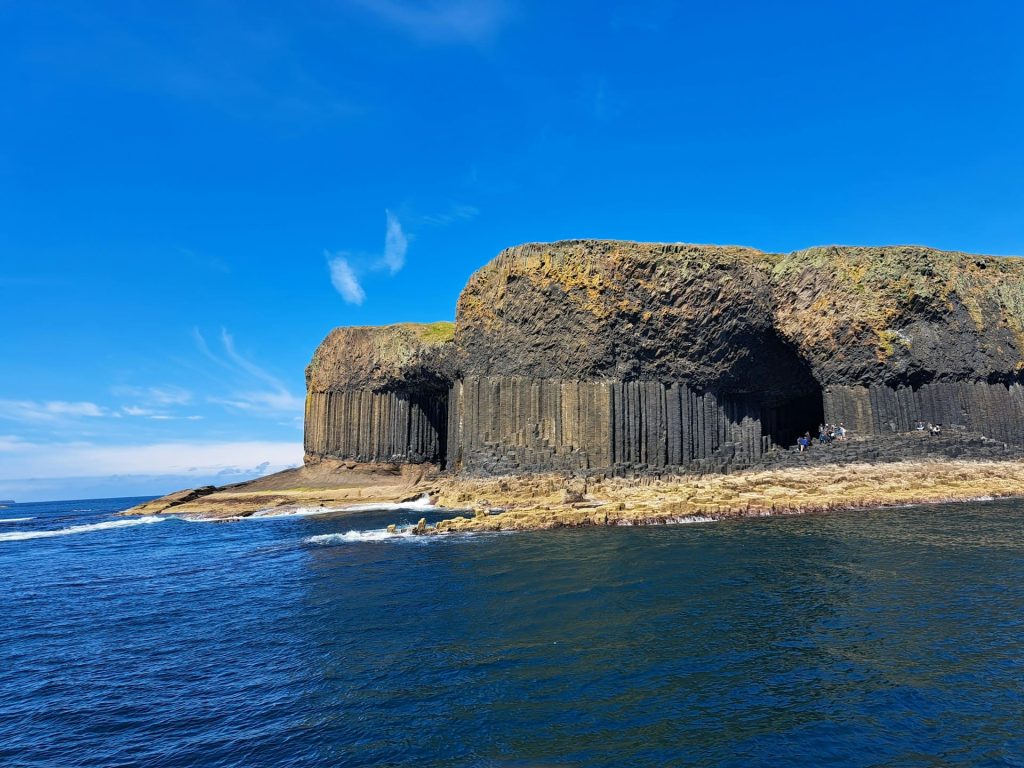
- From Fionnphort or Iona, in spring and summer, boat trips to Staffa for Fingal’s Cave and the puffins.
The moment of perfect silence. Consider staying at least one night. When the last ferry has left to take the day visitors back, Iona becomes once again an island of wind, with the sound of bells ringing from one side of the island to the other and footsteps on the gravel.
Rum: the wild mountain of the Small Isles
Why go. Rum is the largest of the Small Isles and the least populated: a few dozen people gathered around the village of Kinloch, with its castle, the ferry terminal, a shop that doubles as post office, and a primary school. The rest of the island is dominated by the mountain outlines of Hallival and Askival, by moorland and coast. It has been a National Nature Reserve for over fifty years. Visitors’ cars are not allowed, so you get around only on foot or by bike.
Getting there. CalMac ferry from Mallaig, five days a week all year round: the crossing takes from about one hour twenty minutes to two and a half hours, depending on the calls. Mallaig can be reached by car or on the West Highland Line train from Fort William. From late April to late September there is also the Arisaig Marine foot-passenger boat from Arisaig.
Not to be missed.
- Kinloch Castle, the extravagant red sandstone residence built between 1897 and 1900 by the wealthy industrialist John Bullough. It was one of the first private homes in Scotland to have electricity. The castle is currently closed to the public and its future is still uncertain.
- The path to Kilmory, on the north coast, an area famous for the study of red deer behaviour carried out by the universities of Edinburgh and Cambridge since 1972.
- The Bullough Mausoleum at Harris, on Rum’s bay of the same name, a small Greek-style temple overlooking a practically deserted coast.
- The Rum Cuillin, mountains for experienced hillwalkers, on whose ridges one of the world’s largest colonies of Manx shearwaters nests.
- Sea eagles and otters along the shores of Loch Scresort, a sea inlet on the east coast of the island.
The moment of perfect silence. Stay at least one night, camping, in the bunkhouse or in one of the cabins at Kinloch. After sunset, the calls of the shearwaters returning to their burrows drift down from the mountains, and the island seems to belong to them alone. A practical tip: in summer Rum is also famous for its midges, so bring a good repellent!
Foula: at the edge of the world, in Shetland
Why go. If you are looking for true isolation, Foula, some thirty kilometres west of the Shetland coast, is the place. With a population of only about thirty, it is one of the most remote inhabited islands in the UK. No shops, no pub, just a post office; everything arrives by sea or by air. Here Christmas is still celebrated according to the old Julian calendar, on 6 January. Getting there takes patience and flexibility because of the weather (and not only, as we will see), but the reward is an ancestral silence and the chance to watch millions of seabirds nesting undisturbed on the rocks.
Getting there. First of all you need to get to Shetland: NorthLink overnight ferry from Aberdeen to Lerwick, or a flight to Sumburgh. From Walls, on the west coast of the Mainland, the foot-passenger ferry leaves: about two hours, twelve seats at most, booking essential, two sailings a week (three in summer). By ferry you cannot do it as a day trip. Alternatively there are Airtask flights from Tingwall, near Lerwick: about a quarter of an hour on a small eight-seat plane, weather permitting.
Not to be missed.
- The Kame, on the west coast, one of the highest sheer sea cliffs in the UK, plunging straight into the sea.
- The Sneug, the island’s summit (418 metres), and the valley of Da Daal at its foot.
- Sneck ida Smaalie, a deep cleft in the rock to be admired from above, without going down.
- Gaada Stack, the great rock arch on the northern tip.
- The seabird colonies and the great skuas, which defend their nests with low swooping flights.
- Foula sheep, a breed that has stayed pure thanks to a ban on bringing others to the island.
The moment of perfect silence. For a truly unique experience, you can stay in one of the self-catering properties, bringing your own supplies or having them sent on the ferry. Allow a few extra days in case the sea or wind decide to keep you there! One last note: mobile signal is poor.
When to go
If silence is the goal, the best months are May, early June and September. The days are long, the ferries run on summer timetables, and the July and August crowds have not yet arrived or have already left.
A word about midges, the tiny biting insects that come out on still evenings. They are the price to pay for Scottish summers, especially from late May to September and on the west coast. On exposed beaches and in Orkney the wind almost always keeps them away; in sheltered glens at sunset, a repellent can make all the difference.
Practical tips for travelling off the beaten track
Remote islands reward those who plan. Here is what you need to know before you go.
- Book car spaces on ferries as soon as timetables are released. In summer, car spaces on CalMac routes sell out weeks in advance. For a multi-island trip, CalMac’s Hopscotch tickets combine several routes into a single itinerary.
- Always allow a spare day. In strong winds ferries are cancelled, sometimes for several days. Better not to book your flight home for the day after your last crossing.
- Check the status of sailings on the morning itself, on the CalMac or other operators’ website or app.
- Learn the rules of single-track roads. Pull into the passing places, always on your left. Thank other drivers with a wave, and never park in a passing place.
- Respect Sunday on Lewis and Harris. By religious tradition many shops, petrol stations and bars stay closed, so be sure to fill up and do your shopping on Saturday.
- Book accommodation well in advance. There are few rooms on the islands and in summer they go quickly. If possible, spend at least one night on Iona or near Callanish: true silence arrives when the day visitors leave.
- Dress in layers. A waterproof jacket, fleece and walking shoes are needed even in August. You can get four seasons in a day!
- Leave places as you found them. No moving stones for photos, no fires on the dunes, and respect for the sheep and for birds’ nests along the cliffs.
Silvia Miraglia