
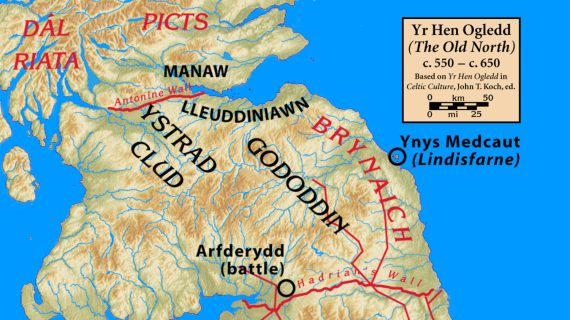
Imagine a Scotland different from that of kilted clans and silent Highlands crossed only by the wind. Imagine a mosaic of tribes, a wild territory called Hen Ogledd (the “Old North”), where borders were not drawn on maps but defended with weapons and, above all, with the heart. It is here, in these lands, within the walls of Din Eidyn (today’s Edinburgh), that the Celtic roots of Scottish literature lie.
In this distant age, long before writing spread, Celtic culture was preserved, guarded and handed down by bards, keepers of a Gaelic and Brittonic oral tradition able to defy the centuries.
The lost legacy of the Old North
Before the unification of the Kingdom of Alba, the south of Scotland was inhabited by the Britons, while the north was home to the Picts and the west to the Scots, who came from Ireland. Choosing to explore the ancient Celtic roots of Scottish literature means rediscovering a deep bond between language (Old Welsh, or Cumbric, spoken by the Britons) and the Scottish land.
The bards: architects of memory
In tribal society the bard was no mere entertainer. He was a sacred figure who embodied many roles but, above all, represented the collective memory of an entire people. Through oral tradition, these poets passed down the valour of warriors, granting them immortality. In a world without books, the spoken word was the only bridge between past and future.
Oral tradition and the magic of words
Before Christianity brought writing to the monasteries, Gaelic culture flourished through storytelling. And so the bard played a key role in the balance of power: one of his tales could help bring down a king or, conversely, turn a man into a kind of god.
The stories told were tied to the hills, rivers and strongholds of the region. Scottish literature was thus born as an extension of the land itself. Legends of giants and heroes such as Cú Chulainn, who according to tradition trained on the Isle of Skye, still permeate local folklore today.
Y Gododdin: Aneirin’s epic at Din Eidyn
The founding pillar of the Celtic roots of Scottish literature is without doubt Y Gododdin, attributed to the bard Aneirin. Although the manuscript has come down to us in Old Welsh, its soul is purely Scottish.
Set around AD 600, it tells of Gododdin, a kingdom formed around the beginning of the 5th century in north-east Britain after the Romans had left.
A feast of mead and death
Aneirin tells how the king of Gododdin hosted warriors from the various British kingdoms for a whole year, drinking mead and feasting in the fortress of Din Eidyn before setting off for battle. The aim of this suicidal expedition was to retake the strategic site of Catraeth, which had fallen into the hands of the Angles.
The epic poem celebrates the deeds of these warriors who, valiant as they were, are all slaughtered by an enemy superior in number. The bard is said to have been present at the battle, which is why he describes the nobility of the sacrifice with stark realism. Aneirin exalts the code of honour that sets them apart and their valour in battle and, above all, makes them immortal.
Y Gododdin is not just an account of war but the first true example of literature produced on Scottish soil, a crucial piece for understanding the Celtic roots of Scottish literature. The tale of the feat of the three hundred brave warriors was handed down orally for centuries, probably in Cumbric, an ancient Welsh dialect. One of the poems in Y Gododdin even refers to King Arthur, when one of the warriors is compared to him.
Aneirin’s legacy
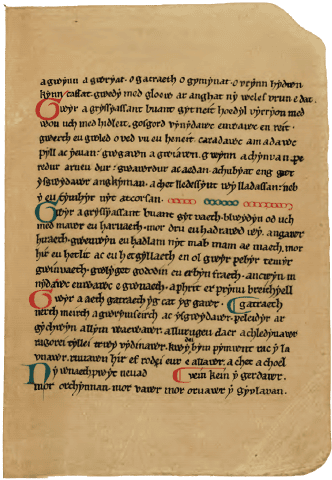
The manuscript known as the Book of Aneirin is therefore one of the most important witnesses to the earliest forms of Scottish literary production. The version now kept in Cardiff, at the National Library of Wales, dates from around 1265, but it is thought to be a copy of an original work from the 9th century. Besides the famous poem Y Gododdin, it also contains other texts that have nothing to do with the epic battle. Although its written form is medieval, scholars agree that it preserves a poetic core dating back to the 7th century.
Why rediscover the Celtic roots of Scottish literature today?
Studying Aneirin and the ancient bards becomes an act of reconnection with an identity that risked disappearing under the weight of history. Y Gododdin is a song of glory and mourning, a lament for a lost age, saved from oblivion first by oral memory and then by written texts.
Modern Scottish folklore is the direct offspring of those ancient Gaelic songs, a flame that keeps burning in the stories we still tell today.
Silvia Miraglia